
Join Our 100% Job-Guaranteed ETL Course in OMR. We Provide Quality ETL training with an affordable Cost in OMR. Our ETL syllabus covers the ETL fundamentals, data integration concepts, workflow design, transformation logic, data quality management, and performance optimization. At Softlogic Systems, you’ll earn globally recognized certifications, build real-time projects, and receive complete placement assistance to launch a successful career in your chosen field.

ETL Training In Omr
DURATION
2 Months
EMI
0% Interest
Mode
Live Online / Offline
Let's take the first step to becoming an expert in ETL
100% Placement
Assurance
Get Certified
JOB PLACEMENT ELIGIBILITY TEST
Your Placement Eligibility Report
Want more details about ETL Course?
Course Schedules
Course Syllabus
Course Fees
or any other questions...
Fees, Duration & Batch Timings for ETL Course
Hands On Training
3-5 Real Time Projects
60-100 Practical Assignments
3+ Assessments / Mock Interviews
June 2026
Week days
(Mon-Fri)
Online/Offline
2 Hours Real Time Interactive Technical Training
1 Hour Aptitude
1 Hour Communication & Soft Skills
(Suitable for Fresh Jobseekers / Non IT to IT transition)
June 2026
Week ends
(Sat-Sun)
Online/Offline
4 Hours Real Time Interactive Technical Training
(Suitable for working IT Professionals)
Save up to 20% in your Course Fee on our Job Seeker Course Series
Syllabus of ETL Course
Module 1 : DWH Data Ware Housing Concepts
- What is Data Warehouse?
- Need of Data Warehouse
- Introduction to OLTP, ETL and OLAP Systems
- Difference between OLTP and OLAP
- Data Warehouse Architecture
- Data Marts
- ODS [Operational Data Store]
- Dimensional Modelling
- Difference between relation and dimensional modelling
- Star Schema and Snowflake Schema
- What is fact table
- What is Dimension table
- Normalization and De-Normalization
Module 2 : ETL Testing
- ETL architecture.
- What is ETL and importance of ETL testing
- How DWH ETL Testing is different from the Application Testing
- SDLC/STLC in the ETL Projects (ex: V Model, Water fall model)
Module 3 : Challenges in DWH ETL Testing compare to other testing
- Incompatible and duplicate data
- Loss of data during ETL process
- Testers have no privileges to execute ETL jobs by their own
- Volume and complexity of data is very huge
- Fault in business process and procedures
- Trouble acquiring and building test data
Module 4 : ETL Testing Work flow activities involved
- Analyze and interpret business requirements/ workflows to Create estimations
- Approve requirements and prepare the Test plan for the system testing
- Prepare the test cases with the help of design documents provided by the
- developer team
- Execute system testing and integration testing
- Best practices to Create quality documentations (Test plans, Test Scripts and Test closure summaries)
- How to detect the bugs in the ETL testing
- How to report the bugs in the ETL testing
- How to co-ordinate with developer team for resolving the defects
Module 5 : Types of ETL Testing
- Data completeness
- Data transformation
- Data quality
- Performance and scalability
- Integration testing
- User-acceptance testing
- SQL Queries for ETL Testing
- Incremental load testing
- Initial Load / Full load testing
Module 6 : Different ETL tools available in the market
- Informatica
- Ab Initio
- IBM Data stage
Module 7 : Power Center Components
- Designer
- Repository Manager
- Workflow Manager
- Workflow Monitor
- Power Center Admin Console
Module 8 : Informatica Concepts and Overview
- Informatica Architecture
Module 9 : Sources
- Working with relational Sources
- Working with Flat Files
Module 10 : Targets
- Working with Relational Targets
- Working with Flat file Targets
Module 11 : Transformations – Active and Passive Transformations
- Expression
- Lookup –Different types of lookup Caches
- Sequence Generator
- Filter
- Joiner
- Sorter
- Rank
- Router
- Aggregator
- Source Qualifer
- Update Strategy
- Normalizer
- Union
- Stored Procedure
- Slowly Changing Dimension
- SCD Type1
- SCD Type2 — Date, Flag and Version
- SCD Type3
Module 12 : Workflow Manger
- Creating Reusable tasks
- Workflows, Worklets & Sessions
- Tasks
- Indirect Loading
- Constraint based load ordering
- Target Load plan
- Worklet ,Mapplet ,Resuable transformation
- Migration ?ML migration and Folder Copy
- Scheduling Workflow
- Parameter and variables
- XML Source, Target and Transformations
Module 13 : Performance Tuning
- Pipeline Partition
- Dynamic Partition
- Pushdown optimization
- Preparation of Test Cases
- Executing Test case
- Preparing Sample data
- Data validation in Source and target
- Load and performance testing
- Unit testing Procedures
- Error handling procedures
Objectives of ETL Training
Our ETL Training in OMR is one of the few courses among other IT institutes that teaches rare topics under its syllabus. Our syllabus is curated by IT industry professionals and experts, according to the current trends in the IT industry. Some of the syllabus topics are discussed below:
- In the beginning of the course, students will be introduced to basic concepts like introduction to data warehousing, warehouse architecture, data marts etc.
- The course will then move on to topics like, types of ETL Testing, Power Center Components, Informatica concepts etc.
- The course will finally move on to advanced topics like, Targets, workflow manager, Performance tuning etc.
Why Softlogic Systems is the Best Choice for ETL Training – Learn, Practice, and Get Placed!
Online & Offline Training Options
Learn from 100+ Real-Time Developers
Hands-on Projects & Codeathons
0% EMI Fee Options
Resume & Interview Support
Placement with Top IT Firms
1000+ Hiring Partners
No Backdoor Jobs
Highlights of ETL Course
What is ETL?
ETL, which stands for Extract, Transform, Load, constitutes a pivotal process within data warehousing and integration. Its purpose is to gather data from diverse sources, standardize it into a uniform format, and then transfer it to a designated destination, often a data warehouse or database. This facilitates subsequent analysis, reporting, or utilization for other objectives.
What are the reasons for learning ETL?
The following are the reasons for learning ETL:
- Integration of Data: ETL permits the consolidation of data from diverse origins into one cohesive system, fostering thorough analysis and reporting capabilities.
- Enhanced Data Quality: Through the transformation and cleansing stages of ETL, data can be refined to ensure its precision, uniformity, and trustworthiness, thereby elevating overall data quality.
- Informed Decision-Making: ETL facilitates access to well-structured and unified data, empowering organizations to make insightful decisions based on reliable information.
What are the prerequisites for learning the ETL Training in OMR?
- Foundational Database Knowledge: Understanding tables, records, SQL queries, and relational database management systems (RDBMS) like MySQL, PostgreSQL, or Oracle is crucial.
- Data Analysis Expertise: Skill in data analysis principles, including data types, manipulation techniques, and statistical analysis methods, is essential for comprehending the importance of data transformation in ETL processes.
- Programming Skills: While not always required, skill in programming languages such as Python, Java, or Scala, along with familiarity with scripting languages like Bash or PowerShell, is highly advantageous for ETL tasks and automation.
Our ETL Training Course is suitable for:
- Students
- Job Seekers
- Freshers
- IT professionals aiming to enhance their skills
- Professionals seeking career change
- Enthusiastic programmers
What are the course fees and duration?
The ETL course fees depend on the program level (basic, intermediate, or advanced) and the course format (online or in-person).On average, the ETL course fees come in the range of ₹25,000 to ₹30,000 INR for 2 months, inclusive of international certification. For some of the most precise and up-to-date details on fees, duration, and certified ETL certification, kindly contact our Best Placement Training Institute in Chennai directly.
What are some of the jobs related to ETL?
The following are some of the jobs related to ETL:
- ETL Developer
- Data Engineer
- Business Intelligence Developer
- Data Analyst
What is the salary range for the position of ETL Developer?
The ETL Developer freshers salary typically with less than a couple of years of experience earn approximately ₹3-4 lakhs annually. For a mid-career ETL Developer with around 3 years of experience, the average annual salary is around ₹6-7 lakhs. An experienced ETL Developer with more than 5 years of experience can anticipate an average yearly salary of around ₹8-9 lakhs. Visit SLA for more courses.
List a few real time ETL applications.
Here are several real time ETL applications:
- Social Media Analytics
- IoT Data Processing
- Fraud Detection
- Clickstream Analysis
Boost Your Skills with Our ETL Training Experts
Our Mentors are from Top Companies like:
The following are the trainer’s profile for our ETL Training in OMR:
- Our ETL instructors are dedicated professionals in the field of enterprise data warehousing and business analytics, possessing extensive technical expertise.
- They possess hands-on experience in developing, managing, and optimizing data warehouses, as well as extracting, transforming, and loading data from diverse sources.
- With a deep understanding of ETL applications and platforms, they educate students on database development, data integration, analysis, analytics, and reporting concepts.
- They adeptly prepare students for certification examinations by employing example-based teaching methods and conducting interactive live sessions.
- Our instructors exhibit excellent communication and interpersonal skills, fostering effective coordination and learning interactions with students.
- Our trainers demonstrate technical skills in developing ETL processes for software applications, handling both structured and unstructured data, and implementing best practices for data mappings.
- Our trainers are capable of developing ETL workflows, conducting data validation and testing using specialized ETL tools, and resolving complex ETL challenges.
- Our trainers possess the skills required for monitoring and maintaining data warehouses, ensuring smooth operations and promptly addressing any issues that arise.
- Using ETL testing tools and techniques, our instructors assess students’ performance and offer constructive feedback to enhance their technical skills.
- With a collaborative mindset and positive attitude, our trainers are committed to helping students acquire knowledge and secure placements in top IT firms seamlessly.
What Modes of Training are available for ETL Course?
Offline / Classroom Training
- Direct Interaction with the Trainer
- Clarify doubts then and there
- Airconditioned Premium Classrooms and Lab with all amenities
- Codeathon Practices
- Direct Aptitude Training
- Live Interview Skills Training
- Direct Panel Mock Interviews
- Campus Drives
- 100% Placement Support
Online Training
- No Recorded Sessions
- Live Virtual Interaction with the Trainer
- Clarify doubts then and there virtually
- Live Virtual Interview Skills Training
- Live Virtual Aptitude Training
- Online Panel Mock Interviews
- 100% Placement Support
Corporate Training
- Industry endorsed Skilled Faculties
- Flexible Pricing Options
- Customized Syllabus
- 12X6 Assistance and Support
Certifications
Improve your abilities to get access to rewarding possibilities
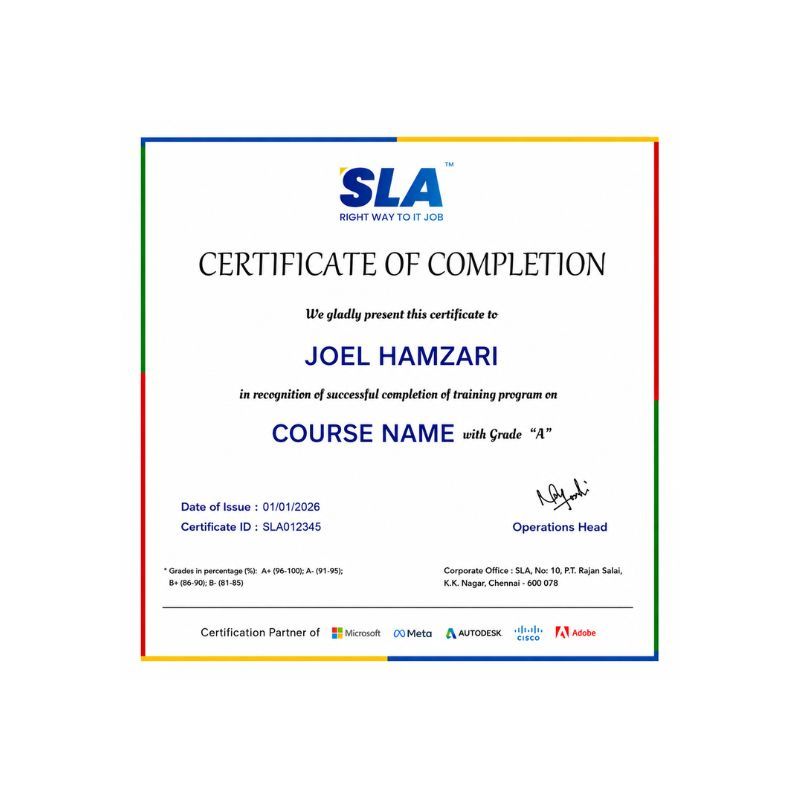
Earn Your Certificate of Completion
Take Your Career to the Next Level with Certifications
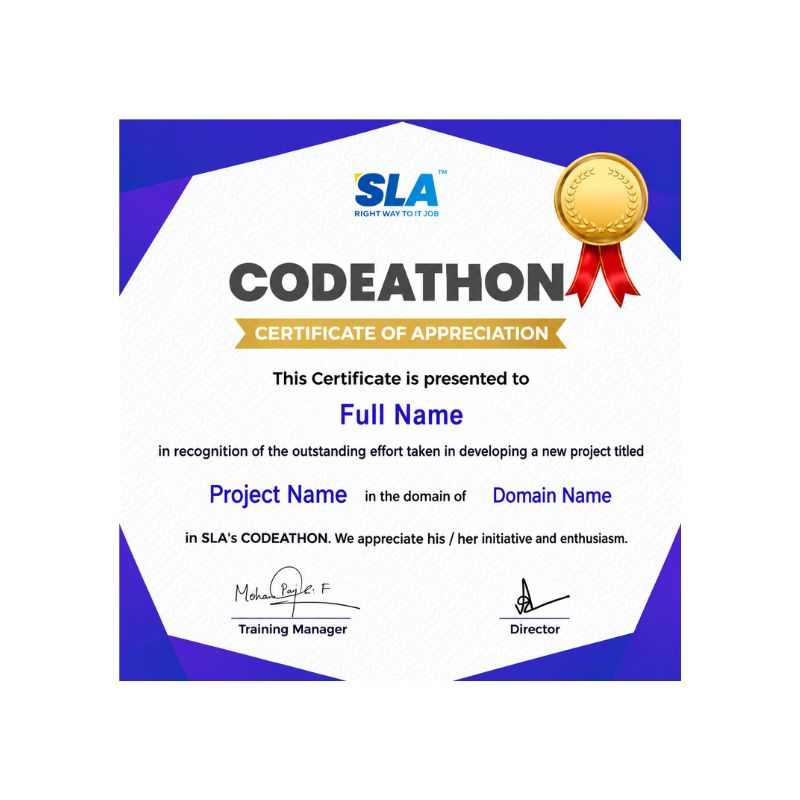
Stand Out from the Crowd with Codethon Certificate
Hands-on Project Practices in ETL Course
Real-time Sales and Inventory Tracking
Health Monitoring
Energy Usage Monitoring
Click Fraud Detection
Weather Data Analysis
Sensor Anomaly Detection
Supply Chain Optimization
Customer Churn Prediction
Social Media Dashboard
The SLA Way to Get Placed in Top IT Companies
Enrollment
Technology Training
Realtime Projects
Placement Training
Interview Skills
Panel Mock
Interview
Unlimited
Interviews
Interview
Feedback
100%
IT Career
Placement Support for a ETL Job
Genuine Placements. No Backdoor Jobs at Softlogic Systems.
Aptitude Training
from Day 1
Interview Skills
from Day 1
Softskills Training
from Day 1
Build Your Resume
Build your LinkedIn Profile
Build your GitHub
digital portfolio
Panel Mock Interview
Unlimited Interviews until you get placed
Life Long Placement Support at no cost
FAQs
Does SLA have EMI?
Yes, SLA supports EMI option with 0% interest.
What kind of payment methods does SLA accept?
SLA accepts cash, cheques, cards and every other UPI and digital payments.
How many branches does SLA have and where is it located?
SLA has two branches, in K.K. Nagar and Navalur, OMR,
What is the specialty about SLA’s OMR branch?
SLA’s OMR branch is located in the middle of OMR’s IT hub, which gives our institute increased credibility and opportunities for students.
How is SLA’s classroom infrastructure?
SLA’s classrooms are equipped with Smart technologies like digital boards, monitors to teach and laptops for students to practice their theoretical learning.
What sets apart ETL from ELT?
ETL (Extract, Transform, Load) involves extracting data from source systems, transforming it to fit the target data model, and loading it into the destination system. On the contrary, ELT (Extract, Load, Transform) first loads data into the target system and then performs transformations within the database.
Which are the commonly used ETL tools in the industry?
Informatica PowerCenter, Talend Open Studio, Microsoft SQL Server Integration Services (SSIS), Apache NiFi, and Apache Spark are popular ETL tools. They offer various features for data integration, transformation, and loading, catering to diverse requirements and use cases.
What practices ensure efficient ETL workflows?
To design efficient ETL workflows:
- Understand data requirements and business objectives upfront.
- Break down workflows into smaller, manageable tasks.
- Utilize parallel processing and partitioning for enhanced performance.
How do you manage incremental data loading in ETL processes?
Incremental data loading involves extracting and loading only new or changed data since the last extraction, rather than reloading the entire dataset. Techniques include using timestamp or sequence numbers for tracking data changes, implementing change data capture (CDC) mechanisms, and utilizing database features like triggers or log-based replication.
What factors are vital for ETL performance tuning?
Considerations for ETL performance tuning encompass:
- Optimizing SQL queries and transformations for efficiency.
- Leveraging indexes and partitions for quicker data access.
- Adjusting memory and disk configurations to allocate resources effectively.
Additional Information for
the ETL Course
History of ETL
The history of ETL traces back to the emergence of data warehousing and business intelligence in the 1970s and 1980s:
- Early Data Warehousing: Businesses saw the need to organize data for analysis, leading to the rise of data warehousing.
- ETL Tools: With data warehousing, demand grew for tools to extract, transform, and load data, giving rise to ETL.
- Custom ETL Solutions: Initially, organizations relied on custom ETL scripts, which were complex and time-consuming.
- Evolution of ETL Tools: Commercial ETL tools emerged in the 1990s, simplifying the process with pre-built features.
- Diversification of Data Sources: The internet expanded data sources, prompting ETL tools to support various formats.
- Integration with Business Intelligence: ETL became part of the broader BI ecosystem, aiding in data analysis.
- Real-time Data Integration: Recent years saw a surge in demand for real-time data integration, prompting ETL tool evolution.
- Modern Data Integration Platforms: Today, ETL encompasses data integration, offering comprehensive solutions across diverse environments.