
Softlogic is one of the Top Training institutes for Oracle SQL. Learn how to use Oracle SQL, from beginner basics to advanced techniques. Our Oracle SQL syllabus covers the Oracle database architecture, SQL syntax, DDL & DML commands, joins, subqueries, views, indexes, and performance tuning. We offer an Oracle SQL Course with Placement Assistance, Mock interviews, Resume building, and certification.
Oracle Sql Training
4.80
(1987)
DURATION

2 Months
EMI

0% Interest
Mode

Live Online / Offline

Let's take the first step to becoming an expert in Oracle Sql Course
Click Here to Get Started
Lifelong Placement
Assistance
Get Certified
IT Training ELIGIBILITY TEST
×
Your Placement Eligibility Report
Want more details about Oracle Sql Course?
Fill out the form, and our counsellors will get in touch with you at your preferred time. You can have all your queries answered. Once you decide that SLA is the perfect fit for your training needs, our counselors will guide you through the process every step of the way.

Course Schedules

Course Syllabus

Course Fees

or any other questions...
Fees, Duration & Batch Timings for Oracle Sql Course
Hands On Training
3-5 Real Time Projects
60-100 Practical Assignments
3+ Assessments / Mock Interviews
August 2026
Week days
(Mon-Fri)
Online/Offline
2 Hours Real Time Interactive Technical Training
1 Hour Aptitude
1 Hour Communication & Soft Skills
(Suitable for Fresh Jobseekers / Non IT to IT transition)
Course Fee
August 2026
Week ends
(Sat-Sun)
Online/Offline
4 Hours Real Time Interactive Technical Training
(Suitable for working IT Professionals)
Course Fee
Save up to 20% in your Course Fee on our Job Seeker Course Series
Learn More
Syllabus of Oracle Sql Course
Download Syllabus
Introduction to Oracle Database
- List the features of Oracle Database 11g
- Discuss the basic design, theoretical, and physical aspects of a relational database
- Categorize the different types of SQL statements
- Describe the data set used by the course
- Log on to the database using SQL Developer environment
- Save queries to files and use script files in SQL Developer
Retrieve Data using the SQL SELECT Statement
- List the capabilities of SQL SELECT statements
- Generate a report of data from the output of a basic SELECT statement
- Select All Columns
- Select Specific Columns
- Use Column Heading Defaults
- Use Arithmetic Operators
- Understand Operator Precedence
- Learn the DESCRIBE command to display the table structure
Learn to Restrict and Sort Data
- Write queries that contain a WHERE clause to limit the output retrieved
- List the comparison operators and logical operators that are used in a WHERE clause
- Describe the rules of precedence for comparison and logical operators
- Use character string literals in the WHERE clause
- Write queries that contain an ORDER BY clause to sort the output of a SELECT statement
- Sort output in descending and ascending order
Usage of Single-Row Functions to Customize Output
- Describe the differences between single row and multiple row functions
- Manipulate strings with character function in the SELECT and WHERE clauses
- Manipulate numbers with the ROUND, TRUNC, and MOD functions
- Perform arithmetic with date data
- Manipulate dates with the DATE functions
Invoke Conversion Functions and Conditional Expressions
- Describe implicit and explicit data type conversion
- Use the TO_CHAR, TO_NUMBER, and TO_DATE conversion functions
- Nest multiple functions
- Apply the NVL, NULLIF, and COALESCE functions to data
- Use conditional IF THEN ELSE logic in a SELECT statement
Aggregate Data Using the Group Functions
- Use the aggregation functions in SELECT statements to produce meaningful reports
- Divide the data in groups by using the GROUP BY clause
- Exclude groups of date by using the HAVING clause
Display Data From Multiple Tables Using Joins
- Write SELECT statements to access data from more than one table
- View data that generally does not meet a join condition by using outer joins
- Join a table by using a self join
Use Sub-queries to Solve Queries
- Describe the types of problem that sub-queries can solve
- Define sub-queries
- List the types of sub-queries
- Write single-row and multiple-row sub-queries
The SET Operators
- Describe the SET operators
- Use a SET operator to combine multiple queries into a single query
- Control the order of rows returned
Data Manipulation Statements
- Describe each DML statement
- Insert rows into a table
- Change rows in a table by the UPDATE statement
- Delete rows from a table with the DELETE statement
- Save and discard changes with the COMMIT and ROLLBACK statements
- Explain read consistency
Use of DDL Statements to Create and Manage Tables
- Categorize the main database objects
- Review the table structure
- List the data types available for columns
- Create a simple table
- Decipher how constraints can be created at table creation
- Describe how schema objects work
Other Schema Objects
- Create a simple and complex view
- Retrieve data from views
- Create, maintain, and use sequences
- Create and maintain indexes
- Create private and public synonyms
Control User Access
- Differentiate system privileges from object privileges
- Create Users
- Grant System Privileges
- Create and Grant Privileges to a Role
- Change Your Password
- Grant Object Privileges
- How to pass on privileges?
- Revoke Object Privileges
Management of Schema Objects
- Add, Modify and Drop a Column
- Add, Drop and Defer a Constraint
- How to enable and disable a Constraint?
- Create and Remove Indexes
- Create a Function-Based Index
- Perform Flashback Operations
- Create an External Table by Using ORACLE_LOADER and by Using ORACLE_DATAPUMP
- Query External Tables
Manage Objects with Data Dictionary Views
- Explain the data dictionary
- Use the Dictionary Views
- USER_OBJECTS and ALL_OBJECTS Views
- Table and Column Information
- Query the dictionary views for constraint information
- Query the dictionary views for view, sequence, index and synonym information
- Add a comment to a table
- Query the dictionary views for comment information
Manipulate Large Data Sets
- Use Subqueries to Manipulate Data
- Retrieve Data Using a Subquery as Source
- Insert Using a Subquery as a Target
- Usage of the WITH CHECK OPTION Keyword on DML Statements
- List the types of Multitable INSERT Statements
- Use Multitable INSERT Statements
- Merge rows in a table
- Track Changes in Data over a period of time
Data Management in Different Time Zones
- Time Zones
- CURRENT_DATE, CURRENT_TIMESTAMP, and LOCALTIMESTAMP
- Compare Date and Time in a Session’s Time Zone
- DBTIMEZONE and SESSIONTIMEZONE
- Difference between DATE and TIMESTAMP
- INTERVAL Data Types
- Use EXTRACT, TZ_OFFSET and FROM_TZ
- Invoke TO_TIMESTAMP,TO_YMINTERVAL and TO_DSINTERVAL
Retrieve Data Using Sub-queries
- Multiple-Column Subqueries
- Pairwise and Nonpairwise Comparison
- Scalar Subquery Expressions
- Solve problems with Correlated Subqueries
- Update and Delete Rows Using Correlated Subqueries
- The EXISTS and NOT EXISTS operators
- Invoke the WITH clause
- The Recursive WITH clause
Regular Expression Support
- Use the Regular Expressions Functions and Conditions in SQL
- Use Meta Characters with Regular Expressions
- Perform a Basic Search using the REGEXP_LIKE function
- Find patterns using the REGEXP_INSTR function
- Extract Substrings using the REGEXP_SUBSTR function
- Replace Patterns Using the REGEXP_REPLACE function
- Usage of Sub-Expressions with Regular Expression Support
- Implement the REGEXP_COUNT function
Objectives of Oracle Sql Course
The objectives of learning Oracle SQL training include
- Understanding the fundamentals of the SQL programming language and relational databases.
- Acquiring knowledge about how to query, retrieve, and filter data using the SELECT statement and WHERE clause.
- Acquiring the knowledge of sorting and limiting data output to fulfill particular information needs.
- Finding out how to use the single-row methods in Oracle SQL to personalize and display data.
- Acquiring knowledge of how to manipulate and regulate data output using conversion functions and conditional statements.
Request a Free Callback
Why Softlogic Systems is the Best Choice for Oracle Sql Course – Learn, Practice, and Get Placed!

Online & Offline Training Options
Learn at your convenience with flexible classroom and live online training.

Learn from 100+ Real-Time Developers
Get trained by industry professionals with years of hands-on experience.

Hands-on Projects & Codeathons
Practice with real-time projects and coding challenges to build confidence.
0% EMI Fee Options
Pay your course fees flexibly with easy EMI plans at zero interest.

Resume & Interview Support
Get expert help with resume building, mock interviews, and soft skills.

Placement with Top IT Firms
Access placement opportunities with leading MNCs and IT companies.

1000+ Hiring Partners
Benefit from Softlogic’s strong recruiter network for faster job placement.

No Backdoor Jobs
We ensure only genuine placement opportunities with trusted companies.
Request a Free Callback
Highlights of Oracle Sql Course
What is an Oracle SQL database?
Oracle SQL, or Structured Query Language, is a collection of statements used by all users and programs to access data in an Oracle database. While Oracle applications and tools often allow users to access databases without requiring SQL, the apps themselves must utilize SQL to process the user’s request.
What are the reasons for learning Oracle SQL?
Learning Oracle SQL is beneficial for several reasons:
- In-demand skills: A popular certification in SQL can help you advance your profession in programming, science, or data analysis.
- Versatile skills: SQL can help you become quickly proficient in any relational database system, allowing you to work for any company or use any program.
- Entry-level learning: For those pursuing IT jobs, Oracle SQL might be a useful starting learning platform.
- Database Administration: DBAs and developers can construct commands with the help of SQL.
What are the prerequisites for learning Oracle SQL?
Oracle SQL can be learned without any particular qualifications, but there are several prerequisites that can help with the learning process. They’re
- Fundamental Computer Knowledge
- Foundations of Databases
- Introduction to Oracle Database Concepts
Our Oracle SQL Course is suitable for:
- Students
- Professionals seeking a career change
- IT professionals aiming to enhance their skills
- Enthusiastic programmers
- Job Seekers
What are the course fees and duration?
Our Oracle SQL training is offered for around 30,000 INR, with potential variations based on the course level (basic, intermediate, or advanced) and format (online or in person). Generally, the training spans approximately 1- 2 months and includes certification upon completion. For accurate details concerning fees, duration, and certification, we suggest reaching out to our Oracle SQL training institute directly.
What are some job roles related to Oracle SQL?
Proficiency in Oracle SQL leads to numerous career opportunities within the information technology sector. Some well-known positions linked to Oracle SQL are as follows:
- Database Developer
- Data Engineer
- Data Analyst
- Software Developer
- Data Architect
- Database Consultant
- ETL Developer.
What is the salary range for an Oracle SQL engineer?
An Oracle SQL professional with less than three years of experience usually makes between ₹2-4 lakhs per year. The average yearly compensation for an Oracle SQL experts in their mid-career who have roughly 7 years of experience is ₹13.4 lakhs. An average monthly income of approximately ₹33 lakhs can be expected for experienced Oracle SQL experts with over 10 years of experience.
List a few Oracle SQL real-time applications.
Many real-time applications across a variety of sectors choose Oracle SQL because of its performance, scalability, and dependability. A few of the handful are,
- Supply Chain Management Systems
- Data Warehousing and Business Intelligence
- Online Booking and Reservation Systems
- Online Transaction Processing (OLTP) Systems
- Enterprise Resource Planning (ERP) Systems
- IoT (Internet of Things) Applications
- Healthcare Information Systems
Boost Your Skills with Our Oracle Sql Course Experts
Our Mentors are from Top Companies like:
- Our Oracle-SQL trainers are highly skilled, certified experts in their fields.
- They are knowledgeable about creating databases and the related storage needs.
- Large-scale production databases and memory databases are areas of expertise for them to develop, optimize, and manage.
- They have extensive knowledge of creating database triggers, PL/SQL, and SQL in an Oracle context.
- Our instructors are skilled in creating and designing Oracle platform packages and stored procedures.
- They recognize how crucial data security is and how related technologies are to enabling safe upgrades and access to data.
- Our trainers possess the technical know-how to establish roles and privileges in Oracle databases and guarantee optimal procedures for replication, tweaking, and indexing.
Request a Free Callback
What Modes of Training are available for Oracle Sql Course?
Offline / Classroom Training

A Personalized Learning Experience with Direct Trainer Engagement!
- Direct Interaction with the Trainer
- Clarify doubts then and there
- Airconditioned Premium Classrooms and Lab with all amenities
- Codeathon Practices
- Direct Aptitude Training
- Live Interview Skills Training
- Direct Panel Mock Interviews
- Campus Drives
- 100% Placement Support
Online Training

Instructor Led Live Training! Learn at the comfort of your home
- No Recorded Sessions
- Live Virtual Interaction with the Trainer
- Clarify doubts then and there virtually
- Live Virtual Interview Skills Training
- Live Virtual Aptitude Training
- Online Panel Mock Interviews
- 100% Placement Support
Corporate Training

Blended Delivery model (both Online and Offline as per Clients’ requirement)
- Industry endorsed Skilled Faculties
- Flexible Pricing Options
- Customized Syllabus
- 12X6 Assistance and Support
GET Free Consultation
Certifications
Take your career to new heights with Softlogic's software training certifications.
Improve your abilities to get access to rewarding possibilities
Improve your abilities to get access to rewarding possibilities

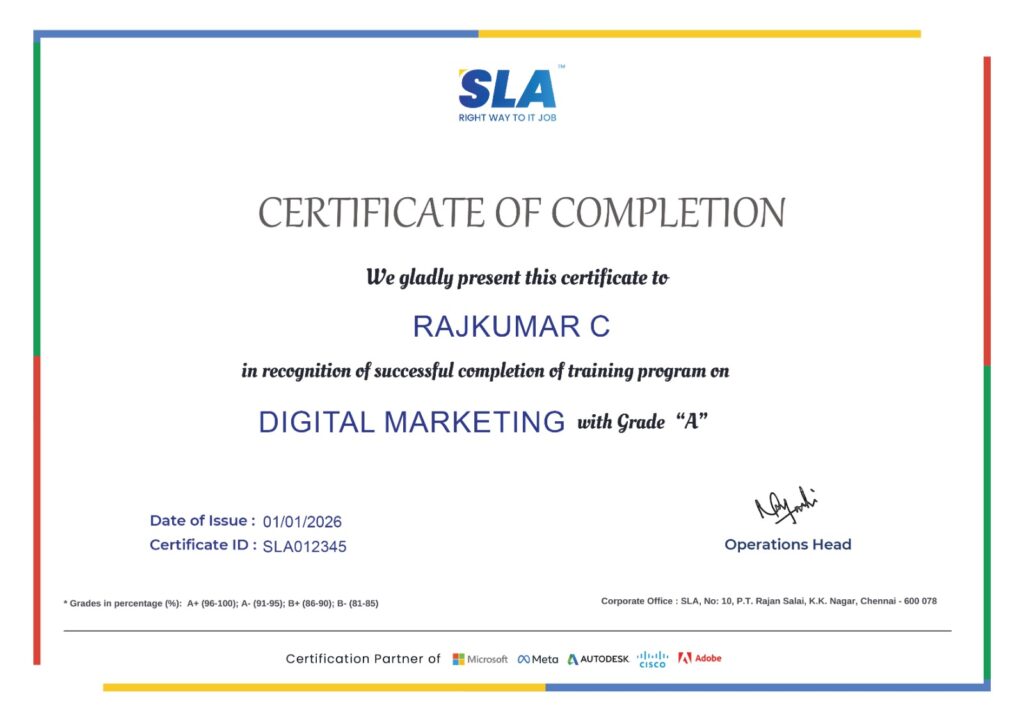
Earn Your Certificate of Completion
Validate your achievements with Softlogic's Certificate of Completion, verifying successful fulfillment of all essential components.
Take Your Career to the Next Level with Certifications
Get a certifications through our training programs to gain a competitive edge in the industry.

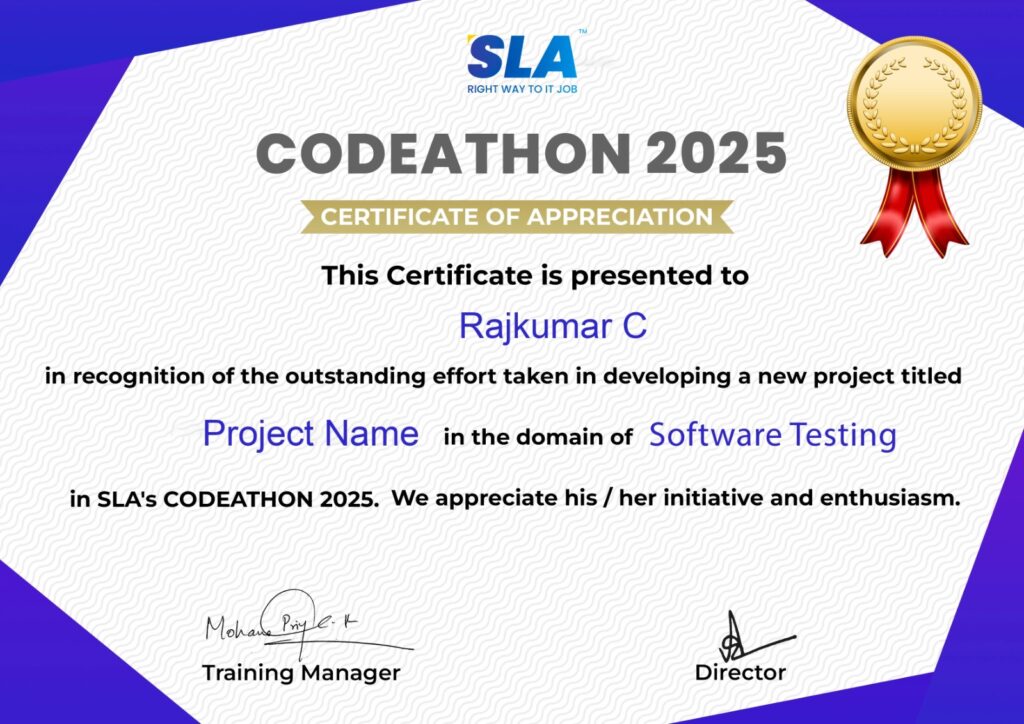
Stand Out from the Crowd with Codethon Certificate
Verify the authenticity of your real-time projects with Softlogic's Codethon certificate.
Hands-on Project Practices in Oracle Sql Course
Management of Student Databases
Management of Blood Donations
Sales at Grocery Stores
Pricing & Discount System
Railway Control System Information
System for Managing Libraries
Database for e-commerce driven by Oracle SQL
Supplier Management System
Wholesale Management System
The SLA Way to Get Placed in Top IT Companies
Enrollment

Technology Training
Coding Practices
Realtime Projects
Realtime Projects
Placement Training
Aptitude Training
Interview Skills
Interview Skills
Panel Mock
Interview

Unlimited
Interviews

Interview
Feedback

100%
IT Career
Placement Support for a Oracle Sql Course Job
Genuine Placements. No Backdoor Jobs at Softlogic Systems.

Aptitude Training
from Day 1
Interview Skills
from Day 1

Softskills Training
from Day 1
Build Your Resume

Build your LinkedIn Profile

Build your GitHub
digital portfolio

Panel Mock Interview
Unlimited Interviews until you get placed

Life Long Placement Support at no cost
Request a Free Callback
FAQs
What is Oracle SQL used for?
To define, access, and preserve data, Oracle SQL offers a simple, elegant, and efficient architecture. Utilize SQL with APEX, Hadoop, PHP, Java, Python,.NET, and Oracle.
Is Oracle SQL different from SQL?
Yes, Oracle and SQL (Structured Query Language) are different. Relational databases are managed and altered using standardized languages called SQL, while Oracle is a commercial database management system (DBMS) created by Oracle Corporation.
Why learn Oracle SQL?
One of the most popular database management systems in use today is Oracle SQL. It is especially well-liked by big businesses with mission-critical databases, and it powers mostly commercial and enterprise apps.
Is Oracle easy to learn?
It won’t take long to learn the foundations of Oracle APEX. But if you’re not sure where to begin, need some reading material, or just a little motivation along the way, check out these helpful resources.
Is Oracle SQL better than MySQL?
While MySQL excels at managing smaller-scale relational databases and provides both vertical and horizontal scalability, Oracle is geared for large-scale operations with high-performance techniques and real application clusters.
Is Oracle SQL in demand?
The data indicates that there is a continuous high demand for Oracle SQL certifications. It verifies knowledge of database design and the development of data-driven applications.
Is Oracle SQL good for a career?
Yes, having an understanding of Oracle SQL can help you in your work. One could pursue a career in database development, data analysis, or database management and maintenance.
What certification will I receive after finishing the Oracle SQL course?
You will receive internationally recognized SLA course completion certificates for Oracle SQL training, prestigious IBM credentials, and Codeathon certificates upon completing the training, all of which validate your practical project expertise.
What are the possible payment methods at SLA for Oracle SQL training?
We take cash, credit cards (Visa, Maestro, Mastercard), Netbanking, and other major payment options for Oracle SQL training at SLA.
I still have some questions for the Oracle SQL Course.
Kindly contact our Oracle SQL course advisor via WhatsApp or at +91 86818 84318. As an alternative, you can contact us by chat on our website, email enquiry@softlogicsys.in, or through our contact form.
Additional Information for
the Oracle Sql Course
Future Prospects
Being a SQL developer in the future can involve more than simply computer science. Nevertheless, it’s evident in the public sector, science and technology, healthcare, retail, finance, and other areas. To store data, all businesses require databases.
- Combining big data technologies with Oracle SQL.
- SQL Solutions on the Cloud.
- AI integration with machine learning.
- Hybrid Solutions for NoSQL and SQL.
Oracle SQL Certification Value
A career in entry-level database development can pave the way for a lucrative Oracle SQL career for those with strong analytical, problem-solving, and communication skills. Because information technology is always changing, skills need to be updated on a regular basis. Therefore, if this fascinating sector of work appeals to you, having a passion for lifelong learning is imperative.
New Features of Oracle SQL
Newly added Oracle SQL features are as follows:
- Indexing automatically.
- Improvements to SQL Diagnostics and Repair.
- Bitmap-Based Unique SQL Function for Counting.
- Big Data and Optimizing Performance for In-Memory External Tables.
- SQL Plan Management on Autopilot.
- Real-time statistics.
- Automatic Optimizer Statistics Collection with High Frequency.
- Tables with hybrid partitions.
Related Blogs
Oracle SQL Developer Challenges and Solutions
Published On: November 5, 2024
Introduction Oracle SQL is a language for managing relational databases in Oracle Database. It enables…
Oracle SQL Projects
Published On: October 23, 2024
Introduction Learning Oracle SQL Projects is one of the best ways to gain hands-on experience…
Oracle SQL Developer Salary for Freshers and Experienced
Published On: October 5, 2024
Introduction Oracle SQL is the bedrock of enterprise-level database management in today's data-driven landscape. For…
Top 20 Oracle SQL Interview Questions and Answers
Published On: June 10, 2024
Introduction Database work often starts with SQL. Developers write queries to read data, update records,…
Google Reviews

Rating
4.8
1,053 Google reviews

NalluKumar Ravichandran
Hi, I recently completed the DOT NET Full Stack Development course at SLA, and I had a great learning experience. The teaching style and student…

Click here for Full Review

MATHAN KUMAR G EEE
SLA Institute provides a structured learning environment for data analytics. The syllabus is relevant, and trainers are knowledgeable. Some sessions were very useful practically, while…
Click here for Full Review

Surya
Special thanks to Vishal Sir, the Placement Officer, for his interview guidance, resume support, and continuous motivation throughout the placement process. I would also like…
Click here for Full Review

SARAN M
SLA Institute provides training in communication and aptitude along with strong technical skills. The trainers explain concepts clearly with a practical approach, which helps build…
Click here for Full Review

Nithish Sahoo
I had an excellent experience taking this DevOps course. The curriculum is well-structured and covers both fundamental and advanced DevOps concepts in a clear manner.…
Click here for Full Review

Shaaru Menan
I had a 3 year career break. Joined SLA on Java Full Stack course and completed it.Did projects with the help of my Mentor. They…
Click here for Full Review