
Softlogic Systems Oracle SQL Course Syllabus is specifically designed for College Students, Freshers, and Job Seekers. Our Oracle SQL syllabus covers the Oracle database architecture, SQL syntax, DDL & DML commands, joins, subqueries, views, indexes, and performance tuning. Our Oracle SQL Course Content helps you learn Oracle SQL step by Step with real-time projects and Interview Preparations.
Oracle SQL Course Syllabus
4.80
(1425)
DURATION

2 Months
JOB READY

Syllabus
CERTIFIED

Courses

Let's take the first step to becoming an expert in Oracle SQL
Click Here to Get Started
Lifelong Placement
Support
Get Certified
Check Your Job Eligibility
×
Your Placement Eligibility Report
Syllabus for The Oracle SQL Course
Download Syllabus
Introduction to Oracle Database
- List the features of Oracle Database 11g
- Discuss the basic design, theoretical, and physical aspects of a relational database
- Categorize the different types of SQL statements
- Describe the data set used by the course
- Log on to the database using SQL Developer environment
- Save queries to files and use script files in SQL Developer
Retrieve Data using the SQL SELECT Statement
- List the capabilities of SQL SELECT statements
- Generate a report of data from the output of a basic SELECT statement
- Select All Columns
- Select Specific Columns
- Use Column Heading Defaults
- Use Arithmetic Operators
- Understand Operator Precedence
- Learn the DESCRIBE command to display the table structure
Learn to Restrict and Sort Data
- Write queries that contain a WHERE clause to limit the output retrieved
- List the comparison operators and logical operators that are used in a WHERE clause
- Describe the rules of precedence for comparison and logical operators
- Use character string literals in the WHERE clause
- Write queries that contain an ORDER BY clause to sort the output of a SELECT statement
- Sort output in descending and ascending order
Usage of Single-Row Functions to Customize Output
- Describe the differences between single row and multiple row functions
- Manipulate strings with character function in the SELECT and WHERE clauses
- Manipulate numbers with the ROUND, TRUNC, and MOD functions
- Perform arithmetic with date data
- Manipulate dates with the DATE functions
Invoke Conversion Functions and Conditional Expressions
- Describe implicit and explicit data type conversion
- Use the TO_CHAR, TO_NUMBER, and TO_DATE conversion functions
- Nest multiple functions
- Apply the NVL, NULLIF, and COALESCE functions to data
- Use conditional IF THEN ELSE logic in a SELECT statement
Aggregate Data Using the Group Functions
- Use the aggregation functions in SELECT statements to produce meaningful reports
- Divide the data in groups by using the GROUP BY clause
- Exclude groups of date by using the HAVING clause
Display Data From Multiple Tables Using Joins
- Write SELECT statements to access data from more than one table
- View data that generally does not meet a join condition by using outer joins
- Join a table by using a self join
Use Sub-queries to Solve Queries
- Describe the types of problem that sub-queries can solve
- Define sub-queries
- List the types of sub-queries
- Write single-row and multiple-row sub-queries
The SET Operators
- Describe the SET operators
- Use a SET operator to combine multiple queries into a single query
- Control the order of rows returned
Data Manipulation Statements
- Describe each DML statement
- Insert rows into a table
- Change rows in a table by the UPDATE statement
- Delete rows from a table with the DELETE statement
- Save and discard changes with the COMMIT and ROLLBACK statements
- Explain read consistency
Use of DDL Statements to Create and Manage Tables
- Categorize the main database objects
- Review the table structure
- List the data types available for columns
- Create a simple table
- Decipher how constraints can be created at table creation
- Describe how schema objects work
Other Schema Objects
- Create a simple and complex view
- Retrieve data from views
- Create, maintain, and use sequences
- Create and maintain indexes
- Create private and public synonyms
Control User Access
- Differentiate system privileges from object privileges
- Create Users
- Grant System Privileges
- Create and Grant Privileges to a Role
- Change Your Password
- Grant Object Privileges
- How to pass on privileges?
- Revoke Object Privileges
Management of Schema Objects
- Add, Modify and Drop a Column
- Add, Drop and Defer a Constraint
- How to enable and disable a Constraint?
- Create and Remove Indexes
- Create a Function-Based Index
- Perform Flashback Operations
- Create an External Table by Using ORACLE_LOADER and by Using ORACLE_DATAPUMP
- Query External Tables
Manage Objects with Data Dictionary Views
- Explain the data dictionary
- Use the Dictionary Views
- USER_OBJECTS and ALL_OBJECTS Views
- Table and Column Information
- Query the dictionary views for constraint information
- Query the dictionary views for view, sequence, index and synonym information
- Add a comment to a table
- Query the dictionary views for comment information
Manipulate Large Data Sets
- Use Subqueries to Manipulate Data
- Retrieve Data Using a Subquery as Source
- Insert Using a Subquery as a Target
- Usage of the WITH CHECK OPTION Keyword on DML Statements
- List the types of Multitable INSERT Statements
- Use Multitable INSERT Statements
- Merge rows in a table
- Track Changes in Data over a period of time
Data Management in Different Time Zones
- Time Zones
- CURRENT_DATE, CURRENT_TIMESTAMP, and LOCALTIMESTAMP
- Compare Date and Time in a Session’s Time Zone
- DBTIMEZONE and SESSIONTIMEZONE
- Difference between DATE and TIMESTAMP
- INTERVAL Data Types
- Use EXTRACT, TZ_OFFSET and FROM_TZ
- Invoke TO_TIMESTAMP,TO_YMINTERVAL and TO_DSINTERVAL
Retrieve Data Using Sub-queries
- Multiple-Column Subqueries
- Pairwise and Nonpairwise Comparison
- Scalar Subquery Expressions
- Solve problems with Correlated Subqueries
- Update and Delete Rows Using Correlated Subqueries
- The EXISTS and NOT EXISTS operators
- Invoke the WITH clause
- The Recursive WITH clause
Regular Expression Support
- Use the Regular Expressions Functions and Conditions in SQL
- Use Meta Characters with Regular Expressions
- Perform a Basic Search using the REGEXP_LIKE function
- Find patterns using the REGEXP_INSTR function
- Extract Substrings using the REGEXP_SUBSTR function
- Replace Patterns Using the REGEXP_REPLACE function
- Usage of Sub-Expressions with Regular Expression Support
- Implement the REGEXP_COUNT function
The SLA way to Become
a Oracle SQL Expert

Enrollment

Technology Training
Coding Practices
Realtime Projects
Realtime Projects

Placement Training
Aptitude Training
Interview Skills
Interview Skills

Panel Mock
Interview

Unlimited
Interviews

Interview
Feedback

100%
IT Career
FAQ
What is SQL?
SQL stands for Structured Query Language and is used to interact with relational databases to manipulate data. It includes commands such as SELECT, INSERT, UPDATE, and DELETE that allow users to query and modify data.
What is Oracle SQL used for?
To define, access, and preserve data, Oracle SQL offers a simple, elegant, and efficient architecture. Utilize SQL with APEX, Hadoop, PHP, Java, Python,.NET, and Oracle.
What is Oracle SQL used for?
SQL stands for Structured Query Language, and it is used for data access, definition, and maintenance. To define, access, and preserve data, Oracle SQL offers a simple, elegant, and efficient architecture. Utilize SQL with Oracle, PHP, Python, Java,.NET, Hadoop, and Node. To learn more, enroll in our Oracle SQL online training at SLA.
Why opt for SLA as your preferred Oracle SQL Training Institute in OMR?
Choose SLA as your preferred Oracle SQL Training Institute in OMR for its expert-led training, hands-on learning, guaranteed placement guidance, flexible scheduling, and personalized support. Our program guarantees your success in mastering Oracle SQL.
Are you looking for exciting offers?
Call +91 86818 84318 right away and find out all about the great deals that are now available to you!
Is Oracle SQL different from SQL?
Yes, Oracle and SQL (Structured Query Language) are different. Relational databases are managed and altered using standardized languages called SQL, while Oracle is a commercial database management system (DBMS) created by Oracle Corporation.
Is Oracle SQL easy to learn?
Learning it isn’t that difficult, provided you know your way around Linux and SQL.
Does SLA provide EMI options for students?
Yes, SLA offers EMI options for students with 0% interest to make the training more financially manageable.
How do you connect to an Oracle database using SQL?
You can connect to an Oracle database using SQL by using sqlplus, a command-line interface for writing and running SQL scripts. This can be done either directly or through programming languages such as Java, PHP, Python, etc.
Does SLA have any other branch?
SLA operates two branches, one in K.K. Nagar and the other in OMR Navalur, providing students with convenient access to their training centers.
Why learn Oracle SQL?
One of the most popular database management systems in use today is Oracle SQL. It is especially well-liked by big businesses with mission-critical databases, and it powers mostly commercial and enterprise apps.
Is Oracle SQL suitable for beginners?
Compared to other programming languages like Java and C++, SQL is simpler to master. It assists you in managing large amounts of structured data. Simple SQL procedures can query a million rows of data. SQL enables you to normalize and standardize your data.
Is Oracle easy to learn?
It won’t take long to learn the foundations of Oracle APEX. But if you’re not sure where to begin, need some reading material, or just a little motivation along the way, check out these helpful resources.
Is Oracle SQL very difficult?
Oracle SQL can be challenging for beginners due to its complexity and the need to understand database concepts. However, with practice and guidance, it becomes easier to work with.
What are the basic ORACLE-SQL commands?
The basic sql commands in oracle are CREATE, ALTER, INSERT, SELECT, UPDATE and DELETE. These commands help in creating, altering, inserting, selecting, updating and deleting the data respectively.
Is SQL a good career?
When it comes to database jobs, SQL offers some of the most lucrative opportunities, with some of the highest incomes.
Is there a future for SQL?
These enhancements are essential to SQL’s future adaptability and evolution with the shifting data landscape, and they help SQL meet the demands of big data processing.
Is Oracle SQL better than MySQL?
While MySQL excels at managing smaller-scale relational databases and provides both vertical and horizontal scalability, Oracle is geared for large-scale operations with high-performance techniques and real application clusters.
What are the different SQL data types?
The different types of SQL data types are NUMERIC, VARCHAR, BOOLEAN, DATE and TIMESTAMP.
Is Oracle SQL useful?
Oracle SQL is very helpful. It’s used to manage and query data in Oracle databases, which are commonly used in many businesses. Knowing Oracle SQL is essential for handling data efficiently and is valuable for database professionals.
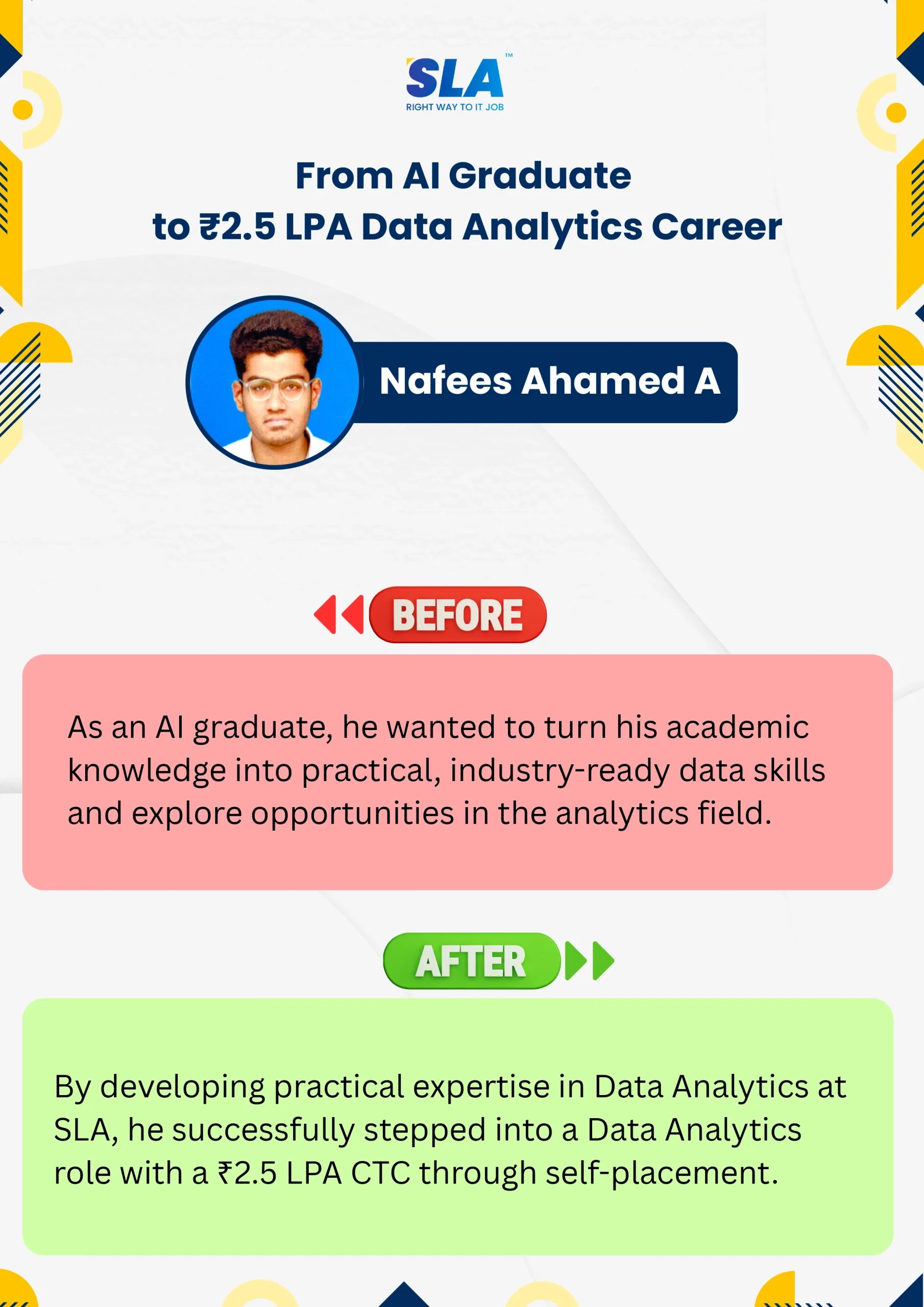
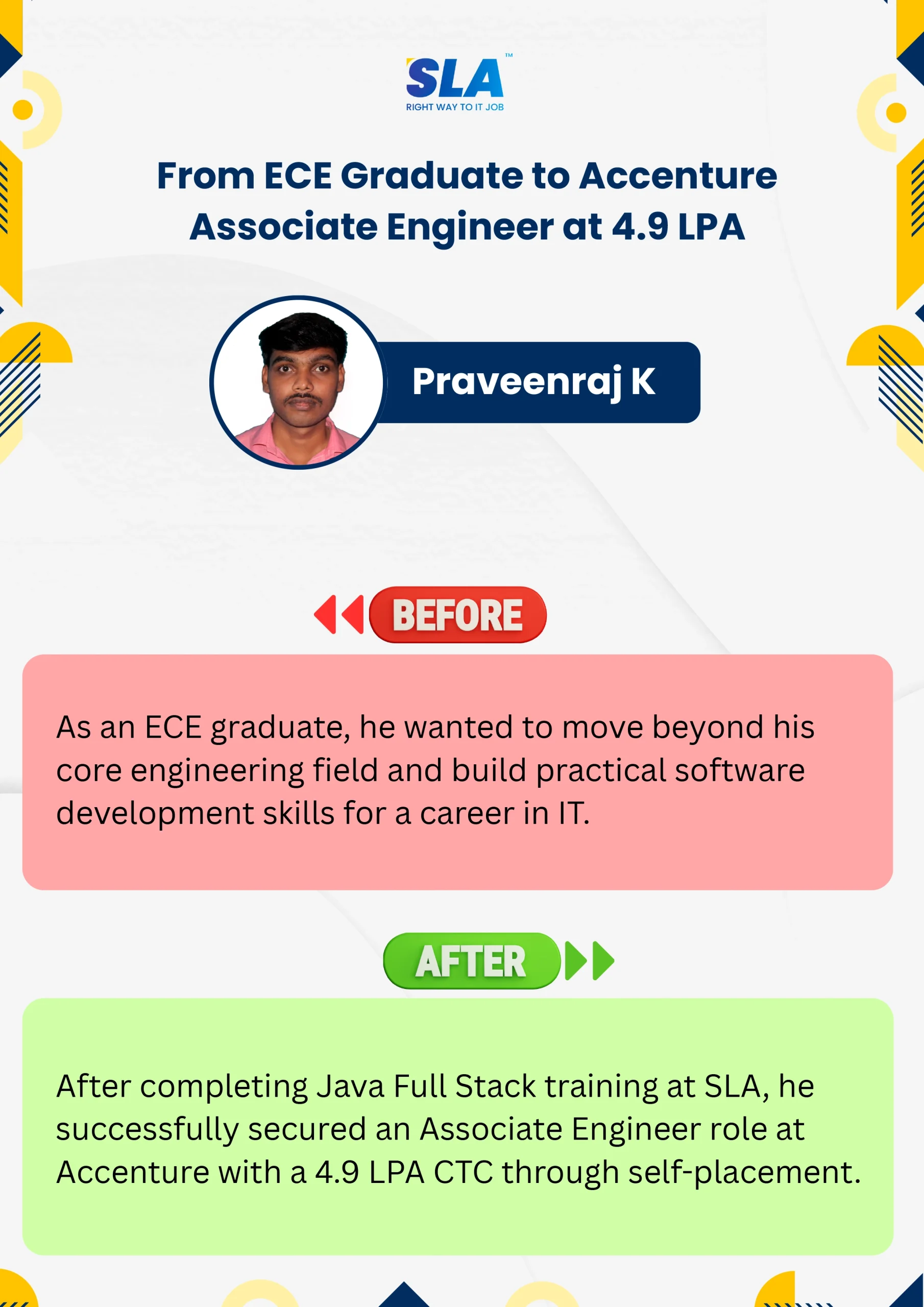
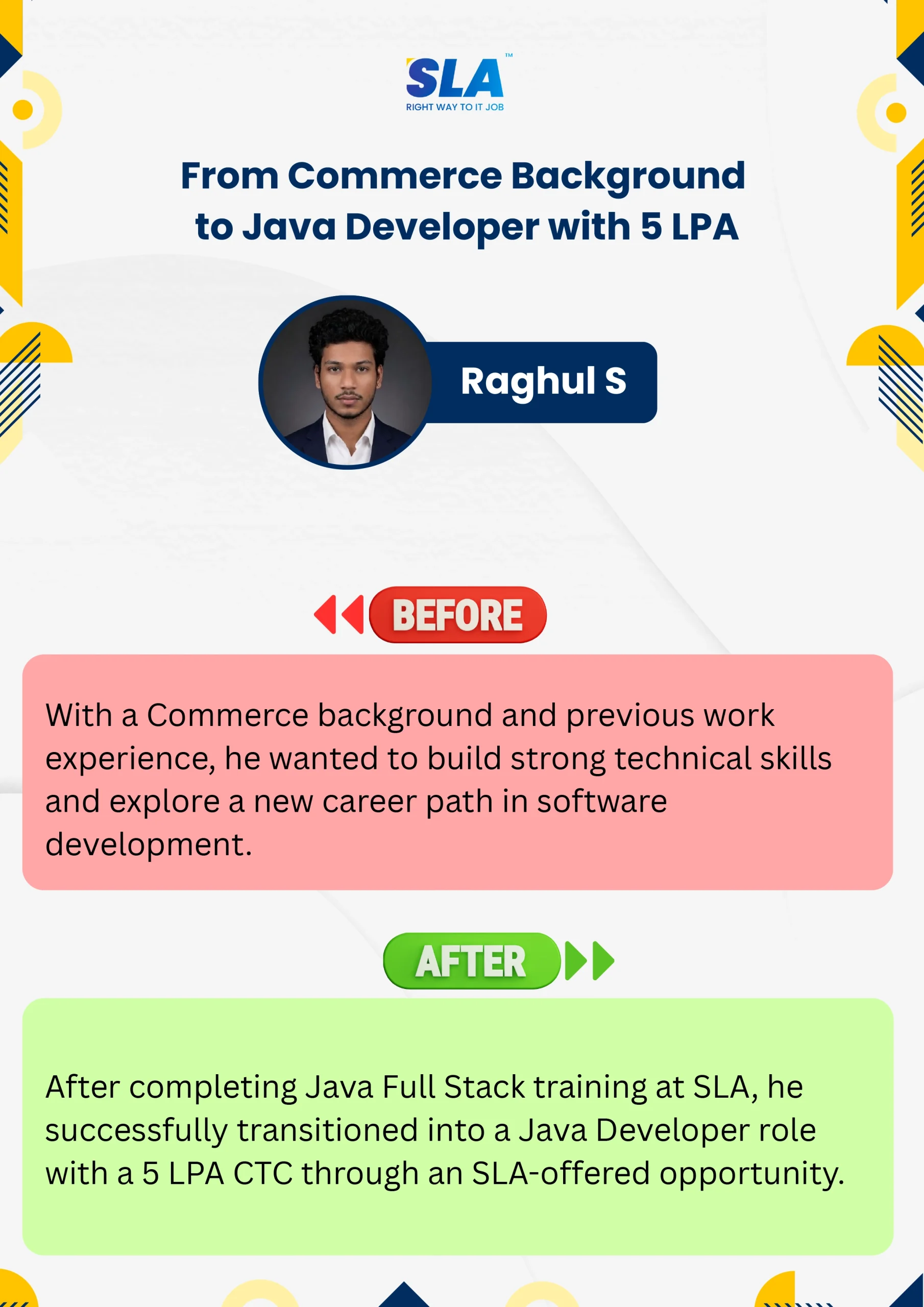
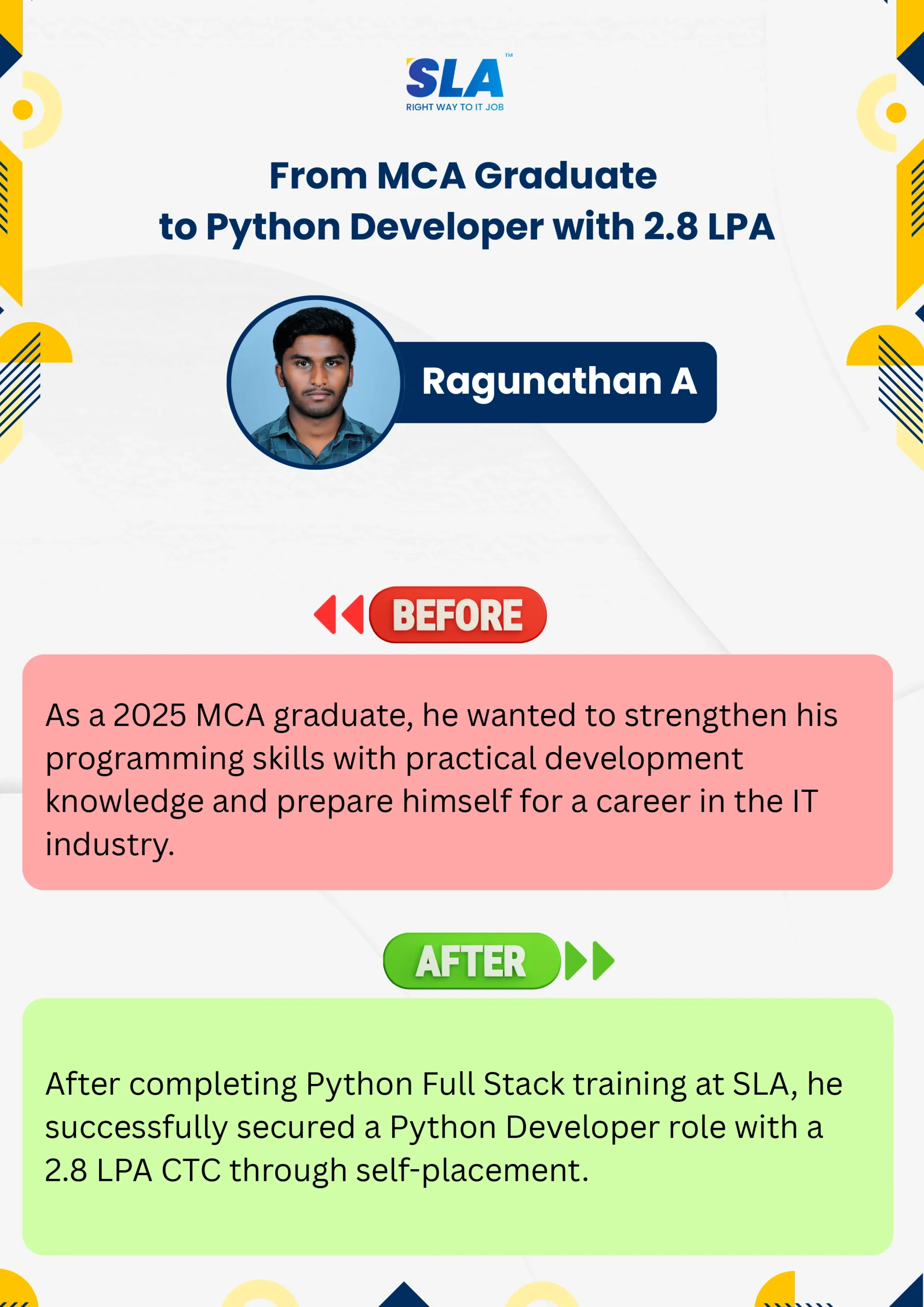
Google Reviews

Rating
4.8
1,053 Google reviews

NalluKumar Ravichandran
Hi, I recently completed the DOT NET Full Stack Development course at SLA, and I had a great learning experience. The teaching style and student…

Click here for Full Review

Surya
Special thanks to Vishal Sir, the Placement Officer, for his interview guidance, resume support, and continuous motivation throughout the placement process. I would also like…
Click here for Full Review

SARAN M
SLA Institute provides training in communication and aptitude along with strong technical skills. The trainers explain concepts clearly with a practical approach, which helps build…
Click here for Full Review

Shaaru Menan
I had a 3 year career break. Joined SLA on Java Full Stack course and completed it.Did projects with the help of my Mentor. They…
Click here for Full Review

MATHAN KUMAR G EEE
SLA Institute provides a structured learning environment for data analytics. The syllabus is relevant, and trainers are knowledgeable. Some sessions were very useful practically, while…
Click here for Full Review

Nithish Sahoo
I had an excellent experience taking this DevOps course. The curriculum is well-structured and covers both fundamental and advanced DevOps concepts in a clear manner.…
Click here for Full Review
Discover What Our Students Have To Say
See More ReviewsRelated Blogs for
The Oracle SQL Course
Oracle SQL Developer Challenges and Solutions
Published On: November 5, 2024
Introduction Oracle SQL is a language for managing relational databases in Oracle Database. It enables…
Oracle SQL Projects
Published On: October 23, 2024
Introduction Learning Oracle SQL Projects is one of the best ways to gain hands-on experience…
Oracle SQL Developer Salary for Freshers and Experienced
Published On: October 5, 2024
Introduction Oracle SQL is the bedrock of enterprise-level database management in today's data-driven landscape. For…
Oracle SQL Tutorial for Beginners
Published On: June 28, 2024
Introduction Are you overwhelmed by the technical jargon of databases and struggling to write your…
Top 20 Oracle SQL Interview Questions and Answers
Published On: June 10, 2024
Introduction Database work often starts with SQL. Developers write queries to read data, update records,…