
Our Oracle SQL Online Training programs are designed for students, freshers, and working professionals who want to upskill and stay relevant. We offer Oracle SQL Online Courses that are practical, interactive, and aligned with the latest industry demands. Our Oracle SQL syllabus covers the Oracle database architecture, SQL syntax, DDL & DML commands, joins, subqueries, views, indexes, and performance tuning. Enroll now and learn from industry experts with flexible timings and get Job support.
Oracle Sql Online Training
DURATION
2 Months
EMI
0% Interest
Mode
Live Online / Offline
Let's take the first step to becoming an expert in Oracle SQL
100% Placement
Assurance
Get Certified
JOB PLACEMENT ELIGIBILITY TEST
Your Placement Eligibility Report
Want more details about Oracle SQL Course?
Course Schedules
Course Syllabus
Course Fees
or any other questions...
Fees, Duration & Batch Timings for Oracle SQL Course
Hands On Training
3-5 Real Time Projects
60-100 Practical Assignments
3+ Assessments / Mock Interviews
July 2026
Week days
(Mon-Fri)
Online/Offline
2 Hours Real Time Interactive Technical Training
1 Hour Aptitude
1 Hour Communication & Soft Skills
(Suitable for Fresh Jobseekers / Non IT to IT transition)
July 2026
Week ends
(Sat-Sun)
Online/Offline
4 Hours Real Time Interactive Technical Training
(Suitable for working IT Professionals)
Save up to 20% in your Course Fee on our Job Seeker Course Series
Syllabus of Oracle SQL Course
Introduction to Oracle Database
- List the features of Oracle Database 11g
- Discuss the basic design, theoretical, and physical aspects of a relational database
- Categorize the different types of SQL statements
- Describe the data set used by the course
- Log on to the database using SQL Developer environment
- Save queries to files and use script files in SQL Developer
Retrieve Data using the SQL SELECT Statement
- List the capabilities of SQL SELECT statements
- Generate a report of data from the output of a basic SELECT statement
- Select All Columns
- Select Specific Columns
- Use Column Heading Defaults
- Use Arithmetic Operators
- Understand Operator Precedence
- Learn the DESCRIBE command to display the table structure
Learn to Restrict and Sort Data
- Write queries that contain a WHERE clause to limit the output retrieved
- List the comparison operators and logical operators that are used in a WHERE clause
- Describe the rules of precedence for comparison and logical operators
- Use character string literals in the WHERE clause
- Write queries that contain an ORDER BY clause to sort the output of a SELECT statement
- Sort output in descending and ascending order
Usage of Single-Row Functions to Customize Output
- Describe the differences between single row and multiple row functions
- Manipulate strings with character function in the SELECT and WHERE clauses
- Manipulate numbers with the ROUND, TRUNC, and MOD functions
- Perform arithmetic with date data
- Manipulate dates with the DATE functions
Invoke Conversion Functions and Conditional Expressions
- Describe implicit and explicit data type conversion
- Use the TO_CHAR, TO_NUMBER, and TO_DATE conversion functions
- Nest multiple functions
- Apply the NVL, NULLIF, and COALESCE functions to data
- Use conditional IF THEN ELSE logic in a SELECT statement
Aggregate Data Using the Group Functions
- Use the aggregation functions in SELECT statements to produce meaningful reports
- Divide the data in groups by using the GROUP BY clause
- Exclude groups of date by using the HAVING clause
Display Data From Multiple Tables Using Joins
- Write SELECT statements to access data from more than one table
- View data that generally does not meet a join condition by using outer joins
- Join a table by using a self join
Use Sub-queries to Solve Queries
- Describe the types of problem that sub-queries can solve
- Define sub-queries
- List the types of sub-queries
- Write single-row and multiple-row sub-queries
The SET Operators
- Describe the SET operators
- Use a SET operator to combine multiple queries into a single query
- Control the order of rows returned
Data Manipulation Statements
- Describe each DML statement
- Insert rows into a table
- Change rows in a table by the UPDATE statement
- Delete rows from a table with the DELETE statement
- Save and discard changes with the COMMIT and ROLLBACK statements
- Explain read consistency
Use of DDL Statements to Create and Manage Tables
- Categorize the main database objects
- Review the table structure
- List the data types available for columns
- Create a simple table
- Decipher how constraints can be created at table creation
- Describe how schema objects work
Other Schema Objects
- Create a simple and complex view
- Retrieve data from views
- Create, maintain, and use sequences
- Create and maintain indexes
- Create private and public synonyms
Control User Access
- Differentiate system privileges from object privileges
- Create Users
- Grant System Privileges
- Create and Grant Privileges to a Role
- Change Your Password
- Grant Object Privileges
- How to pass on privileges?
- Revoke Object Privileges
Management of Schema Objects
- Add, Modify and Drop a Column
- Add, Drop and Defer a Constraint
- How to enable and disable a Constraint?
- Create and Remove Indexes
- Create a Function-Based Index
- Perform Flashback Operations
- Create an External Table by Using ORACLE_LOADER and by Using ORACLE_DATAPUMP
- Query External Tables
Manage Objects with Data Dictionary Views
- Explain the data dictionary
- Use the Dictionary Views
- USER_OBJECTS and ALL_OBJECTS Views
- Table and Column Information
- Query the dictionary views for constraint information
- Query the dictionary views for view, sequence, index and synonym information
- Add a comment to a table
- Query the dictionary views for comment information
Manipulate Large Data Sets
- Use Subqueries to Manipulate Data
- Retrieve Data Using a Subquery as Source
- Insert Using a Subquery as a Target
- Usage of the WITH CHECK OPTION Keyword on DML Statements
- List the types of Multitable INSERT Statements
- Use Multitable INSERT Statements
- Merge rows in a table
- Track Changes in Data over a period of time
Data Management in Different Time Zones
- Time Zones
- CURRENT_DATE, CURRENT_TIMESTAMP, and LOCALTIMESTAMP
- Compare Date and Time in a Session’s Time Zone
- DBTIMEZONE and SESSIONTIMEZONE
- Difference between DATE and TIMESTAMP
- INTERVAL Data Types
- Use EXTRACT, TZ_OFFSET and FROM_TZ
- Invoke TO_TIMESTAMP,TO_YMINTERVAL and TO_DSINTERVAL
Retrieve Data Using Sub-queries
- Multiple-Column Subqueries
- Pairwise and Nonpairwise Comparison
- Scalar Subquery Expressions
- Solve problems with Correlated Subqueries
- Update and Delete Rows Using Correlated Subqueries
- The EXISTS and NOT EXISTS operators
- Invoke the WITH clause
- The Recursive WITH clause
Regular Expression Support
- Use the Regular Expressions Functions and Conditions in SQL
- Use Meta Characters with Regular Expressions
- Perform a Basic Search using the REGEXP_LIKE function
- Find patterns using the REGEXP_INSTR function
- Extract Substrings using the REGEXP_SUBSTR function
- Replace Patterns Using the REGEXP_REPLACE function
- Usage of Sub-Expressions with Regular Expression Support
- Implement the REGEXP_COUNT function
Objectives of Oracle SQL Training
Upon the successful completion of our Oracle SQL Online Course, learners can
- Understand the fundamentals of SQL and its role in database administration.
- Acquire knowledge about data retrieval strategies to effectively retrieve information from databases.
- Learn how to create and change database objects with DDL commands.
- Learn how to manage data in databases with DML commands.
- Understand integrity limitations and how they contribute to the accuracy and consistency of data.
- Examine the built-in data manipulation and calculation functions.
- Learn about subqueries, joins, set operators, and data aggregation
Why Softlogic Systems is the Best Choice for Oracle SQL Training – Learn, Practice, and Get Placed!
Online & Offline Training Options
Learn from 100+ Real-Time Developers
Hands-on Projects & Codeathons
0% EMI Fee Options
Resume & Interview Support
Placement with Top IT Firms
1000+ Hiring Partners
No Backdoor Jobs
Highlights of Oracle SQL Course
What is PL/SQL in Oracle?
The Oracle Corporation creates and sells the proprietary multi-model database management system known as Oracle Database. Data warehousing, hybrid database workloads, and online transaction processing are frequently carried out on this database. Learn further in our Oracle SQL Online Course.
What are the reasons for learning Oracle SQL?
Here are the reasons to learn Oracle SQL for your promising career in databases:
- Minimizes operating expenses
- Storing all data types in a single database
- Offers a safe hybrid cloud environment
- Improved user restrictions and identity management
- Carries out rapid backup and recovery
- Offer support for numerous databases.
- Provides better scalability
- Incorporates flashback technology
What are the prerequisites for learning the Oracle SQL Online Course?
There are no hard prerequisites for beginners to learn our online Oracle SQL course. On the other hand, a basic comprehension of the following enhances the educational process.
- Fundamental Computer Knowledge
- Foundations of Databases
- Introduction to Oracle Database Concepts
Our Oracle SQL Online Course is suitable for:
- Students/Freshers
- Working professionals seeking a career change
- Any Job Seekers
What are the course fees and duration?
The Oracle SQL online course fees may change based on the type of course and program level. The Oracle SQL online training cost is normally about 30,000 INR, for the duration of 1 – 2 months, including international certification. For further details, like discounts and other benefits, contact the learning advisors of our Oracle SQL online training institute.
What are some job roles related to the Oracle SQL online course?
Mastery of Oracle SQL opens you to a wide range of job opportunities in database application development. Some of the jobs include:
- Database Developer
- Data Analyst
- Database Engineer
- Database Architect
- Database Consultant
- SQL Developer
- ETL Developer
What is the salary range for Oracle SQL professionals?
The Oracle SQL salary for Freshers in India is between ₹3.7 lakhs and ₹13 lakhs annually. The Oracle SQL salary for experienced professionals is around ₹28.5 LPA. Join our Oracle SQL Online Certification Training to get high-paying jobs in the database field.
List a few Oracle SQL real-time applications.
Some of the real-time Oracle SQL applications for data processing are:
- Supply Chain Management
- Business and data warehousing
- Online Reservations and Booking
- Online Transaction Processing (OLTP)
- Enterprise Resource Planning (ERP)
- Internet of Things
Boost Your Skills with Our Oracle SQL Training Experts
Our Mentors are from Top Companies like:
- Our Oracle-SQL trainers are highly skilled experts in their fields with certifications.
- They are well-versed in the construction of databases and the related storage needs.
- They are masters at building, refining, and overseeing massive production databases as well as in-memory databases.
- Our trainers are skilled in creating packages and stored procedures for the Oracle platform.
- Our trainers are technically competent to establish roles and privileges in Oracle databases and guarantee optimal tuning, indexing, and replication procedures.
- Furthermore, they possess expertise in creating and refining techniques and procedures for data and information transfer across databases and applications.
- To guarantee the most efficient transmission of knowledge, our SQL trainers establish cooperative connections with students and are very communicative.
What Modes of Training are available for Oracle SQL Course?
Offline / Classroom Training
- Direct Interaction with the Trainer
- Clarify doubts then and there
- Airconditioned Premium Classrooms and Lab with all amenities
- Codeathon Practices
- Direct Aptitude Training
- Live Interview Skills Training
- Direct Panel Mock Interviews
- Campus Drives
- 100% Placement Support
Online Training
- No Recorded Sessions
- Live Virtual Interaction with the Trainer
- Clarify doubts then and there virtually
- Live Virtual Interview Skills Training
- Live Virtual Aptitude Training
- Online Panel Mock Interviews
- 100% Placement Support
Corporate Training
- Industry endorsed Skilled Faculties
- Flexible Pricing Options
- Customized Syllabus
- 12X6 Assistance and Support
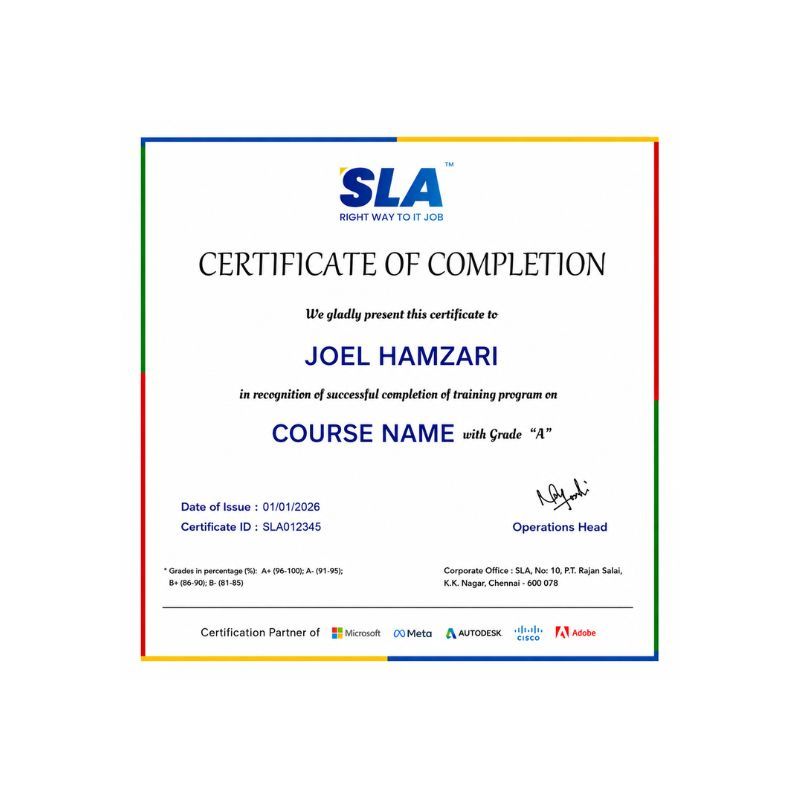
Certifications
Improve your abilities to get access to rewarding possibilities
Earn Your Certificate of Completion
Take Your Career to the Next Level with Certifications
Stand Out from the Crowd with Codethon Certificate
Hands-on Project Practices in Oracle SQL Course
Management of Student Databases
Grocery Store Sales
Management of Blood Donations
The system of discounts and wholesale pricing
System for Managing Libraries
Railway Control System Information
Supplier Administration Information
A database for wholesale management
Oracle SQL-powered E-commerce database
The SLA Way to Get Placed in Top IT Companies
Enrollment
Technology Training
Realtime Projects
Placement Training
Interview Skills
Panel Mock
Interview
Unlimited
Interviews
Interview
Feedback
100%
IT Career
Placement Support for a Oracle SQL Job
Genuine Placements. No Backdoor Jobs at Softlogic Systems.
Aptitude Training
from Day 1
Interview Skills
from Day 1
Softskills Training
from Day 1
Build Your Resume
Build your LinkedIn Profile
Build your GitHub
digital portfolio
Panel Mock Interview
Unlimited Interviews until you get placed
Life Long Placement Support at no cost
FAQs
What is Oracle SQL used for?
SQL stands for Structured Query Language, and it is used for data access, definition, and maintenance. To define, access, and preserve data, Oracle SQL offers a simple, elegant, and efficient architecture. Utilize SQL with Oracle, PHP, Python, Java,.NET, Hadoop, and Node. To learn more, enroll in our Oracle SQL online training at SLA.
Is Oracle SQL easy to learn?
Learning it isn’t that difficult, provided you know your way around Linux and SQL.
Is Oracle SQL suitable for beginners?
Compared to other programming languages like Java and C++, SQL is simpler to master. It assists you in managing large amounts of structured data. Simple SQL procedures can query a million rows of data. SQL enables you to normalize and standardize your data.
Is SQL a good career?
When it comes to database jobs, SQL offers some of the most lucrative opportunities, with some of the highest incomes.
Is there a future for SQL?
These enhancements are essential to SQL’s future adaptability and evolution with the shifting data landscape, and they help SQL meet the demands of big data processing.
Is SQL in demand?
Yes. SQL is a strong and liberating tool. Experts utilize it to process, evaluate, and analyze large amounts of data, and it is in high demand.
How long does it take to learn an Oracle SQL online course?
Oracle SQL Online Training can take 2 to 3 months, depending on your commitment. Many beginners can pick up the fundamentals of Oracle SQL within a few days, but to get comfortable with the system, they need regular practice.
Does SLA provide placement support with the Oracle SQL Online Course?
Yes, we help our students get into various jobs through our Oracle SQL Online Course. To assist you in beginning your job search, we offer extra tools like recruiting drives, practice interviews, and interview preparation classes in our Oracle SQL online training institute.
What kind of payment methods does SLA accept for Oracle SQL online courses?
Payments in cash, checks, cards, and UPI payments of any form are all accepted in our Oracle SQL Online Course.
How many branches of SLA are there?
SLA is located in two places: K.K. Nagar and OMR, Navalur, along with the Oracle SQL online training program.
Additional Information for
the Oracle SQL Course
Skills to become an SQL developer
- Strong programming foundations are essential for SQL developers, including familiarity with one or more of the following languages
- Java,.NET, C++, Python, or Ruby on Rails.
- To create front-end user interfaces, developers should also be familiar with web application development languages and tools (e.g., HTML, PHP).
Latest Features of Oracle SQL
With Oracle SQL 2024, new features include:
- Application Continuity
- Automatic Indexing
- Automatic SQL Plan Management
- Data Guard
- Database Security Fundamentals
- Liquibase Integration for Schema Versioning
- MERGE statement
- New Table Constructor
- Simplified Recovery Standby
Enhance your skills by enrolling in our Oracle SQL Online Training.