
Softlogic is one of the Top Training institutes for Java. Learn how to use Java, from beginner basics to advanced techniques. Our Java Syllabus covers the Core Java, Advanced Java (J2EE), JDBC, Servlets, JSP, Spring, Hibernate, and more. We offer a Java Course with Placement Assistance, Mock interviews, Resume building, and certification.
Java Course For Freshers
4.80
(3021)
DURATION

3 Months
EMI

0% Interest
Mode

Live Online / Offline

Let's take the first step to becoming an expert in Java Course For Freshers
Click Here to Get Started
Lifelong Placement
Assistance
Get Certified
IT Training ELIGIBILITY TEST
×
Your Placement Eligibility Report
Want more details about Java Course For Freshers?
Fill out the form, and our counsellors will get in touch with you at your preferred time. You can have all your queries answered. Once you decide that SLA is the perfect fit for your training needs, our counselors will guide you through the process every step of the way.

Course Schedules

Course Syllabus

Course Fees

or any other questions...
Fees, Duration & Batch Timings for Java Course For Freshers
Hands On Training
3-5 Real Time Projects
60-100 Practical Assignments
3+ Assessments / Mock Interviews
August 2026
Week days
(Mon-Fri)
Online/Offline
2 Hours Real Time Interactive Technical Training
1 Hour Aptitude
1 Hour Communication & Soft Skills
(Suitable for Fresh Jobseekers / Non IT to IT transition)
Course Fee
August 2026
Week ends
(Sat-Sun)
Online/Offline
4 Hours Real Time Interactive Technical Training
(Suitable for working IT Professionals)
Course Fee
Save up to 20% in your Course Fee on our Job Seeker Course Series
Learn More
Syllabus of Java Course For Freshers
Download Syllabus
Introduction
- Why Java
- Paradigms
- Diff B/W Java & Other (C,C++)
- Java History
- Java Features
- Java programming format
- Java Statements
- Java Data Types
OOPS (Object Oriented Programming & Systems)
- Introduction
- Object
- Constructors
- This Key Word
- Inheritance
- Super Key Word
- Polymorphism (Over Loading & Over Riding)
- Abstraction
- Interface
- Encapsulation
- Introduction to all predefined packages
- User Defined Packages
- Access Specifiers
STRING Manipulation
- String
- String Buffer
Array
- What is Array
- Single Dimensional Array
- Multi Dimensional Array
- Sorting of Arrays
Exception Handling
- Introduction
- Pre Defined Exceptions
- Try-Catch-Finally
- Throws, throw
- User Defined Exception examples
I/O Streams
- Introduction
- Byte-oriented streams
- Character – oriented streams
- File
Multithreading
- Introduction
- Thread Creations
- Thread Life Cycle
- Life Cycle Methods
- Synchronization
- Wait() notify() notify all() methods
Wrapper Classes
- Introduction
- Byte, Short, Integer, Long, Float, Double, Character
- Boolean classes
Inner Classes
- Introduction
- Member Inner Class
- Static Inner Class
- Local Inner Class
- Anonymous Inner Class
Collection Frame Work
- Introduction
- Util Package interfaces, List, Set, Map
- List Interface 7 Its Classes
- Set Interface & Its Classes
- Map Interface & Is Classes
AWT
- Introduction
- Components
- Event-Delegation-Model
- Listeners
- Layouts
- Individual Components Lable, Button, Check Box, Radio Button,
- Choice, List, Menu, Text Field, Text Area
SWING (JFC)
- Introduction Diff B/W AWT and SWING
- Components hierarchy
- Panes
- Individual Swings components J Label
- JButton, JTextField, JTextAres
Advanced Java Syllabus (J2EE Course Syllabus) — Introduction to Enterprise Edition
- Distributed Multitier Applications
- J2EE Containers
- Web Services Support
- Packaging Applications
- J2EE 1.4 APIs
Web Server and Application Server
- Tomcat-Introduction
- Overview, installation, Configuring Tomcat
- Jboss server-Introduction
- Overview,installation and Configuration
- Comparison
SQL
- Basics of SQL queries
- SQL Joins
JDBC
- Introduction
- JDBC Architecture
- Types of Drivers
- Statement
- Result Set
- Read Only Result Set
- Updatable Result Set
- Forward Only Result Set
- Scrollable Result Set
- Prepared Statement
Servlets
- Introduction
- Web application Architecture
- HTTP Protocol & HTTP Methods
- Web Server & Web Container
- Servlet Interface
- HTTPServlet
- GenericServlet
- Servlet Life Cycle
- Servlet Config
- Servlet Context
- Servlet Communication<.li>
Servlet-Browser Communication
- sendError
- setHeader
- sendRedirect
Web-Component Communication
- Forward
- Include
Servlet-Applet Communication
- Session Tracking Mechanisms
- Http Session
- Cookies
- URL-Rewriting
- Hidden-Form Fields
- Filters & Wrappers
- Listeners
- Web-Security
JSP
- Introduction
- Jsp LifeCycle
- Jsp Implicit Objects & Scopes
- Jsp Directives
- page
- include
- taglib
Jsp Scripting Elements
- declaratives
- scriptlets
- expressions
JSP Actions
Standard Actions
- useBean tag
- setProperty tag
- getProperty tag
- include tag
- forward tag
- param tag
- plug-in tag
- params tag
- fallback tag
- directives tag
- scriptlet tag
- expression tag
Objectives of Java Course For Freshers
The Java Training will cover all the topics ranging from fundamental to advanced concepts, which will make it easy for students to grasp Java. The Java Course Curriculum is composed of some of the most useful and rare concepts that will surely give students a complete understanding of Java as well. So, some of those curriculum are discussed below as objectives:
- To make students well-versed with fundamental concepts of Java like – Java History, Java Features, OOPs, STRING Manipulation, Array, Exception Handling, I/O Streams etc.
- To make students more aware of Java, by making them learn more Java concepts like – Multithreading, Wrapper Classes, Inner Classes, Collection Framework, AWT, SWING (JFC) etc.
- To make students knowledgeable on advanced Java Course like – Introduction to Enterprise Edition, Web Server and Application Server, SQL, JDBC, Servlets etc.
Request a Free Callback
Why Softlogic Systems is the Best Choice for Java Course For Freshers – Learn, Practice, and Get Placed!
Online & Offline Training Options
Learn at your convenience with flexible classroom and live online training.

Learn from 100+ Real-Time Developers
Get trained by industry professionals with years of hands-on experience.

Hands-on Projects & Codeathons
Practice with real-time projects and coding challenges to build confidence.
0% EMI Fee Options
Pay your course fees flexibly with easy EMI plans at zero interest.

Resume & Interview Support
Get expert help with resume building, mock interviews, and soft skills.

Placement with Top IT Firms
Access placement opportunities with leading MNCs and IT companies.

1000+ Hiring Partners
Benefit from Softlogic’s strong recruiter network for faster job placement.

No Backdoor Jobs
We ensure only genuine placement opportunities with trusted companies.
Request a Free Callback
Highlights of Java Course For Freshers
What is Java?
Java is a versatile, high-level, object-oriented language known for its portability, security, and powerfulness. Developed by Sun Microsystems and now managed by Oracle, it allows cross-platform execution via bytecode and JVM. With rich libraries, strong community support, and capabilities in web, enterprise, and mobile applications, Java remains widely used.
What is Java Full Stack?
Java Full Stack development covers both front-end and back-end aspects of application creation using Java technologies. It includes designing user interfaces (HTML, CSS, JavaScript frameworks), managing server-side logic (Java, Spring, Hibernate), handling data access (JPA, JDBC), and integrating systems (REST, SOAP). Tools like IDEs, build systems, and deployment technologies complete the stack.
What are the reasons for learning Java?
The following are the reasons for learning Java:
- Versatility: Java is utilized across various fields, including web and mobile development, enterprise solutions, and embedded systems.
- Platform Independence: Java’s “Write Once, Run Anywhere” feature enables applications to execute on any platform with a Java Virtual Machine (JVM).
- Strong Community Support: Java benefits from a large community and a wealth of resources, such as libraries, frameworks, and development tools that streamline coding.
- Career Prospects: Mastery of Java can lead to numerous career opportunities in software development, covering areas like web, mobile, and enterprise applications.
What are the prerequisites for learning Java?
The following are the prerequisites for learning Java, but they are not mandatory:
- Basic Computer Skills: Understanding general computer operations and file management is essential for setting up your development environment and grasping programming concepts.
- Programming Fundamentals: A grasp of basic programming concepts such as variables, data types, control structures (loops and conditionals), and algorithms is beneficial. Previous experience with another programming language can be advantageous.
- Object-Oriented Programming (OOP) Knowledge: Java is an object-oriented language, so familiarity with OOP principles such as classes, objects, inheritance, polymorphism, and encapsulation is crucial for effective code writing and organization.
- Basic Mathematical Skills: Proficiency in basic arithmetic and algebra is important for solving programming problems and understanding algorithms.
What are the course fees and duration?
Our Java Course Fees may vary depending on the specific course program you choose (basic / intermediate / full stack), course duration, and course format (remote or in-person). On an average the Java Course Fees range from 85k to 70k, for a duration of 3-6 months total with international certification.
What are some of the jobs related to Java?
The following are the jobs related to Java:
- Java Developer
- Java Software Engineer
- Full Stack Developer
- Java Architect
- Java Backend Developer
- Android Developer
List a few real time Java applications.
The following are the real-time Java applications:
- Enterprise Resource Planning (ERP) Systems
- E-Commerce Platforms
- Banking and Financial Services
- Mobile Applications
- Web Applications
- Big Data Processing
Boost Your Skills with Our Java Course For Freshers Experts
Our Mentors are from Top Companies like:
- Our instructors have over ten years of practical Java training experience. They have worked on a wide range of projects across various industries, ensuring that their knowledge is applicable to real-world scenarios.
- Each year, they mentor and support more than 2,000 students, demonstrating a strong track record of effective guidance.
- They consistently deliver high-quality training that aligns with industry standards, bridging theoretical concepts with practical applications seamlessly.
- With established connections to HR professionals at multinational companies, our trainers offer valuable insights into current industry trends and job prospects.
- They are proficient in core Java concepts such as Exception Handling, Threads, JSP, Operators, XML handling, Loops, Collections, Database Connectivity, and Servlets.
- Their training includes extensive hands-on experience in these areas. Known for their excellent communication skills, they make learning engaging and comprehensible by using relevant examples.
- Committed to student success, they focus on helping learners achieve their educational goals and prepare confidently for interviews.
Request a Free Callback
What Modes of Training are available for Java Course For Freshers?
Offline / Classroom Training

A Personalized Learning Experience with Direct Trainer Engagement!
- Direct Interaction with the Trainer
- Clarify doubts then and there
- Airconditioned Premium Classrooms and Lab with all amenities
- Codeathon Practices
- Direct Aptitude Training
- Live Interview Skills Training
- Direct Panel Mock Interviews
- Campus Drives
- 100% Placement Support
Online Training

Instructor Led Live Training! Learn at the comfort of your home
- No Recorded Sessions
- Live Virtual Interaction with the Trainer
- Clarify doubts then and there virtually
- Live Virtual Interview Skills Training
- Live Virtual Aptitude Training
- Online Panel Mock Interviews
- 100% Placement Support
Corporate Training

Blended Delivery model (both Online and Offline as per Clients’ requirement)
- Industry endorsed Skilled Faculties
- Flexible Pricing Options
- Customized Syllabus
- 12X6 Assistance and Support
GET Free Consultation
Certifications
Take your career to new heights with Softlogic's software training certifications.
Improve your abilities to get access to rewarding possibilities
Improve your abilities to get access to rewarding possibilities

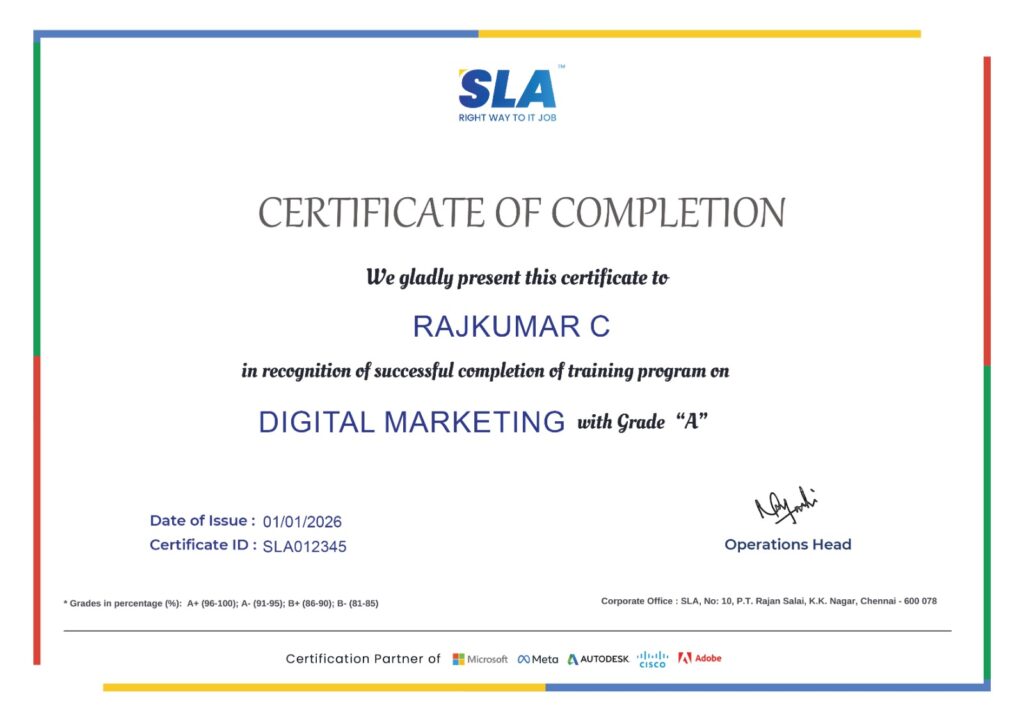
Earn Your Certificate of Completion
Validate your achievements with Softlogic's Certificate of Completion, verifying successful fulfillment of all essential components.
Take Your Career to the Next Level with Certifications
Get a certifications through our training programs to gain a competitive edge in the industry.

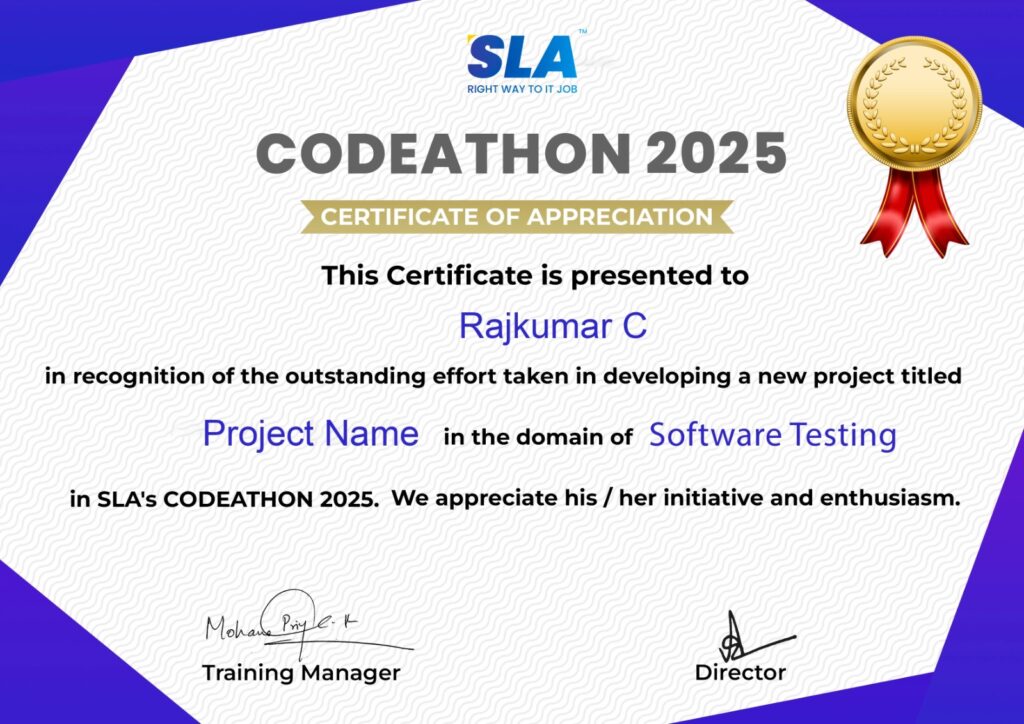
Stand Out from the Crowd with Codethon Certificate
Verify the authenticity of your real-time projects with Softlogic's Codethon certificate.
Hands-on Project Practices in Java Course For Freshers
Healthcare Management System
Social Media Application
Event Management Application
Learning Management System (LMS)
Inventory Tracking System
Hotel Booking System
Customer Relationship Management System
Online Banking Application
E-Commerce Website
The SLA Way to Get Placed in Top IT Companies
Enrollment

Technology Training
Coding Practices
Realtime Projects
Realtime Projects
Placement Training
Aptitude Training
Interview Skills
Interview Skills
Panel Mock
Interview

Unlimited
Interviews

Interview
Feedback

100%
IT Career
Placement Support for a Java Course For Freshers Job
Genuine Placements. No Backdoor Jobs at Softlogic Systems.

Aptitude Training
from Day 1
Interview Skills
from Day 1

Softskills Training
from Day 1
Build Your Resume

Build your LinkedIn Profile

Build your GitHub
digital portfolio

Panel Mock Interview
Unlimited Interviews until you get placed

Life Long Placement Support at no cost
Request a Free Callback
FAQs
What is the difference between == and equals() in Java?
In Java, == is used to compare object references, determining if two references point to the same memory location. The equals() method, however, is used to compare the contents of objects, checking if the data within the objects is equal. For custom objects, it is important to override the equals() method to define logical equality.
What are Java Streams, and how can they be utilized?
Java Streams are part of the Java 8 java.util.stream package, providing a functional approach to processing sequences of elements. They support operations such as filtering, mapping, and reducing in a declarative manner. Streams facilitate operations on collections, enabling efficient and concise data processing.
How does Java handle concurrency with the synchronized keyword?
In Java, the synchronized keyword is employed to guarantee that a specific block of code or object is accessed by only one thread at any given moment. This helps prevent race conditions and ensures thread safety by locking the specified object or method, thus avoiding concurrent modification issues.
What are Java interfaces and how do they differ from abstract classes?
Java interfaces are used to define a contract of methods that implementing classes must provide.Interfaces enable multiple inheritance in Java, allowing a class to implement several interfaces simultaneously. Abstract classes, on the other hand, can provide some method implementations and can maintain state, but a class can only extend one abstract class. Interfaces are more flexible for defining roles or capabilities.
What is the Java Memory Model (JMM)?
The Java Memory Model (JMM) defines how threads interact through memory and how changes made by one thread are visible to others. It ensures consistency and visibility of shared variables in a multi-threaded environment, and provides rules for synchronization, volatile variables, and atomic operations to avoid issues like stale data and concurrency bugs.
How does Java handle serialization and deserialization?
Java handles serialization through the Serializable interface, which marks a class whose objects can be converted into a byte stream and saved or transmitted. Deserialization is the reverse process, where the byte stream is converted back into a Java object. The ObjectOutputStream and ObjectInputStream classes are used for these operations.
What are lambda expressions in Java, and how are they utilized?
Lambda expressions, introduced in Java 8, provide a concise way to express instances of functional interfaces (interfaces with a single abstract method). They allow for more readable and less verbose code, especially when working with functional programming concepts. Lambda expressions are used with the java.util.function package to enable functional-style operations on collections and streams.
What is the purpose of the volatile keyword in Java?
The volatile keyword in Java is used to signal that a variable’s value may be changed by multiple threads. It ensures that changes to the variable are immediately visible to all threads and prevents the compiler and runtime from applying optimizations that could lead to inconsistencies. This is crucial for ensuring visibility and correctness in multi-threaded applications.
Where is the corporate office of Softlogic Systems located?
The corporate office of the Softlogic Systems is located at the institute’s K.K.Nagar branch.
What payment methods does Softlogic accept?
Softlogic accepts a wide range of payment methods, including:
- Cash
- Debit cards
- Credit cards (MasterCard, Visa, Maestro)
- Net banking
- UPI
- Including EMI.
Additional Information for
the Java Course For Freshers
Scopes available in the future for learning Java
The following are the scopes available in the future for learning Java Course:
- Cloud Computing: Java continues to be a top choice for developing cloud-based applications. Utilizing cloud platforms like AWS, Azure, and Google Cloud, Java developers can build scalable, resilient applications. Emerging cloud-native Java frameworks such as Spring Boot and Jakarta EE enhance this potential.
- Microservices Architecture: As microservices architecture gains traction, Java is integral to this approach. Frameworks like Spring Cloud and MicroProfile help developers create, deploy, and manage microservices, promoting scalable and maintainable systems.
- Big Data and Analytics: Java’s role extends to big data technologies and frameworks like Apache Hadoop and Apache Spark. Mastering Java’s integration with these tools is valuable for handling and analyzing large datasets, making it crucial in data-centric fields.
- Artificial Intelligence and Machine Learning: Java is increasingly utilized in AI and ML projects through libraries like DeepLearning4J and Weka. Implementing and integrating machine learning algorithms and models in Java opens up opportunities in these rapidly advancing areas.
- Internet of Things (IoT): Java is ideal for IoT development due to its portability and scalability. Java ME (Micro Edition) and frameworks such as Eclipse Kura support building applications for connected devices, sensors, and embedded systems.
- Mobile Application Development: Despite Kotlin’s rise as the preferred language for Android development, Java remains essential for Android apps. Ongoing maintenance and updates for existing Java-based Android applications ensure continued relevance.
- Enterprise Solutions: Java Enterprise Edition (Jakarta EE) remains fundamental for enterprise application development. Its robustness and comprehensive features make it ideal for constructing large-scale, mission-critical enterprise applications.
- Web Development: Java is vital for web development with frameworks like Spring MVC, JSF, and Vaadin. The creation of dynamic, secure, and scalable web applications using Java continues to be a significant area of growth.
Related Blogs
Java Frameworks
Published On: April 9, 2026
Introduction to Java Frameworks Java frameworks are the "power tools" of the software industry, making…
Java Operators
Published On: April 8, 2026
Introduction to Java Operators In Java, operators are special symbols that perform certain operations on…
Literals in Java
Published On: April 8, 2026
Introduction to Literals in Java In the overall architecture of a Java program, literals in…
Java Developer Roadmap – From Beginner to Expert
Published On: May 9, 2025
Introduction Java continues to serve as a fundamental technology in the field of software development.…
Java Developer Course Eligibility
Published On: February 18, 2025
Introduction To enroll in a Java Developer course, it's important to understand the eligibility for…
Java Code Challenges and Solutions for Beginners
Published On: November 2, 2024
Introduction Java’s versatility is one of its best qualities. You can discover that the same…
Java Project Ideas
Published On: October 5, 2024
Java is a powerful and widely adopted programming language used for developing applications across web,…
Java Developer Salary For Freshers and Experienced
Published On: September 27, 2024
Introduction Java development has become a core skill for professionals in software engineering, enterprise application…
Java Tutorial for Beginners
Published On: September 20, 2024
Introduction Sick of job hunting that requires advanced skills you lack? Java is the robust…
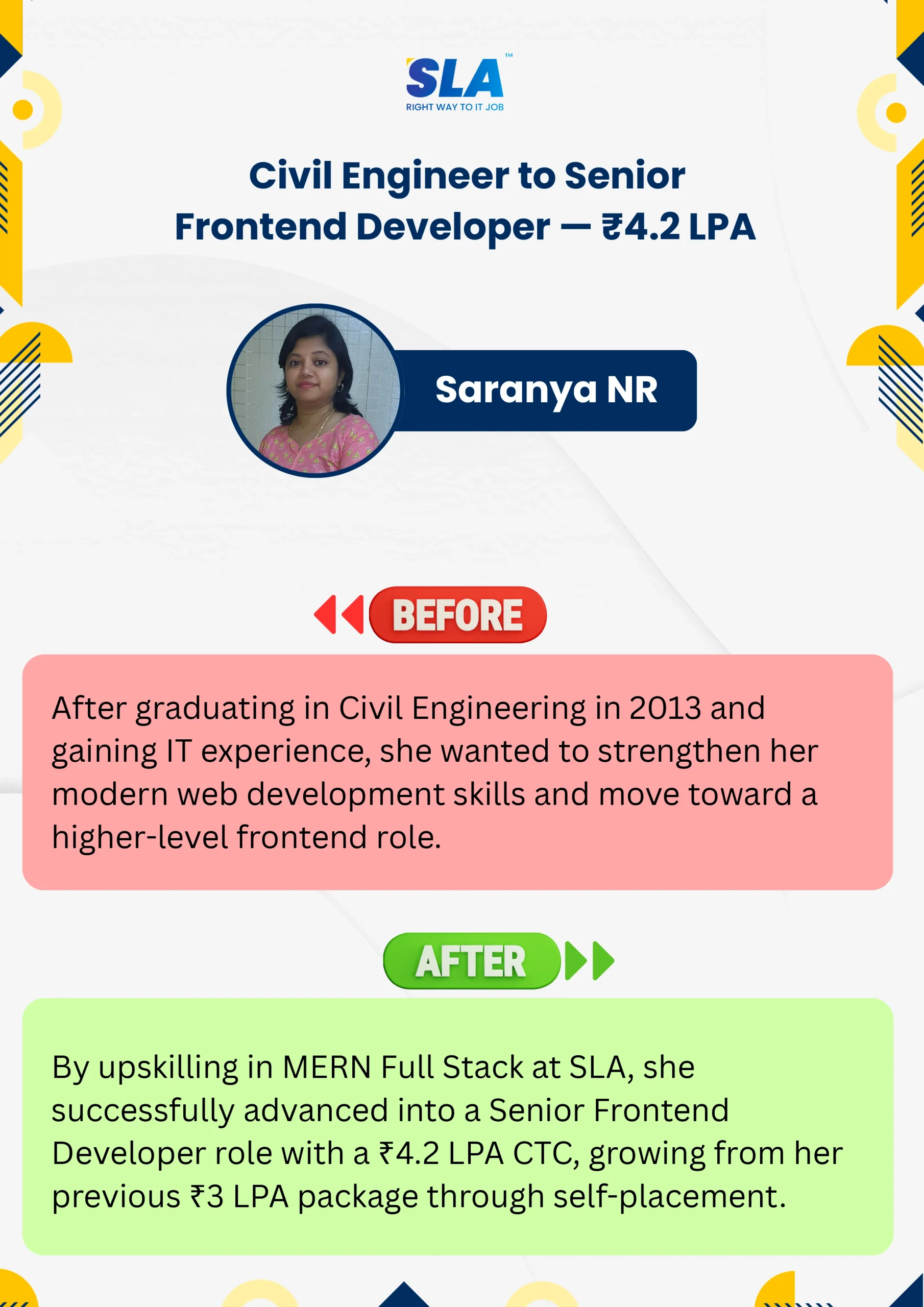
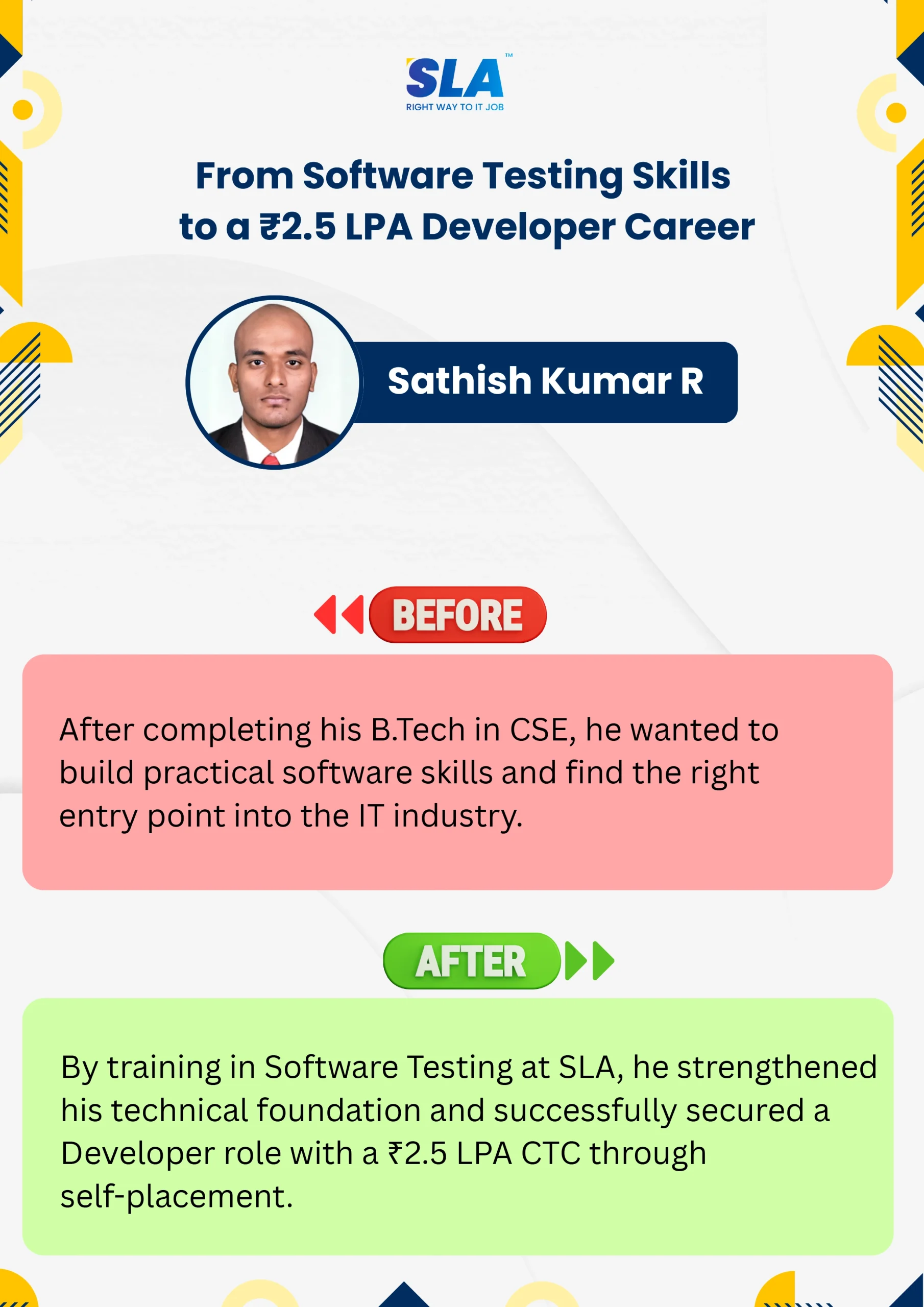
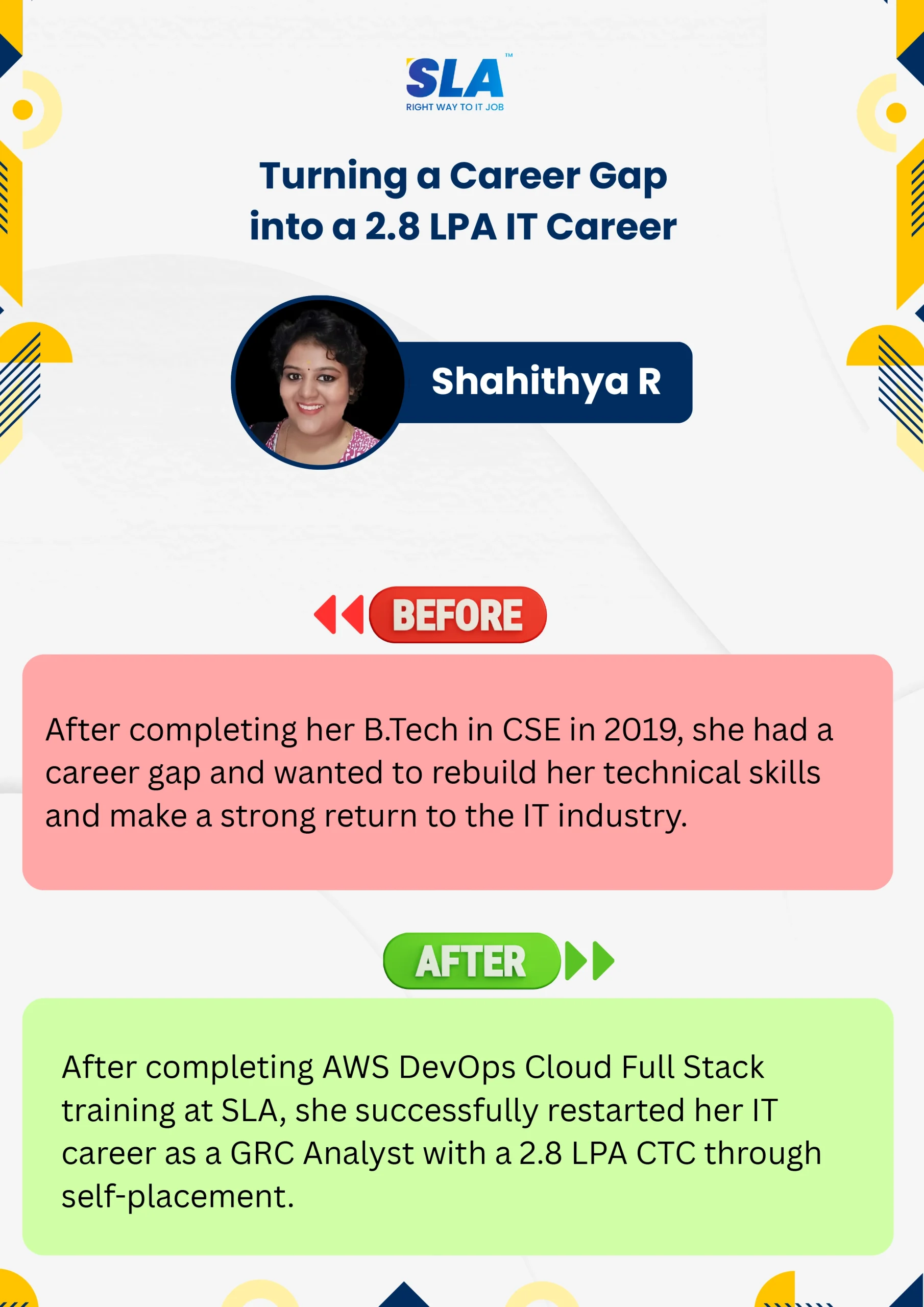
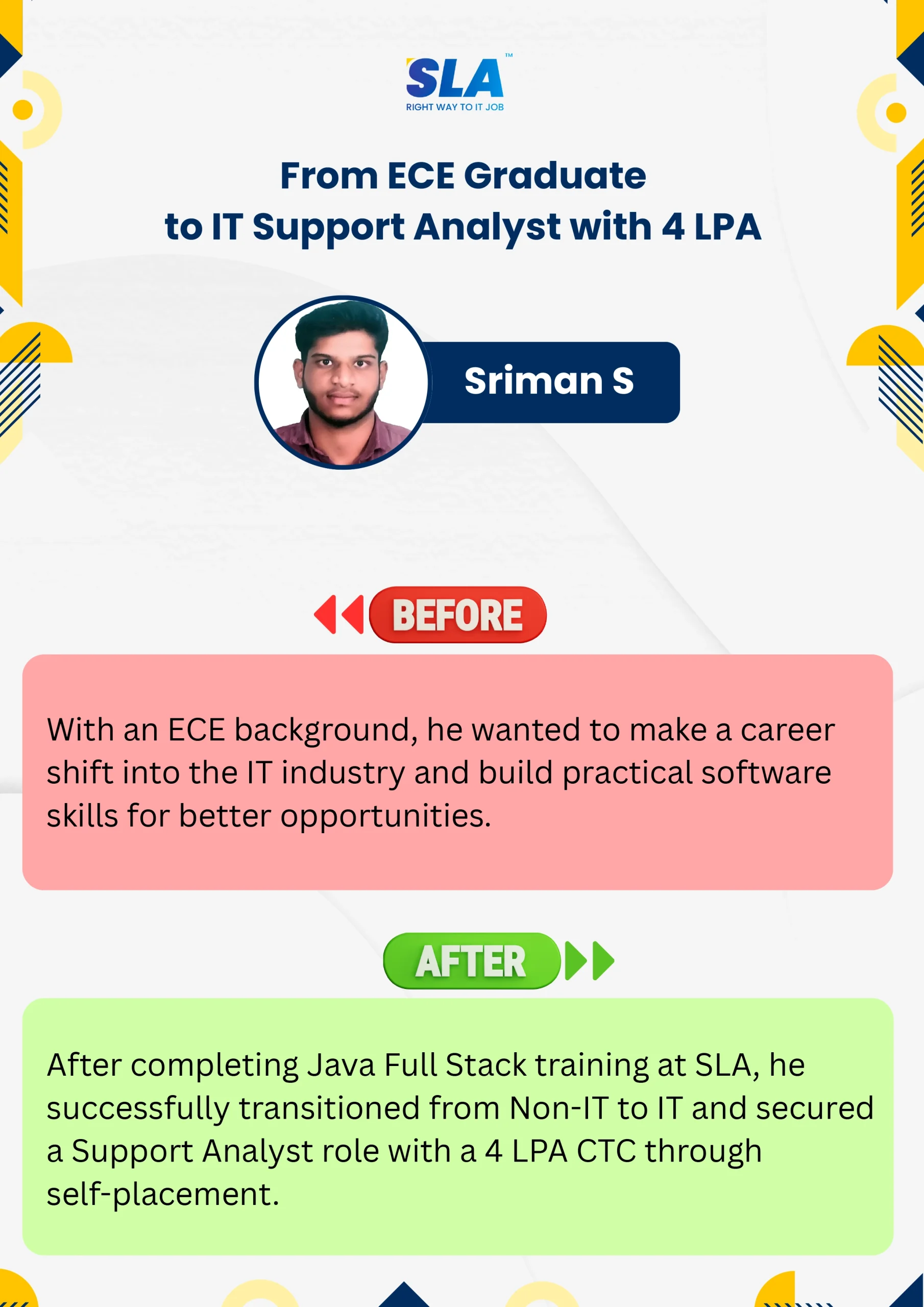
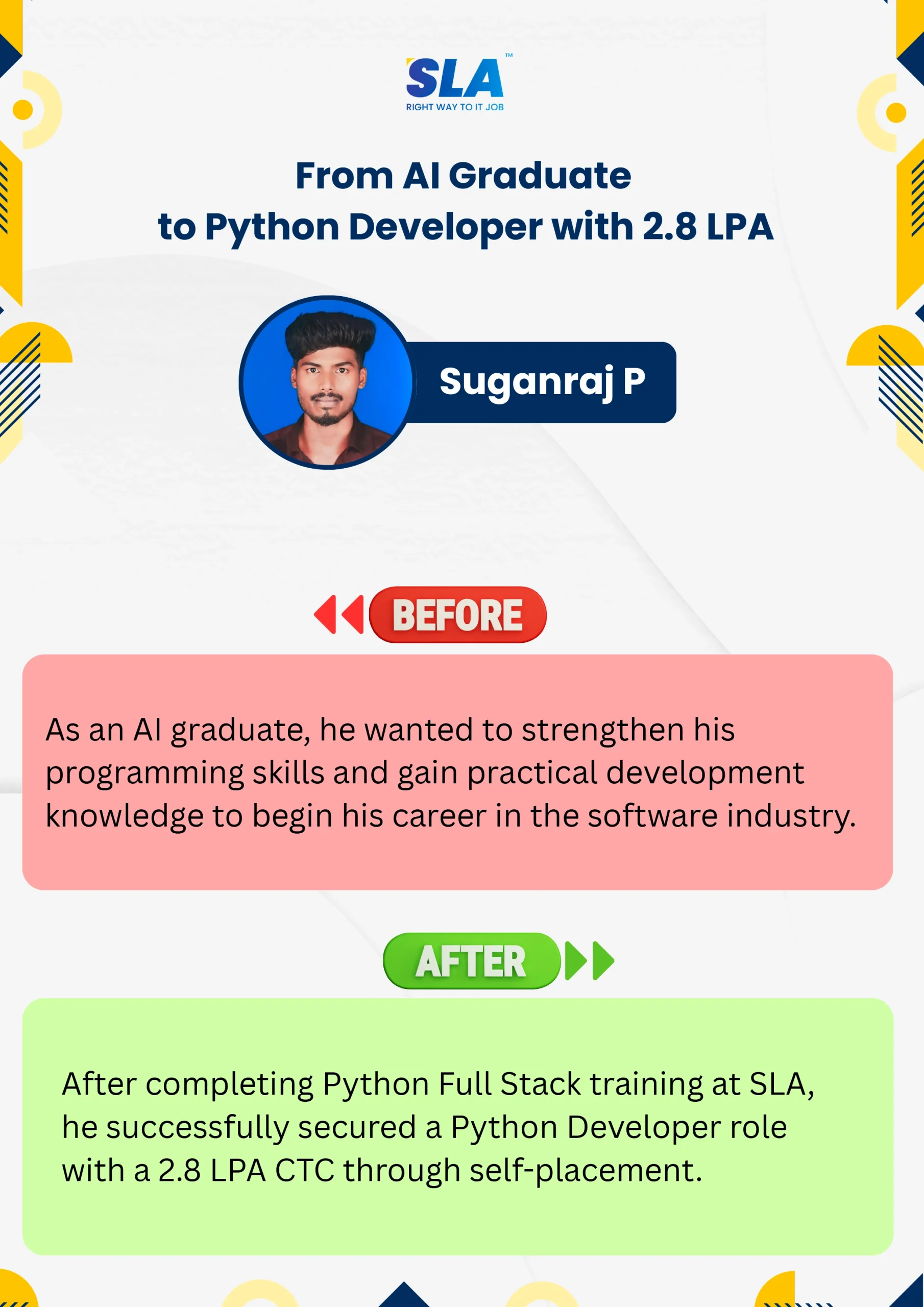
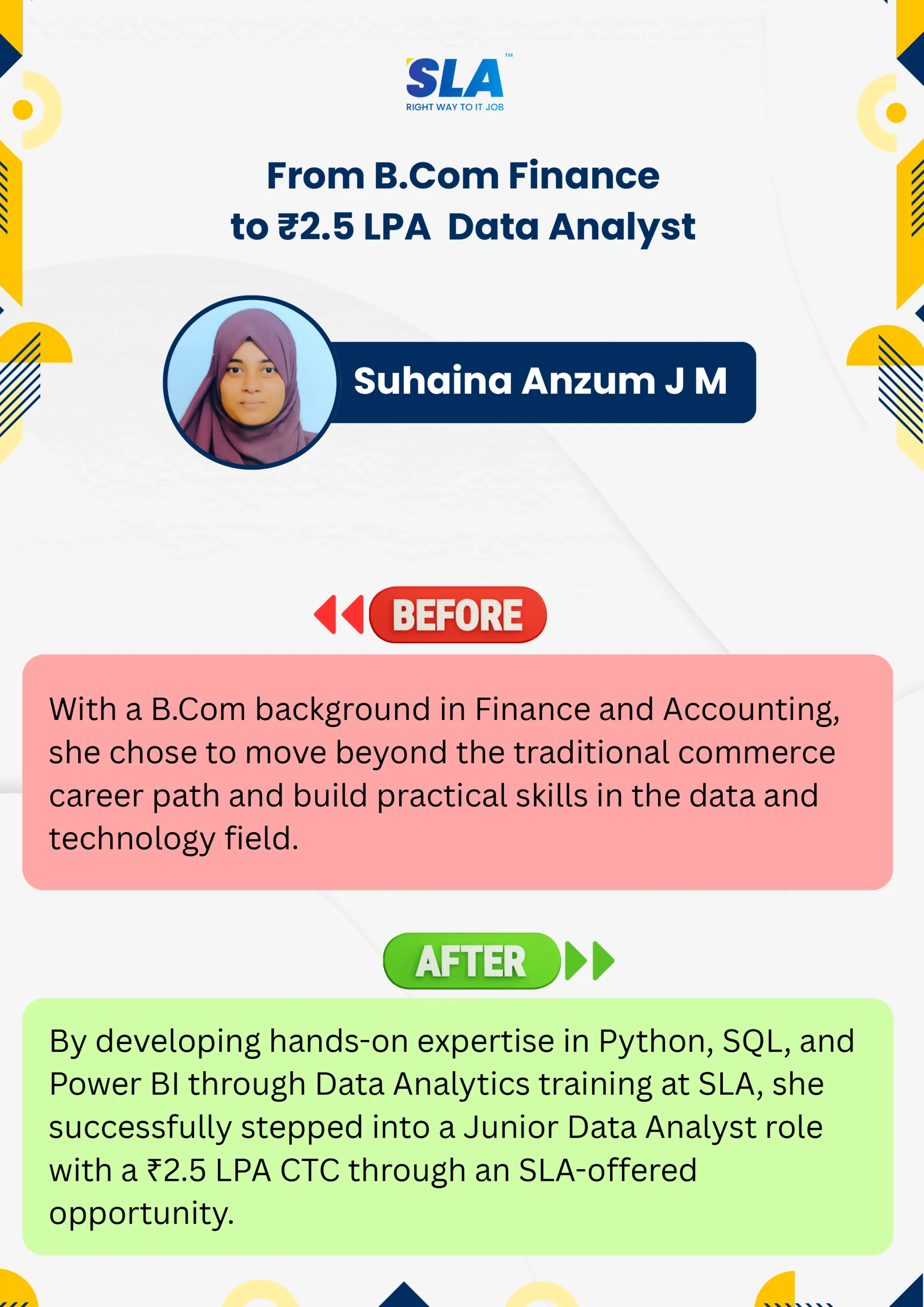
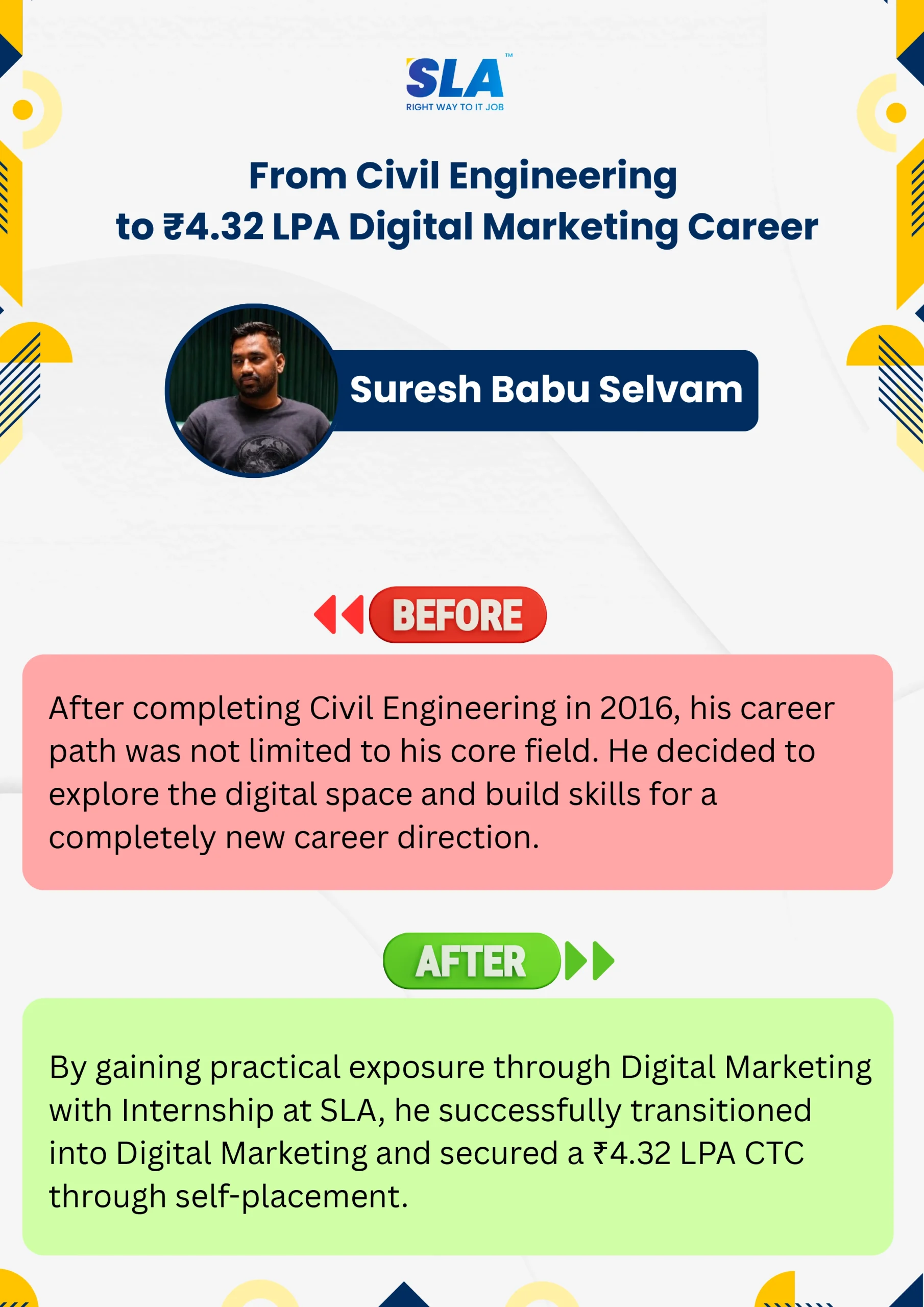
Google Reviews

Rating
4.8
1,053 Google reviews

Shaaru Menan
I had a 3 year career break. Joined SLA on Java Full Stack course and completed it.Did projects with the help of my Mentor. They…

Click here for Full Review

SARAN M
SLA Institute provides training in communication and aptitude along with strong technical skills. The trainers explain concepts clearly with a practical approach, which helps build…
Click here for Full Review

MATHAN KUMAR G EEE
SLA Institute provides a structured learning environment for data analytics. The syllabus is relevant, and trainers are knowledgeable. Some sessions were very useful practically, while…
Click here for Full Review

NalluKumar Ravichandran
Hi, I recently completed the DOT NET Full Stack Development course at SLA, and I had a great learning experience. The teaching style and student…
Click here for Full Review

Nithish Sahoo
I had an excellent experience taking this DevOps course. The curriculum is well-structured and covers both fundamental and advanced DevOps concepts in a clear manner.…
Click here for Full Review

Surya
Special thanks to Vishal Sir, the Placement Officer, for his interview guidance, resume support, and continuous motivation throughout the placement process. I would also like…
Click here for Full Review