
Join Our 100% Job-Guaranteed Artificial Intelligence Course in OMR. We Provide Quality Artificial Intelligence training with an affordable Cost in OMR. Our Artificial Intelligence Syllabus covers the essential topics such as machine learning, deep learning, natural language processing, computer vision, neural networks, and AI model deployment. At Softlogic Systems, you’ll earn globally recognized certifications, build real-time projects, and receive complete placement assistance to launch a successful career in your chosen field.
Artificial Intelligence Training In Omr
4.60
(1524)
DURATION

2 Months
EMI

0% Interest
Mode

Live Online / Offline

Let's take the first step to becoming an expert in Artificial Intelligence
Click Here to Get Started
Lifelong Placement
Assistance
Get Certified
JOB PLACEMENT ELIGIBILITY TEST
×
Your Placement Eligibility Report
Want more details about Artificial Intelligence?
Fill out the form, and our counsellors will get in touch with you at your preferred time. You can have all your queries answered. Once you decide that SLA is the perfect fit for your training needs, our counselors will guide you through the process every step of the way.

Course Schedules

Course Syllabus

Course Fees

or any other questions...
Fees, Duration & Batch Timings for Artificial Intelligence
Hands On Training
3-5 Real Time Projects
60-100 Practical Assignments
3+ Assessments / Mock Interviews
July 2026
Week days
(Mon-Fri)
Online/Offline
2 Hours Real Time Interactive Technical Training
1 Hour Aptitude
1 Hour Communication & Soft Skills
(Suitable for Fresh Jobseekers / Non IT to IT transition)
Course Fee
July 2026
Week ends
(Sat-Sun)
Online/Offline
4 Hours Real Time Interactive Technical Training
(Suitable for working IT Professionals)
Course Fee
Save up to 20% in your Course Fee on our Job Seeker Course Series
Learn More
Syllabus of Artificial Intelligence
Download Syllabus
Deep Learning: A revolution in Artificial Intelligence
- Limitations of Machine Learning
What is Deep Learning?
- Need for Data Scientists
- Foundation of Data Science
- What is Business Intelligence
- What is Data Analysis
- What is Data Mining
What is Machine Learning? Analytics vs Data Science
- Value Chain
- Types of Analytics
- Lifecycle Probability
- Analytics Project Lifecycle
- Advantage of Deep Learning over Machine learning
- Reasons for Deep Learning
- Real-Life use cases of Deep Learning
- Review of Machine Learning
Data
- Basis of Data Categorization
- Types of Data
- Data Collection Types
- Forms of Data & Sources
- Data Quality & Changes
- Data Quality Issues
- Data Quality Story
- What is Data Architecture
- Components of Data Architecture
- OLTP vs OLAP
- How is Data Stored?
Big Data
- What is Big Data?
- 5 Vs of Big Data
- Big Data Architecture
- Big Data Technologies
- Big Data Challenge
- Big Data Requirements
- Big Data Distributed Computing & Complexity
- Hadoop
- Map Reduce Framework
- Hadoop Ecosystem
Data Science Deep Dive
- What Data Science is
- Why Data Scientists are in demand
- What is a Data Product
- The growing need for Data Science
- Large Scale Analysis Cost vs Storage
- Data Science Skills
- Data Science Use Cases
- Data Science Project Life Cycle & Stages
- Data Acuqisition
- Where to source data
- Techniques
- Evaluating input data
- Data formats
- Data Quantity
- Data Quality
- Resolution Techniques
- Data Transformation
- File format Conversions
- Annonymization
Python
- Python Overview
- About Interpreted Languages
- Advantages/Disadvantages of Python pydoc.
- Starting Python
- Interpreter PATH
- Using the Interpreter
- Running a Python Script
- Using Variables
- Keywords
- Built-in Functions
- StringsDifferent Literals
- Math Operators and Expressions
- Writing to the Screen
- String Formatting
- Command Line Parameters and Flow Control.
- Lists
- Tuples
- Indexing and Slicing
- Iterating through a Sequence
- Functions for all Sequences
Operators and Keywords for Sequences
- The xrange() function
- List Comprehensions
- Generator Expressions
- Dictionaries and Sets.
Numpy & Pandas
- Learning NumPy
- Introduction to Pandas
- Creating Data Frames
- GroupingSorting
- Plotting Data
- Creating Functions
- Slicing/Dicing Operations.
Deep Dive – Functions & Classes & Oops
- Functions
- Function Parameters
- Global Variables
- Variable Scope and Returning Values. Sorting
- Alternate Keys
- Lambda Functions
- Sorting Collections of Collections
- Classes & OOPs
Statistics
- What is Statistics
- Descriptive Statistics
- Central Tendency Measures
- The Story of Average
- Dispersion Measures
- Data Distributions
- Central Limit Theorem
- What is Sampling
- Why Sampling
- Sampling Methods
- Inferential Statistics
- What is Hypothesis testing
- Confidence Level
- Degrees of freedom
- what is pValue
- Chi-Square test
- What is ANOVA
- Correlation vs Regression
- Uses of Correlation & Regression
Introduction
- ML Fundamentals
- ML Common Use Cases
- Understanding Supervised and Unsupervised Learning Techniques
Clustering
- Similarity Metrics
- Distance Measure Types: Euclidean, Cosine Measures
- Creating predictive models
- Understanding K-Means Clustering
- Understanding TF-IDF, Cosine Similarity and their application to Vector Space Model
- Case study
Implementing Association rule mining
- What is Association Rules & its use cases?
- What is Recommendation Engine & it’s working?
- Recommendation Use-case
- Case study
Decision Tree Classifier
- How to build Decision trees
- What is Classification and its use cases?
- What is Decision Tree?
- Algorithm for Decision Tree Induction
- Creating a Decision Tree
- Confusion Matrix
- Case study
Random Forest Classifier
- What is Random Forests
- Features of Random Forest
- Out of Box Error Estimate and Variable Importance
- Case study
Naive Bayes Classifier.
- Case study
Problem Statement and Analysis
- Various approaches to solve a Data Science Problem
- Pros and Cons of different approaches and algorithms.
Linear Regression
- Case study
- Introduction to Predictive Modeling
- Linear Regression Overview
- Simple Linear Regression
- Multiple Linear Regression
Logistic Regression
- Case study
- Logistic Regression Overview
- Data Partitioning
- Univariate Analysis
- Bivariate Analysis
- Multicollinearity Analysis
- Model Building
- Model Validation
- Model Performance Assessment AUC & ROC curves
- Scorecard
Objectives of Artificial Intelligence
The objectives of learning Artificial Intelligence Training include
- Introduction to Artificial Intelligence: Begin by grasping the basics of Artificial Intelligence, including its setup and core concepts.
- Inventory Handling: Learn to manage your server inventory effectively using Artificial Intelligence, enabling better organization and control.
- Using Artificial Intelligence Playbooks: Master the creation and execution of Artificial Intelligence playbooks, which automate tasks and system configurations.
- Working with Docker: Explore how Artificial Intelligence can interact with Docker, facilitating the management of Docker containers.
- Creating Robust Infrastructure: Discover how Artificial Intelligence can be leveraged to build resilient, highly available infrastructure.
- Automating Deployments: Learn to automate the deployment process, ensuring efficient and error-free application deployment across servers.
Request a Free Callback
Why Softlogic Systems is the Best Choice for Artificial Intelligence – Learn, Practice, and Get Placed!

Online & Offline Training Options
Learn at your convenience with flexible classroom and live online training.

Learn from 100+ Real-Time Developers
Get trained by industry professionals with years of hands-on experience.

Hands-on Projects & Codeathons
Practice with real-time projects and coding challenges to build confidence.
0% EMI Fee Options
Pay your course fees flexibly with easy EMI plans at zero interest.

Resume & Interview Support
Get expert help with resume building, mock interviews, and soft skills.

Placement with Top IT Firms
Access placement opportunities with leading MNCs and IT companies.

1000+ Hiring Partners
Benefit from Softlogic’s strong recruiter network for faster job placement.

No Backdoor Jobs
We ensure only genuine placement opportunities with trusted companies.
Request a Free Callback
Highlights of Artificial Intelligence
What is Artificial Intelligence?
Artificial Intelligence (AI) is a field of computer science that enables machines to perform tasks that typically require human intelligence, like recognizing images, understanding speech, and making decisions. AI systems learn from data, adapt to new inputs, and can work independently. The goal is to create machines that think, reason, and act like humans, ultimately enhancing our lives.
What are the reasons for learning Artificial Intelligence?
Learning Artificial Intelligence (AI) is beneficial for several reasons:
- Career Opportunities: AI offers many job options in various industries.
- Creativity: AI lets you develop innovative solutions.
- Problem-Solving: AI enhances your ability to solve complex problems.
- Future Technology: AI is part of the future of technology.
- Automation: AI can automate tasks, improving efficiency.
What are the prerequisites for learning Artificial Intelligence?
No specific requirements are needed to begin learning Artificial Intelligence (AI). Basic math knowledge, such as algebra, and some programming skills, particularly in Python, can be beneficial.
Our Artificial Intelligence Training in OMR is suitable for:
- Students
- Professionals seeking a career change
- IT professionals aiming to enhance their skills
- Enthusiastic programmers
- Job Seekers
What are the course fees and duration?
Our Artificial Intelligence Training in OMR costs around 18,000 INR, but the fee can vary depending on the course level (basic, intermediate, or advanced) and format (online or in-person). The training usually lasts for about 1.5 months and includes certification. For accurate details on fees, duration, and certification, please contact our training center directly.
What are some job roles related to Artificial Intelligence?
Here are some jobs related to Artificial Intelligence (AI):
- Machine Learning Engineer: Creates AI programs that learn from data.
- Data Scientist: Analyzes data to find patterns and make predictions using AI.
- AI Research Scientist: Conducts research to improve AI technologies.
- AI Solutions Architect: Designs AI systems for businesses.
- AI Product Manager: Manages the development of AI products.
- Robotics Engineer: Designs and builds AI-powered robots.
- Natural Language Processing Engineer: Develops AI for understanding and using human language.
What is the salary range for Artificial Intelligence Engineer?
A fresher in AI engineering typically earns about ₹8,00,000 annually with less than three years of experience. A mid-career AI Engineer, with 4-9 years of experience, earns an average of ₹1,51,000 per year. An experienced AI Engineer, with 10-20 years of experience, earns an average of ₹3,71,000 Lakhs per year.
List a few Artificial Intelligence real-time applications.
Here are some real-time applications of Artificial Intelligence (AI) across industries:
- Healthcare: AI is used in medical image analysis, treatment planning, and virtual health assistants.
- Finance: AI is applied in fraud detection, algorithmic trading, and customer service chatbots.
- Retail: AI powers recommendation systems, inventory management, and personalized marketing.
- Automotive: AI enables autonomous vehicles, driver-assist systems, and predictive maintenance.
- Manufacturing: AI is used for predictive maintenance, quality control, and supply chain optimization.
- Agriculture: AI is used for crop monitoring, predictive analytics for crop yield, and precision farming.
Boost Your Skills with Our Artificial Intelligence Experts
Our Mentors are from Top Companies like:
- Our instructors for Artificial Intelligence (AI) Training in OMR are seasoned experts with extensive knowledge of AI technologies.
- They hold advanced degrees in computer science, data science, or related fields.
- Often, our instructors have industry certifications in AI and related technologies.
- They bring practical experience from working on AI projects across various industries.
- Proficiency in programming languages such as Python is a distinguishing feature of our instructors.
- Our instructors are well-versed in AI frameworks and libraries commonly used in the industry.
- They excel in communication, ensuring effective teaching of complex AI concepts.
- Our instructors are dedicated to teaching and guiding students towards mastering AI skills.
- They possess a profound understanding of AI concepts and principles.
- Our instructors are committed to staying updated with the latest trends and advancements in AI.
Request a Free Callback
What Modes of Training are available for Artificial Intelligence?
Offline / Classroom Training

A Personalized Learning Experience with Direct Trainer Engagement!
- Direct Interaction with the Trainer
- Clarify doubts then and there
- Airconditioned Premium Classrooms and Lab with all amenities
- Codeathon Practices
- Direct Aptitude Training
- Live Interview Skills Training
- Direct Panel Mock Interviews
- Campus Drives
- 100% Placement Support
Online Training

Instructor Led Live Training! Learn at the comfort of your home
- No Recorded Sessions
- Live Virtual Interaction with the Trainer
- Clarify doubts then and there virtually
- Live Virtual Interview Skills Training
- Live Virtual Aptitude Training
- Online Panel Mock Interviews
- 100% Placement Support
Corporate Training

Blended Delivery model (both Online and Offline as per Clients’ requirement)
- Industry endorsed Skilled Faculties
- Flexible Pricing Options
- Customized Syllabus
- 12X6 Assistance and Support
GET Free Consultation
Certifications
Take your career to new heights with Softlogic's software training certifications.
Improve your abilities to get access to rewarding possibilities
Improve your abilities to get access to rewarding possibilities

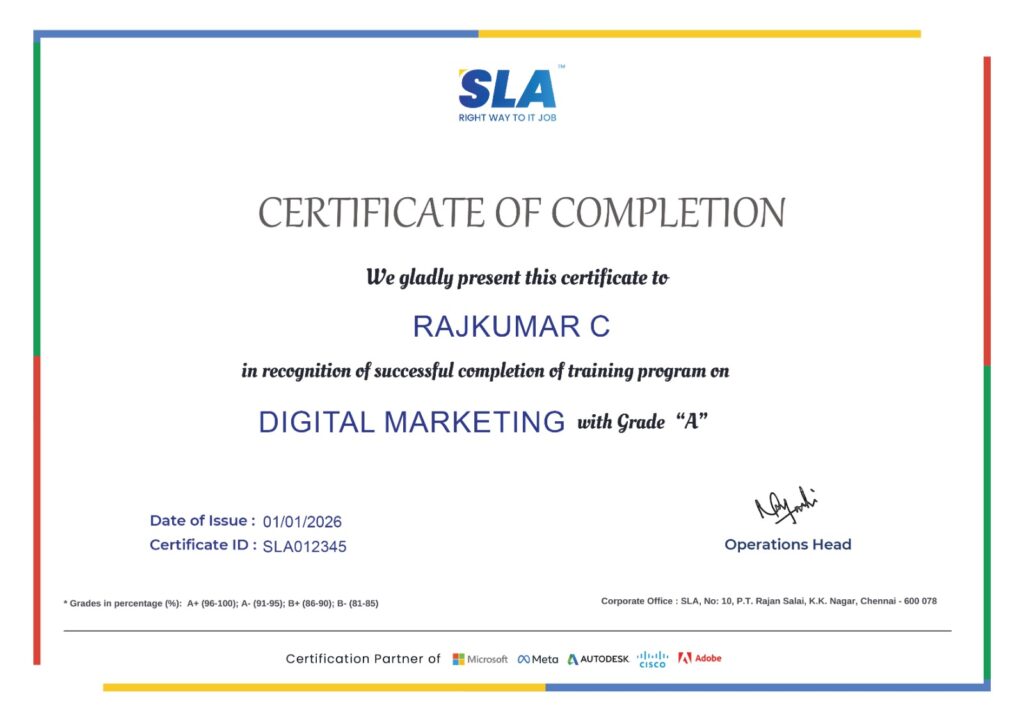
Earn Your Certificate of Completion
Validate your achievements with Softlogic's Certificate of Completion, verifying successful fulfillment of all essential components.
Take Your Career to the Next Level with Certifications
Get a certifications through our training programs to gain a competitive edge in the industry.

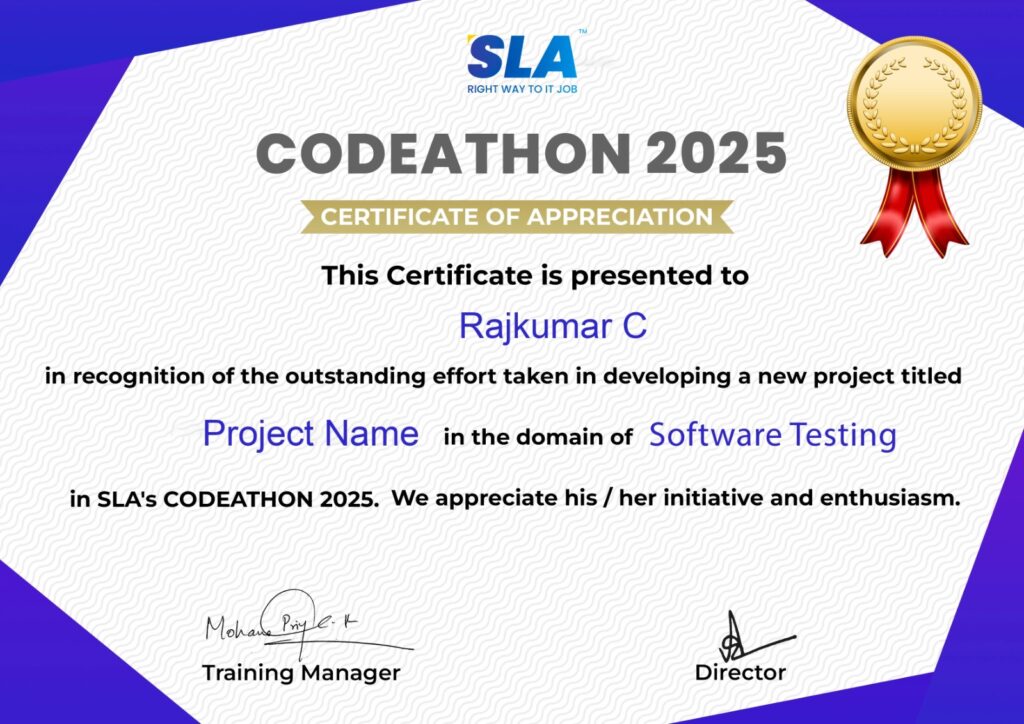
Stand Out from the Crowd with Codethon Certificate
Verify the authenticity of your real-time projects with Softlogic's Codethon certificate.
Hands-on Project Practices in Artificial Intelligence
Energy Management
Environmental Monitoring
Health Monitoring Wearables
Video Surveillance
Sentiment Analysis
Traffic Management
Fraud Detection
Smart Home Automation
Medical Image Analysis
The SLA Way to Get Placed in Top IT Companies
Enrollment

Technology Training
Coding Practices
Realtime Projects
Realtime Projects
Placement Training
Aptitude Training
Interview Skills
Interview Skills
Panel Mock
Interview

Unlimited
Interviews

Interview
Feedback

100%
IT Career
Placement Support for a Artificial Intelligence Job
Genuine Placements. No Backdoor Jobs at Softlogic Systems.
Aptitude Training
from Day 1
Interview Skills
from Day 1

Softskills Training
from Day 1
Build Your Resume

Build your LinkedIn Profile

Build your GitHub
digital portfolio

Panel Mock Interview
Unlimited Interviews until you get placed

Life Long Placement Support at no cost
Request a Free Callback
FAQs
What is the main goal of AI?
The main aim of Artificial Intelligence (AI) is to make machines smart enough to perform tasks that usually need human intelligence, like understanding speech or recognizing objects. The goal is to create AI systems that can learn, adapt, and solve problems on their own, which would help us in many ways.
Who is eligible for an AI course?
Candidates with a minimum educational qualification, such as a bachelor’s degree in any field are eligible for an AI course.
Does AI need maths?
Yes, math is important for AI. It helps develop algorithms and models that AI systems use. Understanding concepts like algebra, calculus, probability, and statistics is essential for working with AI.
What makes SLA Institute a good place to study Artificial Intelligence?
SLA Institute stands out as an excellent AI study destination, boasting expert trainers, practical learning, industry-aligned curriculum, modern facilities, and a strategic location in OMR Chennai’s IT hub.
Is Artificial Intelligence easy to learn?
Artificial Intelligence can be challenging to learn due to its complex concepts and algorithms. However, with dedication, perseverance, and the right resources, it is definitely possible to grasp and excel in AI.
How does the placement team at SLA support us?
The placement team at SLA enhances your job prospects by providing comprehensive support. Whether you’re a certified student looking to switch careers or entering the workforce for the first time, you’ll receive extensive assistance through our placement services. SLA offers the following premium services as part of our placement support:
- Resume building
- Career guidance and advising
- Interview practice sessions
- Career expos
What accreditation will I get once the course is completed?
Upon completion of SLA’s training, you will be awarded with globally recognized course completion certificates from SLA, renowned IBM certificates, and Codeathon certificates, validating your real-time project experience.
What are the different payment options available?
We accept all sort of major payment methods like cash, credit cards (Visa, Maestro, Master card), Netbanking, etc
I have more queries?
Please contact our course counselor by call or Whatsapp at +91 86818 84318. As an alternative, you can use our Website chat, Website form, or email us at enquiry@softlogicsys.in
Additional Information for
the Artificial Intelligence
Artificial Intelligence (AI) Impact:
Artificial Intelligence (AI) is advancing rapidly, with far-reaching implications for various industries. In healthcare, AI enhances medical image analysis, diagnosis, and treatment planning. AI also plays a key role in finance, detecting fraud, automating trading, and personalizing customer experiences.
AI in Transportation and Entertainment:
In transportation, AI drives the development of autonomous vehicles, promising transformative changes in mobility. In entertainment, AI enhances gaming experiences and tailors content recommendations. Overall, AI’s evolution across industries creates new opportunities for innovation and growth, making it an exciting and impactful field.
Related Blogs
Artificial Intelligence Challenges and Solutions
Published On: October 28, 2024
Introduction AI, including telecommunications, healthcare, and financial services, will impact every industry. However, incorporating AI…
Artificial Intelligence project ideas
Published On: October 19, 2024
Introduction Looking to turn your AI knowledge into practical skills? Exploring Artificial Intelligence Project Ideas…
Artificial Intelligence Salary in Chennai
Published On: September 12, 2024
Introduction In the ever-changing landscape of global technology, Artificial Intelligence Engineers are the key innovators.…
Artificial Intelligence Interview Questions and Answers
Published On: April 27, 2019
Introduction Artificial Intelligence is a field in computer science that deals with building systems that…
Google Reviews

Rating
4.8
1,053 Google reviews

Shaaru Menan
I had a 3 year career break. Joined SLA on Java Full Stack course and completed it.Did projects with the help of my Mentor. They…

Click here for Full Review

SARAN M
SLA Institute provides training in communication and aptitude along with strong technical skills. The trainers explain concepts clearly with a practical approach, which helps build…
Click here for Full Review

NalluKumar Ravichandran
Hi, I recently completed the DOT NET Full Stack Development course at SLA, and I had a great learning experience. The teaching style and student…
Click here for Full Review

Nithish Sahoo
I had an excellent experience taking this DevOps course. The curriculum is well-structured and covers both fundamental and advanced DevOps concepts in a clear manner.…
Click here for Full Review

MATHAN KUMAR G EEE
SLA Institute provides a structured learning environment for data analytics. The syllabus is relevant, and trainers are knowledgeable. Some sessions were very useful practically, while…
Click here for Full Review

Surya
Special thanks to Vishal Sir, the Placement Officer, for his interview guidance, resume support, and continuous motivation throughout the placement process. I would also like…
Click here for Full Review