
Softlogic is one of the Top Training institutes for SAS. Learn how to use SAS, from beginner basics to advanced techniques. Our SAS syllabus covers SAS programming, data manipulation, statistical procedures, reporting, data visualization, and predictive modeling. We offer an SAS Course with Placement Assistance, Mock interviews, Resume building, and certification.
SAS Certification Course
4.90
(3021)
DURATION

1 Month
EMI
0% Interest
Mode

Live Online / Offline

Let's take the first step to becoming an expert in SAS
Click Here to Get Started
Lifelong Placement
Assistance
Get Certified
JOB PLACEMENT ELIGIBILITY TEST
×
Your Placement Eligibility Report
Want more details about SAS?
Fill out the form, and our counsellors will get in touch with you at your preferred time. You can have all your queries answered. Once you decide that SLA is the perfect fit for your training needs, our counselors will guide you through the process every step of the way.

Course Schedules

Course Syllabus

Course Fees

or any other questions...
Fees, Duration & Batch Timings for SAS
Hands On Training
3-5 Real Time Projects
60-100 Practical Assignments
3+ Assessments / Mock Interviews
July 2026
Week days
(Mon-Fri)
Online/Offline
2 Hours Real Time Interactive Technical Training
1 Hour Aptitude
1 Hour Communication & Soft Skills
(Suitable for Fresh Jobseekers / Non IT to IT transition)
Course Fee
July 2026
Week ends
(Sat-Sun)
Online/Offline
4 Hours Real Time Interactive Technical Training
(Suitable for working IT Professionals)
Course Fee
Save up to 20% in your Course Fee on our Job Seeker Course Series
Learn More
Syllabus of SAS
Download Syllabus
BASE SAS
- Introduction of SAS System & Architecture
- History and Various Modules of SAS
- Features of SAS
- Variables & SAS Syntax Rules
- SAS Data Sets
- Data Set Options
- Operators
- Reading Raw Data
- Infile Statement With Options
- Working with External Files & Options
- Multiple Observations
- Input Styles
- Select Statement
- Leave and Continue Statements
- Creating & Redefining Variables
- Where Statement
- If – Then Else Statement
- Goto, Stop And Error Statements
- Output Statement, Put Statement
- Do Loops
- Modifying And Combining Data Sets
- Updating Master Data Set
- Display Manager Commands
- SAS Functions
- An Introduction to Arrays and Array Processing
- Overview Of Methods for Combining SAS Data Sets
BASE SAS PROCEDURES
- Proc Sort
- Proc Print
- Proc Means
- Proc Freq
- Proc Plot
- Proc Chart
- Proc Copy
- Proc Summary
- Proc Append
- Proc Datasets
- Proc Contents
- Proc Delete
- Proc Format
- Proc Import
- Proc Export
SAS/SQL
- Introduction of SAS/ SQL
- Features of SAS/SQL
- Uses of SQL in SAS
- Terminology of SAS/SQL
- Data Types, Key Words, & Operators
- Functions, Predicates
- Formatting Output
- Group by Clause
- Order by Clause
- Having Clause
- Case Expression and Conditional Logic.
- Creating, Populating & Deleting Tables
- Alter Table Statement
- Changing Column’s Length
- Joins
- Constraints
- Renaming A Table & Columns
- Views
SAS/MACROS
- Macro Concepts
- Macros And Macro Variables
- Creating Macro Variables
- Using Macro Variables
- Creating Modular Code With Macros
- Invoking A Macro
- Adding Parameters To Macros
- Macros With Conditional Logic
- Using Various Procedures In Macros
- Automatic Variables
- Macro Functions
- Including External Macros
SAS/ODS
- Creating RTF File
- Creating Html File
- Creating PDF File
SAS/GRAPH
- Chart Procedure
- Vertical, Horizontal, Pie
- Group, Subgroups
- Plot Procedure
- Multiple Plots & Overlay
- Symbol Statement
- Title And Footnote Statements
SAS/REPORTS
- Frequency Report
- One-Way Frequency Report
- Cross Tabular Frequency Report
- Summary Statistics
- Creating a List Report
- Define Statement
- Order Usage and Group
- Printing Grand Totals
- Re-break Statement
- Tabulate Procedure
- One-Dimensional Tables
- Two-Dimensional Tables
- Obtaining A Total
- Analysis Variables with options
- Summary Statistics
SAS/STAT
- Proc Univariate
- Proc Corr
- Proc Reg
- Proc Anova
Objectives of SAS
The objectives of learning SAS training include
- Understanding of features, fundamental ideas, and functionality of the SAS system.
- Acquire knowledge of SAS dataset structure and syntactic guidelines to get ready for more complex programming.
- Become an expert in creating and submitting SAS programs, handling errors during compilation and execution, and the DATA phase.
- Gain the ability to sort datasets to make data analysis easier and to generate basic reports using PROC steps.
- How to manipulate data by applying SAS functions, using If-Then logic, and creating new variables.
Request a Free Callback
Why Softlogic Systems is the Best Choice for SAS – Learn, Practice, and Get Placed!

Online & Offline Training Options
Learn at your convenience with flexible classroom and live online training.

Learn from 100+ Real-Time Developers
Get trained by industry professionals with years of hands-on experience.

Hands-on Projects & Codeathons
Practice with real-time projects and coding challenges to build confidence.
0% EMI Fee Options
Pay your course fees flexibly with easy EMI plans at zero interest.

Resume & Interview Support
Get expert help with resume building, mock interviews, and soft skills.

Placement with Top IT Firms
Access placement opportunities with leading MNCs and IT companies.

1000+ Hiring Partners
Benefit from Softlogic’s strong recruiter network for faster job placement.

No Backdoor Jobs
We ensure only genuine placement opportunities with trusted companies.
Request a Free Callback
Highlights of SAS
What is SAS?
SAS employs in corporate intelligence, data management, and advanced analytics. SAS analytics software is utilized by various industries, including retail, healthcare, and finance.
What are the reasons for learning SAS?
Learning SAS is beneficial for several reasons:
- In-demand skills: SAS proficiency is necessary for many in-demand roles, including business analyst and data scientist.
- Data management and statistical analysis: SAS is a programming language that’s frequently used for these tasks.
- Data manipulation: SAS abilities can assist you in learning how to integrate data sets, discover and fix mistakes, and modify and transform data.
- Predictive modeling: SAS can assist organizations in making predictions based on historical data.
What are the prerequisites for learning SAS?
There are no requirements to enroll in our SAS course. Nonetheless, mastering SQL Fundamentals thoroughly will hasten your advancement through the SAS Training Course.
Our SAS course is suitable for:
- Students
- Professionals seeking a career change
- IT professionals aiming to enhance their skills
- Enthusiastic programmers
- Job Seekers
What are the course fees and duration?
Our SAS training cost ranges from ₹25,000 to ₹50,000 based on the course level (basic, intermediate, or advanced) and format (online or in person). Generally, the SAS course duration is approximately 2 months and includes certification upon completion. For accurate details concerning fees, duration, and certification, we suggest reaching out to our SAS training institute directly.
What are some job roles related to SAS?
The following are a few SAS (Statistical Analysis System)-related jobs:
- Statistical Analyst
- Data Analyst
- Data Manager
- Market Research Analyst
- Business Analyst
- Data Engineer
What is the salary range for a SAS professional?
The average annual salary for a fresh SAS developer with less than three years of experience is ₹3 to ₹4 lakhs. An experienced SAS developer with 10–20 years of experience earns ₹25 lakhs annually, compared to an ordinary SAS developer with 4-6 years of experience who makes ₹11 lakhs.
List a few SAS programming real-time applications.
The statistical analysis system, or SAS, has numerous real-time uses in a variety of fields.
- Manufacturing: SAS provides real-time supply chain optimization, maintenance, and quality control.
- Energy: SAS keeps a real-time eye on maintenance, power grids, and energy usage.
- Retail: SAS segments customers, controls inventories, and estimates sales in real-time.
- Transportation: SAS provides real-time route optimization, fleet management, and transportation analytics.
- Marketing: SAS targets marketing in real-time, monitors campaigns, and assesses sentiment.
- IoT: SAS makes educated decisions by analyzing data in real-time from IoT devices.
Boost Your Skills with Our SAS Experts
Our Mentors are from Top Companies like:
- Our trainers have been working with SAS for more than 10 years.
- They are certified SAS-based programmers with experience in business intelligence and predictive analytics.
- They are experts in Web analytics, clustering techniques, data warehousing, data modeling, and statistical analysis.
- They have extensive knowledge of numerous statistical techniques, including descriptive analytics, predictive analytics, hypothesis testing, and experimental design.
- They also have hands-on expertise with machine learning technologies, such as SAS Text Miner, Enterprise Miner, and Minitab.
- They have worked with SAS coding tools such as SAS Enterprise Miner, SAS Data Integration Studio, SAS/IML Studio, and Enterprise Guide before.
- They are skilled in creating SAS programs for database import, export, joining, and updating, as well as data cleaning and manipulation.
Request a Free Callback
What Modes of Training are available for SAS?
Offline / Classroom Training

A Personalized Learning Experience with Direct Trainer Engagement!
- Direct Interaction with the Trainer
- Clarify doubts then and there
- Airconditioned Premium Classrooms and Lab with all amenities
- Codeathon Practices
- Direct Aptitude Training
- Live Interview Skills Training
- Direct Panel Mock Interviews
- Campus Drives
- 100% Placement Support
Online Training

Instructor Led Live Training! Learn at the comfort of your home
- No Recorded Sessions
- Live Virtual Interaction with the Trainer
- Clarify doubts then and there virtually
- Live Virtual Interview Skills Training
- Live Virtual Aptitude Training
- Online Panel Mock Interviews
- 100% Placement Support
Corporate Training

Blended Delivery model (both Online and Offline as per Clients’ requirement)
- Industry endorsed Skilled Faculties
- Flexible Pricing Options
- Customized Syllabus
- 12X6 Assistance and Support
GET Free Consultation
Certifications
Take your career to new heights with Softlogic's software training certifications.
Improve your abilities to get access to rewarding possibilities
Improve your abilities to get access to rewarding possibilities

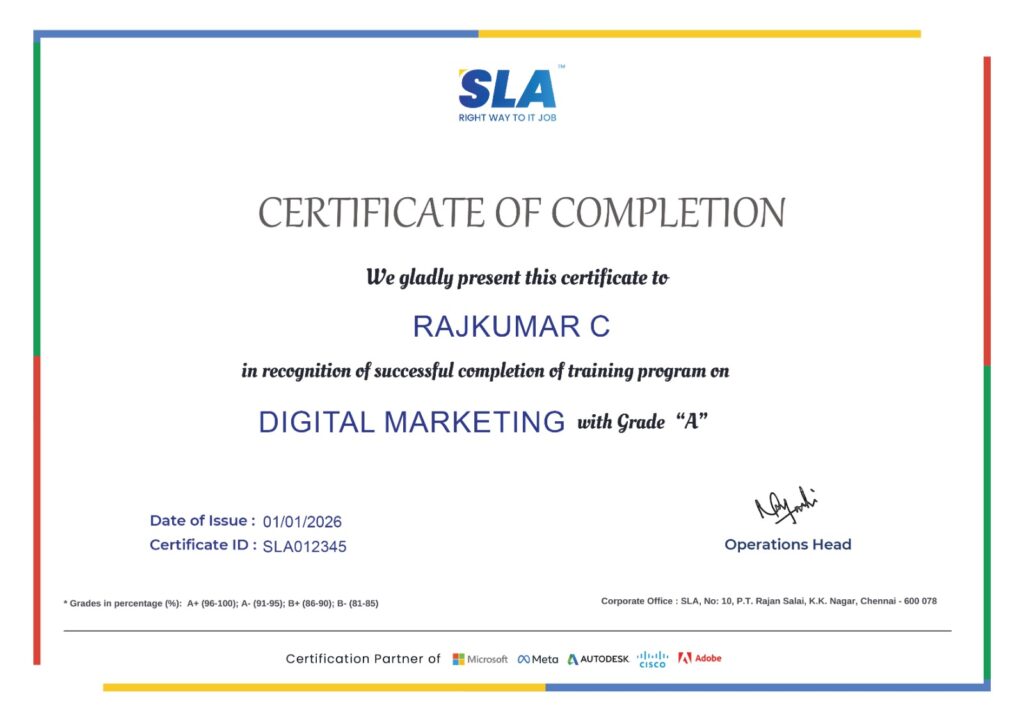
Earn Your Certificate of Completion
Validate your achievements with Softlogic's Certificate of Completion, verifying successful fulfillment of all essential components.
Take Your Career to the Next Level with Certifications
Get a certifications through our training programs to gain a competitive edge in the industry.

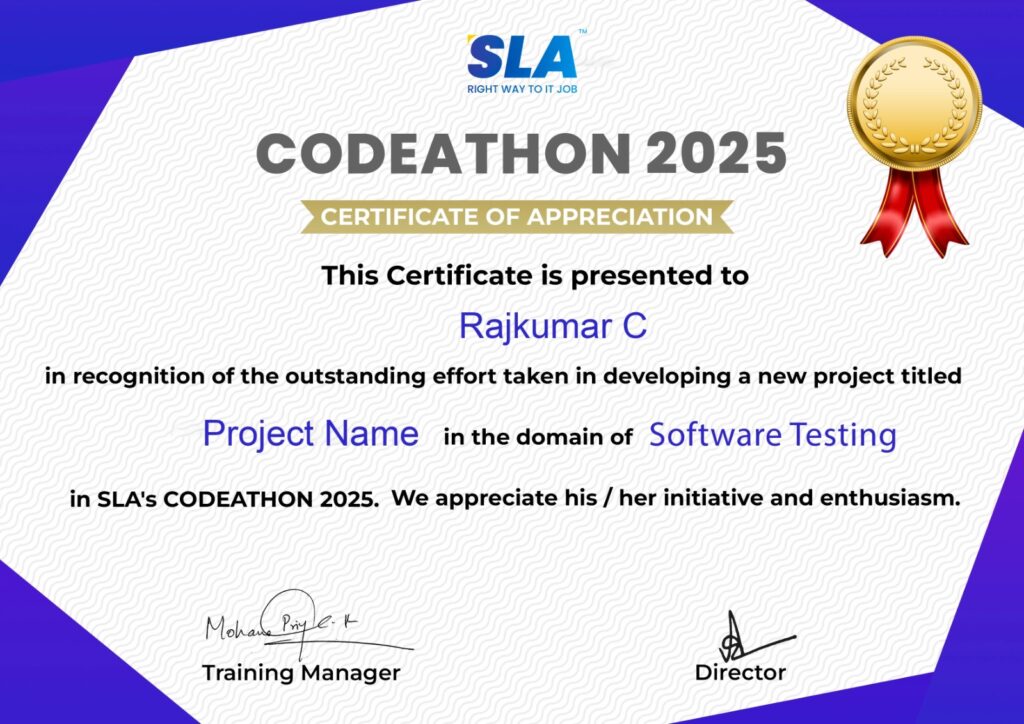
Stand Out from the Crowd with Codethon Certificate
Verify the authenticity of your real-time projects with Softlogic's Codethon certificate.
Hands-on Project Practices in SAS
Operational Risk Analysis
Web Analytics
Social Networks Analysis
Influencer Evaluation
Cost Reduction
Credit Scoring
Data Quality System
Demand Forecasting
Predictive Maintenance
The SLA Way to Get Placed in Top IT Companies
Enrollment

Technology Training
Coding Practices
Realtime Projects
Realtime Projects
Placement Training
Aptitude Training
Interview Skills
Interview Skills
Panel Mock
Interview

Unlimited
Interviews

Interview
Feedback

100%
IT Career
Placement Support for a SAS Job
Genuine Placements. No Backdoor Jobs at Softlogic Systems.

Aptitude Training
from Day 1
Interview Skills
from Day 1

Softskills Training
from Day 1
Build Your Resume

Build your LinkedIn Profile

Build your GitHub
digital portfolio

Panel Mock Interview
Unlimited Interviews until you get placed

Life Long Placement Support at no cost
Request a Free Callback
FAQs
What is SAS?
For data management, advanced analytics, multivariate analysis, corporate intelligence, criminal investigation, and predictive analytics, SAS is a statistical software package produced by the SAS Institute.
What is the SAS tool used for?
SAS is a command-driven software application used for data visualization and statistical analysis. Only Windows operating systems can use it. It is undoubtedly one of the statistical software programs that is utilized the most in both business and education.
Is SAS similar to SQL?
Given that they are both stored programs of the member type VIEW, SAS/ACCESS views, and DATA step views resemble PROC SQL views. The data in DBMS tables from different software manufacturers is described via SAS/ACCESS views.
Is SAS easy to learn?
For those who are familiar with SQL, SAS offers straightforward options (PROC SQL), making it an easy language to master. Other than that, the repository’s encrypted GUI interface is excellent.
Is coding required for SAS?
You don’t need any prior knowledge of coding. Your commitment is the only requirement for studying SAS.
Is SAS still in demand?
The need for people with analytics skills has already exceeded supply. Understanding SAS is an excellent way to secure your future if you’re a student or an independent learner.
How long does it take to learn SAS for a beginner?
It may take 3 to 4 months, with the right commitment and training.
What happens if I miss a SAS course session?
SLA trainers promise that not a single SAS training class will be missed. We will assign substitute SAS classes to those who missed the classes and gave advance notice.
I still have some questions about joining the SAS course at SLA.
Kindly contact our SAS course advisor via WhatsApp or at +91 86818 84318. As an alternative, you can contact us by chat on our website, email enquiry@softlogicsys.in, or through our contact form.
What are the possible payment methods at SLA for SAS training?
We take cash, credit cards (Visa, Maestro, Mastercard), Netbanking, and other major payment options for SAS training at SLA.
Additional Information for
the SAS
Future Prospects of SAS
SAS has a promising future filled with numerous chances for individuals across multiple industries:
- Clinical SAS: The need for clinical SAS specialists is rising as India develops into a center for clinical research.
- Healthcare: Biostatistics, epidemiology, and clinical data management are just a few of the specializations available to SAS programmers.
- Insurance: Actuarial analysis, claims processing, client segmentation, and pricing models are all handled by insurance companies using SAS.
- Finance: SAS is used by financial institutions for consumer analytics, fraud detection, and risk management.
Important SAS Features:
SAS is a powerful data analysis tool with an abundance of useful features. Among SAS’s most crucial characteristics are the following:
- Data analysis: SAS can extract, analyze, and report data with good data analysis capabilities.
- SAS is used for data preparation: Time spent on preliminary tasks is saved by data preparation. SQL or coding knowledge is not necessary.
- Code editing: SAS provides a facility for code editing.
- 4GL SAS Studio: The 4 Generation Programming Language (4GL) in SAS is highly versatile.
- Data encryption algorithm: An algorithm for data encryption exists in SAS.
SAS Certification Value
Numerous advantages of obtaining an SAS certification include:
- Wider career access: Since SAS is a widely used analytics tool, obtaining a certification can demonstrate to potential employers your skills, which can be used in a variety of professions.
- Greater earning potential: A promotion or pay raise is received by 64% of professionals holding an IT certification.
- Improved analytical abilities: Having an SAS certification lets you concentrate on statistical analysis and data management.
- Confidence boost: 92% of people with SAS certifications say they feel more assured in their skills.
- Digital badge: You can use the digital badge you get after passing the certification to prove your accomplishment online.
Additional advantages of SAS certification include receiving job opportunity communications, showcasing your successes, and proving your abilities.
Related Blogs
SAS Challenges For Beginners
Published On: November 4, 2024
Introduction SAS, short for Statistical Analysis System, is an extensive software package designed for advanced…
SAS Project Ideas
Published On: October 28, 2024
Learning SAS becomes more effective when students practice with real projects. SAS skills like data…
SAS Developer Salary for Freshers and Experienced
Published On: October 9, 2024
Introduction In the current scenario, where data is the driver, SAS skill sets remain a…
SAS Tutorial for Beginners
Published On: October 4, 2024
Introduction Ready to learn data analysis but daunted by complicated software? SAS (Statistical Analysis System)…
Top 20+ SAS Interview Questions and Answers
Published On: June 14, 2024
Introduction Potential employers frequently ask you questions to gauge your comfort level with SAS when…


Google Reviews

Rating
4.8
1,053 Google reviews

Shaaru Menan
I had a 3 year career break. Joined SLA on Java Full Stack course and completed it.Did projects with the help of my Mentor. They…

Click here for Full Review

SARAN M
SLA Institute provides training in communication and aptitude along with strong technical skills. The trainers explain concepts clearly with a practical approach, which helps build…
Click here for Full Review

NalluKumar Ravichandran
Hi, I recently completed the DOT NET Full Stack Development course at SLA, and I had a great learning experience. The teaching style and student…
Click here for Full Review

Nithish Sahoo
I had an excellent experience taking this DevOps course. The curriculum is well-structured and covers both fundamental and advanced DevOps concepts in a clear manner.…
Click here for Full Review

MATHAN KUMAR G EEE
SLA Institute provides a structured learning environment for data analytics. The syllabus is relevant, and trainers are knowledgeable. Some sessions were very useful practically, while…
Click here for Full Review

Surya
Special thanks to Vishal Sir, the Placement Officer, for his interview guidance, resume support, and continuous motivation throughout the placement process. I would also like…
Click here for Full Review