
Join Our 100% Job-Guaranteed Oracle PL/SQL Course in OMR. We Provide Quality Oracle PL/SQL training with an affordable Cost in OMR. Our Oracle PL/SQL syllabus covers the PL/SQL architecture, variables & data types, cursors, exceptions, procedures, functions, packages, and triggers. At Softlogic Systems, you’ll earn globally recognized certifications, build real-time projects, and receive complete placement assistance to launch a successful career in your chosen field.
Oracle Pl Sql Training In Omr
DURATION
2 Months
EMI
0% Interest
Mode
Live Online / Offline
Let's take the first step to becoming an expert in Oracle PL/SQL
100% Placement
Assurance
Get Certified
JOB PLACEMENT ELIGIBILITY TEST
Your Placement Eligibility Report
Want more details about Oracle PL/SQL Course?
Course Schedules
Course Syllabus
Course Fees
or any other questions...
Fees, Duration & Batch Timings for Oracle PL/SQL Course
Hands On Training
3-5 Real Time Projects
60-100 Practical Assignments
3+ Assessments / Mock Interviews
June 2026
Week days
(Mon-Fri)
Online/Offline
2 Hours Real Time Interactive Technical Training
1 Hour Aptitude
1 Hour Communication & Soft Skills
(Suitable for Fresh Jobseekers / Non IT to IT transition)
June 2026
Week ends
(Sat-Sun)
Online/Offline
4 Hours Real Time Interactive Technical Training
(Suitable for working IT Professionals)
Save up to 20% in your Course Fee on our Job Seeker Course Series
Syllabus of Oracle PL/SQL Course
Introduction to Oracle Database
- List the features of Oracle Database 12c
- Discuss the basic design, theoretical, and physical aspects of a relational database
- Categorize the different types of SQL statements
- Describe the data set used by the course
- Log on to the database using SQL Developer environment
- Save queries to files and use script files in SQL Developer
Retrieve Data using the SQL SELECT Statement
- List the capabilities of SQL SELECT statements
- Generate a report of data from the output of a basic SELECT statement
- Select All Columns
- Select Specific Columns
- Use Column Heading Defaults
- Use Arithmetic Operators
- Understand Operator Precedence
- Learn the DESCRIBE command to display the table structure
Learn to Restrict and Sort Data
- Write queries that contain a WHERE clause to limit the output retrieved
- List the comparison operators and logical operators that are used in a WHERE clause
- Describe the rules of precedence for comparison and logical operators
- Use character string literals in the WHERE clause
- Write queries that contain an ORDER BY clause to sort the output of a SELECT statement
- Sort output in descending and ascending order
Usage of Single-Row Functions to Customize Output
- Describe the differences between single row and multiple row functions
- Manipulate strings with character function in the SELECT and WHERE clauses
- Manipulate numbers with the ROUND, TRUNC, and MOD functions
- Perform arithmetic with date data
- Manipulate dates with the DATE functions
Invoke Conversion Functions and Conditional Expressions
- Describe implicit and explicit data type conversion
- Use the TO_CHAR, TO_NUMBER, and TO_DATE conversion functions
- Nest multiple functions
- Apply the NVL, NULLIF, and COALESCE functions to data
- Use conditional IF THEN ELSE logic in a SELECT statement
Aggregate Data Using the Group Functions
- Use the aggregation functions to produce meaningful reports
- Divide the retrieved data in groups by using the GROUP BY clause
- Exclude groups of data by using the HAVING clause
Display Data From Multiple Tables Using Joins
- Write SELECT statements to access data from more than one table
- View data that generally does not meet a join condition by using outer joins
- Join a table to itself by using a self-join
Use Sub-queries to Solve Queries
- Describe the types of problem that sub-queries can solve
- Define sub-queries
- List the types of sub-queries
- Write single-row and multiple-row sub-queries
The SET Operators
- Describe the SET operators
- Use a SET operator to combine multiple queries into a single query
- Control the order of rows returned
Data Manipulation Statements
- Describe each DML statement
- Insert rows into a table
- Change rows in a table by the UPDATE statement
- Delete rows from a table with the DELETE statement
- Save and discard changes with the COMMIT and ROLLBACK statements
- Explain read consistency
Use of DDL Statements to Create and Manage Tables
- Categorize the main database objects
- Review the table structure
- List the data types available for columns
- Create a simple table
- Decipher how constraints can be created at table creation
- Describe how schema objects work
Other Schema Objects
- Create a simple and complex view
- Retrieve data from views
- Create, maintain, and use sequences
- Create and maintain indexes
- Create private and public synonyms
Control User Access
- Differentiate system privileges from object privileges
- Create Users
- Grant System Privileges
- Create and Grant Privileges to a Role
- Change Your Password
- Grant Object Privileges
- How to pass on privileges?
- Revoke Object Privileges
Management of Schema Objects
- Add, Modify, and Drop a Column
- Add, Drop, and Defer a Constraint
- How to enable and Disable a Constraint?
- Create and Remove Indexes
- Create a Function-Based Index
- Perform Flashback Operations
- Create an External Table by Using ORACLE_LOADER and by Using ORACLE_DATAPUMP
- Query External Tables
Manage Objects with Data Dictionary Views
- Explain the data dictionary
- Use the Dictionary Views
- USER_OBJECTS and ALL_OBJECTS Views
- Table and Column Information
- Query the dictionary views for constraint information
- Query the dictionary views for view, sequence, index and synonym information
- Add a comment to a table
- Query the dictionary views for comment information
Manipulate Large Data Sets
- Use Subqueries to Manipulate Data
- Retrieve Data Using a Subquery as Source
- Insert Using a Subquery as a Target
- Usage of the WITH CHECK OPTION Keyword on DML Statements
- List the types of Multitable INSERT Statements
- Use Multitable INSERT Statements
- Merge rows in a table
- Track Changes in Data over a period of time
Data Management in different Time Zones
- Time Zones
- CURRENT_DATE, CURRENT_TIMESTAMP, and LOCALTIMESTAMP
- Compare Date and Time in a Session’s Time Zone
- DBTIMEZONE and SESSIONTIMEZONE
- Difference between DATE and TIMESTAMP
- INTERVAL Data Types
- Use EXTRACT, TZ_OFFSET and FROM_TZ
- Invoke TO_TIMESTAMP,TO_YMINTERVAL and TO_DSINTERVAL
Retrieve Data Using Sub-queries
- Multiple-Column Subqueries
- Pairwise and Non-pairwise Comparison
- Scalar Subquery Expressions
- Solve problems with Correlated Subqueries
- Update and Delete Rows Using Correlated Subqueries
- The EXISTS and NOT EXISTS operators
- Invoke the WITH clause
- The Recursive WITH clause
Regular Expression Support
- Use the Regular Expressions Functions and Conditions in SQL
- Use Meta Characters with Regular Expressions
- Perform a Basic Search using the REGEXP_LIKE function
- Find patterns using the REGEXP_INSTR function
- Extract Substrings using the REGEXP_SUBSTR function
- Replace Patterns Using the REGEXP_REPLACE function
- Usage of Sub-Expressions with Regular Expression Support
- Implement the REGEXP_COUNT function
Introduction to PL/SQL
- Overview of PL/SQL
- Identify the benefits of PL/SQL Subprograms
- Overview of the types of PL/SQL blocks
- Create a Simple Anonymous Block
- How to generate output from a PL/SQL Block?
Objectives of Oracle PL/SQL Training
The following are the learning outcomes of the Oracle PL/SQL course in OMR:
- Learn the advantages of writing stored procedures in Oracle PL/SQL to modularize code.
- Knowledge of data types, variables, and control structures to enable iterative execution in PL/SQL codes
- Ability to write SQL statements for transactions and data retrieval within PL/SQL blocks.
- To manage complex data structures with ease, make use of composite data types like records.
- Knowledge of explicit cursor properties and management
- The capacity to effectively manage exceptions is needed to create reliable and error-free PL/SQL applications that can handle a range of scenarios.
- Recognizing the advantages of PL/SQL packages in terms of visibility, persistent state, and other features.
- Use the Oracle-supplied packages to implement dynamic SQL for runtime generation.
- PL/SQL compilation knowledge to control object dependencies.
- practical experience in maximizing PL/SQL performance for debugging and trigger implementation.
Why Softlogic Systems is the Best Choice for Oracle PL/SQL Training – Learn, Practice, and Get Placed!
Online & Offline Training Options
Learn from 100+ Real-Time Developers
Hands-on Projects & Codeathons
0% EMI Fee Options
Resume & Interview Support
Placement with Top IT Firms
1000+ Hiring Partners
No Backdoor Jobs
Highlights of Oracle PL/SQL Course
What is PL/SQL in Oracle?
The syntax of the procedural language PL/SQL was designed specifically to enable SQL statements. On the Oracle Database server, PL/SQL program units are compiled and stored. Learn further in our Oracle PL/SQL course in OMR.
What are the reasons for learning Oracle PL/SQL?
The following are some reasons for learning Oracle PL/SQL:
- PL/SQL and SQL are tightly connected.
- It provides thorough mistake checking.
- It provides a wide range of data kinds.
- A range of programming structures are available.
- It facilitates organized programming using functions and procedures.
- It supports OOPs (object-oriented programming)
- It facilitates the creation of server pages and web applications.
What are the prerequisites for learning the Oracle PL/SQL course in OMR?
There are no hard prerequisites for beginners to learn Oracle PL/SQL. However, a fundamental understanding of the following enriches the learning experience.
- Basic SQL queries
- Knowledge of the INSERT, UPDATE, DELETE, and SELECT statements in data manipulation language (DML)
- Knowledge of the principles of syntax, programming logic, or general programming experience
- Knowledge of functions in DBMS (Database Management System).
Our Oracle PL/SQL course in OMR is suitable for:
- Students/Freshers
- Working professionals seeking a career change
- Any Job Seekers
What are some job roles related to the Oracle PL/SQL course?
Mastery of Oracle PL/SQL opens you to a wide range of job opportunities in database administration and application development. Some of the jobs include:
- PL/SQL Developer
- Application Developer
- Data Analyst
- Data Engineer
- Data Architect
- System Analyst
- Software Engineer
What is the salary range for Oracle PL/SQL professionals?
With 2 to 6 years of expertise, the Oracle PL/SQL Developer Salary in India is between ₹4.1 lakhs and ₹11.9 lakhs annually. Join our Oracle PL/SQL certification training in OMR to get high-paying jobs in database administration.
List a few Oracle PL/SQL real-time applications.
Some of the real-time Oracle PL/SQL applications for data processing are:
- Financial Systems
- E-Commerce Platforms
- Healthcare Information Systems
- Supply Chain Management
- Emergency Response Systems
- Online Gaming.
Boost Your Skills with Our Oracle PL/SQL Training Experts
Our Mentors are from Top Companies like:
- Our Oracle PL/SQL trainers are experts in the field of Oracle PLSQL with extensive expertise.
- They have extensive understanding of and practical experience with a variety of Oracle PLSQL tools and methods.
- Our trainers put a lot of effort into teaching learners useful skills by using case studies and actual situations and they have 15+ years of experience in this field.
- They are skilled in breaking down the fundamentals of PLSQL programming for pupils step-by-step.
- The Oracle Database’s many features, such as PL/SQL, SQL, procedures, triggers, functions, packages, indexing, and more, are well-versed in by our PLSQL teachers.
- Our instructors instruct students on how to use Oracle’s features and functionality to create sophisticated applications efficiently.
- Their cooperative manner and optimistic outlook enable learners to acquire Oracle PLSQL, get ready for interviews, and ace them with ease.
What Modes of Training are available for Oracle PL/SQL Course?
Offline / Classroom Training
- Direct Interaction with the Trainer
- Clarify doubts then and there
- Airconditioned Premium Classrooms and Lab with all amenities
- Codeathon Practices
- Direct Aptitude Training
- Live Interview Skills Training
- Direct Panel Mock Interviews
- Campus Drives
- 100% Placement Support
Online Training
- No Recorded Sessions
- Live Virtual Interaction with the Trainer
- Clarify doubts then and there virtually
- Live Virtual Interview Skills Training
- Live Virtual Aptitude Training
- Online Panel Mock Interviews
- 100% Placement Support
Corporate Training
- Industry endorsed Skilled Faculties
- Flexible Pricing Options
- Customized Syllabus
- 12X6 Assistance and Support
Certifications
Improve your abilities to get access to rewarding possibilities
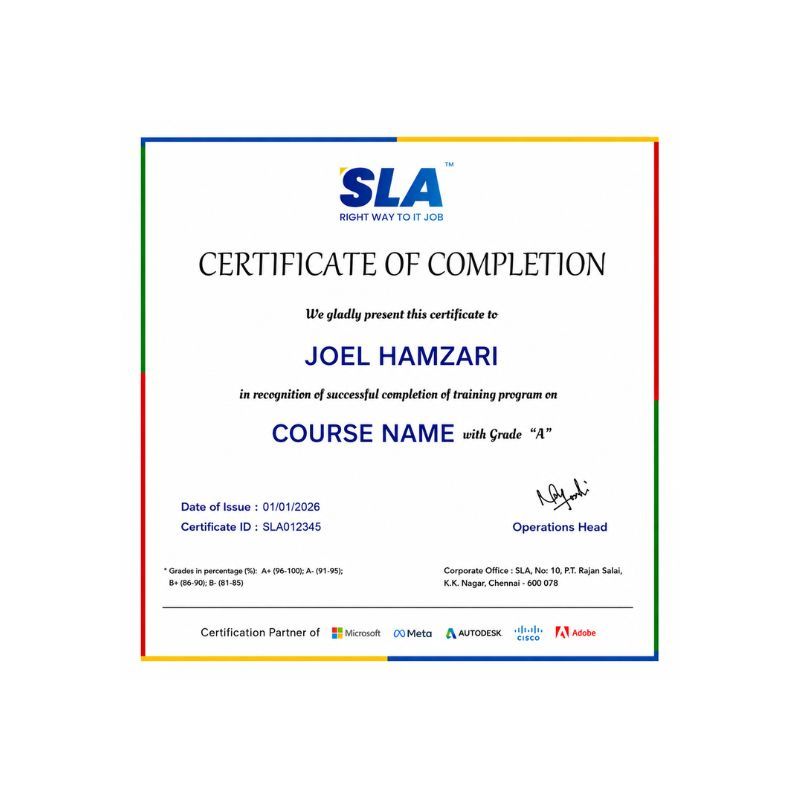
Earn Your Certificate of Completion
Take Your Career to the Next Level with Certifications
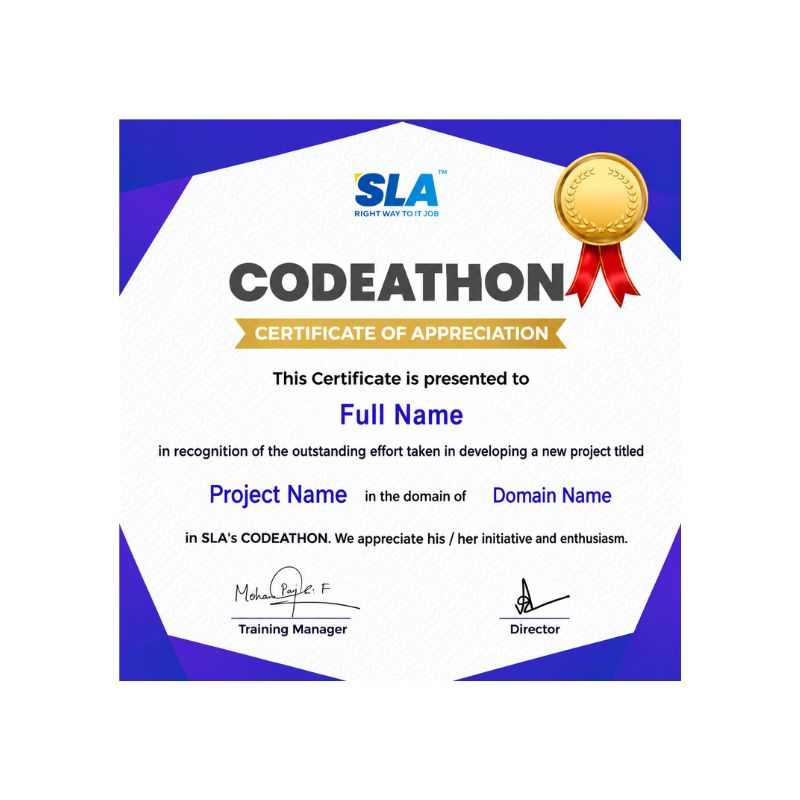
Stand Out from the Crowd with Codethon Certificate
Hands-on Project Practices in Oracle PL/SQL Course
Customer Loyalty App
Centralized College System
Online Retail Application Database
Inventory Control Management
Remote Server Monitoring System
Blood Donation Database
Cooking Recipe App
Carbon Emissions Calculator
Voice-based transport inquiry
The SLA Way to Get Placed in Top IT Companies
Enrollment
Technology Training
Realtime Projects
Placement Training
Interview Skills
Panel Mock
Interview
Unlimited
Interviews
Interview
Feedback
100%
IT Career
Placement Support for a Oracle PL/SQL Job
Genuine Placements. No Backdoor Jobs at Softlogic Systems.
Aptitude Training
from Day 1
Interview Skills
from Day 1
Softskills Training
from Day 1
Build Your Resume
Build your LinkedIn Profile
Build your GitHub
digital portfolio
Panel Mock Interview
Unlimited Interviews until you get placed
Life Long Placement Support at no cost
FAQs
What is Oracle PL/SQL?
A procedural language called PL/SQL was created expressly to support SQL statements in its syntax. To learn more, enroll in our Oracle PL/SQL training in OMR at SLA.
What is PL SQL used for?
You can combine procedural constructs and SQL statements with PL/SQL. Procedures, functions, and packages are examples of PL/SQL program units that can be created and executed using the language. Get hands-on exposure through our Oracle PL/SQL training in OMR.
Is PL SQL for Oracle still in use?
PL. SQL is a fundamental language used in many Oracle systems, and it is not dead and won’t be in a few decades either.
Is PL SQL good for my career?
Yes, having an understanding of Oracle PL SQL can help you in your work. One could pursue a career in database development, data analysis, or database management and maintenance.
What distinguishes T SQL from PL SQL?
- Procedural Language Extensions to SQL is what PL SQL essentially stands for. This is an extension of Oracle’s Structured Query Language (SQL).
- T-SQL, however, essentially stands for “Transact-SQL.” This is Microsoft’s extension for the Structured Query Language (SQL).
Is Oracle PL/SQL easy?
It has several built-in security features and out-of-the-box optimizations, and it is simple to create and read. Gain expertise in our Oracle PL/SQL training institute in OMR.
How long does it take to learn an Oracle PL/SQL course in OMR?
Oracle PL/SQL training in OMR can take 2 to 3 months, depending on your commitment. Many beginners can pick up the fundamentals of Oracle PL/SQL within a few days, but to get comfortable with the system, they need regular practice.
Does SLA provide placement support with the Oracle PL/SQL course in OMR?
Yes, we help our students get into various jobs through our Oracle PL/SQL course in OMR. To assist you in beginning your job search, we offer extra tools like recruiting drives, practice interviews, and interview preparation classes in our Oracle PL/SQL training institute in OMR.
What kind of payment methods does SLA accept for Oracle PL/SQL courses in OMR?
Payments in cash, checks, cards, and UPI payments of any form are all accepted in our Oracle PL/SQL course in OMR.
How many branches of SLA are there?
SLA is located in two places: K.K. Nagar and OMR, Navalur.
Additional Information for
the Oracle PL/SQL Course
Top Trends in Oracle PL/SQL
- Using Oracle Cloud, a technological stack consolidation can lower IT costs.
- Systems Engineered by Oracle: Data center simplification and consolidation
- Big Data: Businesses’ next big thing
Latest Features of Oracle PL/SQL
With Oracle PL/SQL 2024, new features include:
- Insert, modify, or choose across all PL/SQL entries
- Associative arrays
- Constructors defined by the user
- Improvements to the UTL_FILE bundle
- Using the TREAT function on object types
- Improved online documentation linking
What makes Oracle PL/SQL unique?
To succeed in their positions, Oracle PL/SQL developers require a variety of technical skills. These include being proficient in SQL Navigator, PL/SQL, Unix, HTML/CSS, BI, Apex, Java, debugging, and lifecycle management. Enhance your skills by enrolling in our Oracle PL/SQL training in OMR.