
Join Our 100% Job-Guaranteed MongoDB Course in OMR. We Provide Quality MongoDB training with an affordable Cost in OMR. Our MongoDB syllabus covers the MongoDB architecture, CRUD operations, indexing, aggregation, replication, sharding, and data modeling. At Softlogic Systems, you’ll earn globally recognized certifications, build real-time projects, and receive complete placement assistance to launch a successful career in your chosen field.
Mongodb Training In Omr
DURATION
2 Months
EMI
0% Interest
Mode
Live Online / Offline
Let's take the first step to becoming an expert in MongoDB
100% Placement
Assurance
Get Certified
JOB PLACEMENT ELIGIBILITY TEST
Your Placement Eligibility Report
Want more details about MongoDB Course?
Course Schedules
Course Syllabus
Course Fees
or any other questions...
Fees, Duration & Batch Timings for MongoDB Course
Hands On Training
3-5 Real Time Projects
60-100 Practical Assignments
3+ Assessments / Mock Interviews
June 2026
Week days
(Mon-Fri)
Online/Offline
2 Hours Real Time Interactive Technical Training
1 Hour Aptitude
1 Hour Communication & Soft Skills
(Suitable for Fresh Jobseekers / Non IT to IT transition)
June 2026
Week ends
(Sat-Sun)
Online/Offline
4 Hours Real Time Interactive Technical Training
(Suitable for working IT Professionals)
Save up to 20% in your Course Fee on our Job Seeker Course Series
Syllabus of MongoDB Course
strong>Introduction to NoSQL Database
- What in NoSQL?
- Difference between NoSQL and RDBMS
- Benefits of NoSQL
Introduction & Overview of MongoDB
- Objectives
- Design Goals.
- The Mongo Shell
- JSON Introduction
- JSON Structure
MongoDB Installation
- Installing Tools
- Overview of Blog Project.
- Swig, Express
- Node Packaged Modules (npm)
CRUD Operation in MongoDB
- CRUD (Creating, Reading & Updating Data) Mongo Shell
- Query Operators
- Update Operators and a Few Commands
Data Modeling
- Schema Design Pattern
- Case Studies & Tradeoffs
Storage Classes
- Automatic Storage Class
- Static Storage Class
- External Storage Class
- Register Storage Class
Indexing and Performance Considerations
- Performance Using Indexes,
- Monitoring And Understanding Performance
- Performance In Sharded Environments.
Aggregation
- Aggregation Framework Goals
- The Use Of The Pipeline
- Comparison With SQL Facilities.
MongoDB Replication
- Application Engineering Drivers
- Impact Of Replication And Sharding On Design And Development.
Objectives of MongoDB Training
With our MongoDB Training in OMR, students will get the benefit of learning the most up-to-date syllabus curated by IT industry experts while bearing in mind the current trends in IT. The syllabus covers topics ranging from beginners level to advanced level, some of which are discussed below:
- The syllabus begins with fundamental topics like introduction to NOSQL Database, Introduction and overview of MongoDB, MongoDB Installation etc.
- The syllabus also covers topics like CRUD operations in MongoDB, Data Modelling, Storage Classes etc.
- The syllabus then moves onto advanced topics like Aggregation, MongoDB replication etc.
Why Softlogic Systems is the Best Choice for MongoDB Training – Learn, Practice, and Get Placed!
Online & Offline Training Options
Learn from 100+ Real-Time Developers
Hands-on Projects & Codeathons
0% EMI Fee Options
Resume & Interview Support
Placement with Top IT Firms
1000+ Hiring Partners
No Backdoor Jobs
Highlights of MongoDB Course
What is MongoDB?
MongoDB stands out as a well-known NoSQL database system. It falls under the category of document-oriented databases, storing data in adaptable documents resembling JSON format. With a focus on scalability and flexibility, MongoDB proves itself adept at managing diverse data types and structures. Consequently, it finds widespread use in modern web development and various applications seeking versatile and scalable storage solutions.
What are the reasons for learning MongoDB?
The following are reasons for learning MongoDB:
- Flexible Data Modeling: MongoDB’s structure, based on documents, permits adaptable data modeling, accommodating a variety of data types and evolving schemas seamlessly, eliminating the necessity for intricate migrations.
- Scalability: MongoDB is engineered with horizontal scalability in mind, allowing effortless distribution of data across numerous servers, ensuring efficient management of mounting workloads as your application expands.
- Performance: MongoDB’s powerful architecture and advanced indexing functionalities significantly enhance performance, facilitating swift read and write operations, even when handling substantial datasets.
What are the prerequisites for learning MongoDB Training in OMR?
SLA does not require any prerequisites for any course because all the course covers syllabus from beginners to advanced levels. However, having a fundamental knowledge in these below topics will help you learn MongoDB easily:
- Understanding of Databases: Acquaintance with core database concepts including tables, documents, collections, queries, and indexing lays a solid foundation for comprehending MongoDB’s principles and functionalities.
- Basic Programming Skills: While not obligatory, proficiency in programming languages like JavaScript, Python, or similar languages enhances your effectiveness in working with MongoDB, particularly when crafting queries and interacting with the database programmatically.
- JSON: Given that MongoDB stores data in a format resembling JSON (JavaScript Object Notation), possessing a basic understanding of JSON proves advantageous for manipulating MongoDB documents seamlessly.
Our MongoDB Course is suitable for:
- Students
- Job Seekers
- Freshers
- IT professionals aiming to enhance their skills
- Professionals seeking career change
- Enthusiastic programmers
What are the course fees and duration?
The MongoDB course fees depend on the program level (basic, intermediate, or advanced) and the course format (online or in-person).On average, the MongoDB course fees come in the range of ₹25,000 to ₹30,000 INR for 2 months, inclusive of international certification. For some of the most precise and up-to-date details on fees, duration, and certified MongoDB certification, kindly contact our Best Placement Training Institute in Chennai directly.
What are some of the jobs related to MongoDB?
The following are some of the jobs related to MongoDB:
- Database Administrator (DBA)
- Database Developer
- Full Stack Developer
- Backend Developer
What is the salary range for the position of Database Administrator?
The Database Administrator freshers salary typically with around 2 years of experience earn approximately ₹5-5.6. lakhs annually. For a mid-career Database Administrator with around 6 years of experience, the average annual salary is around ₹12-12.5 lakhs. An experienced Database Administrator with more than 10 years of experience can anticipate an average yearly salary of around ₹16-21 lakhs. Visit SLA for more courses.
List a few real time MongoDB applications
Here are several real time MongoDB applications:
- E-commerce platform
- Social Media Analytics Dashboard
- Content Management System
- Real time Chat Applications
Boost Your Skills with Our MongoDB Training Experts
Our Mentors are from Top Companies like:
The following are our trainer’s profile for the MongoDB Training in OMR:
- Our instructors are seasoned MongoDB experts with a track record of guiding students in application development for the past 8 years.
- Our trainers mentored over 5000 students, covering MongoDB fundamentals comprehensively, from installation and configuration to object modeling, CRUD operations, data aggregations, transactions, indexing, scalability, and sharding.
- Their expertise extends to creating various application types, including web applications, data warehouse applications, and distributed systems.
- Our trainers are experts in MongoDB-related technologies like MongoDB Compass, MongoDB Atlas, MongoDB Charts, and MongoDB Stitch, they also excel in popular programming languages like Java, Node.js, Python, and PHP commonly used in app development.
- Moreover, our trainers possess extensive experience in interacting with MongoDB databases through both command-line interfaces and MongoDB APIs.
- Our instructors prioritize teaching MongoDB security techniques, emphasizing authentication, authorization, and encryption.
- They emphasize best practices and impart strategies for ensuring data reliability and scalability, drawing from real-world experiences to illustrate key MongoDB principles applicable in industry settings.
- Ensuring students acquire the necessary MongoDB certifications for professional advancement is a key goal.
- Overall, our instructors are committed to empowering students to maximize their programming skills and thrive as successful MongoDB developers.
What Modes of Training are available for MongoDB Course?
Offline / Classroom Training
- Direct Interaction with the Trainer
- Clarify doubts then and there
- Airconditioned Premium Classrooms and Lab with all amenities
- Codeathon Practices
- Direct Aptitude Training
- Live Interview Skills Training
- Direct Panel Mock Interviews
- Campus Drives
- 100% Placement Support
Online Training
- No Recorded Sessions
- Live Virtual Interaction with the Trainer
- Clarify doubts then and there virtually
- Live Virtual Interview Skills Training
- Live Virtual Aptitude Training
- Online Panel Mock Interviews
- 100% Placement Support
Corporate Training
- Industry endorsed Skilled Faculties
- Flexible Pricing Options
- Customized Syllabus
- 12X6 Assistance and Support
Certifications
Improve your abilities to get access to rewarding possibilities
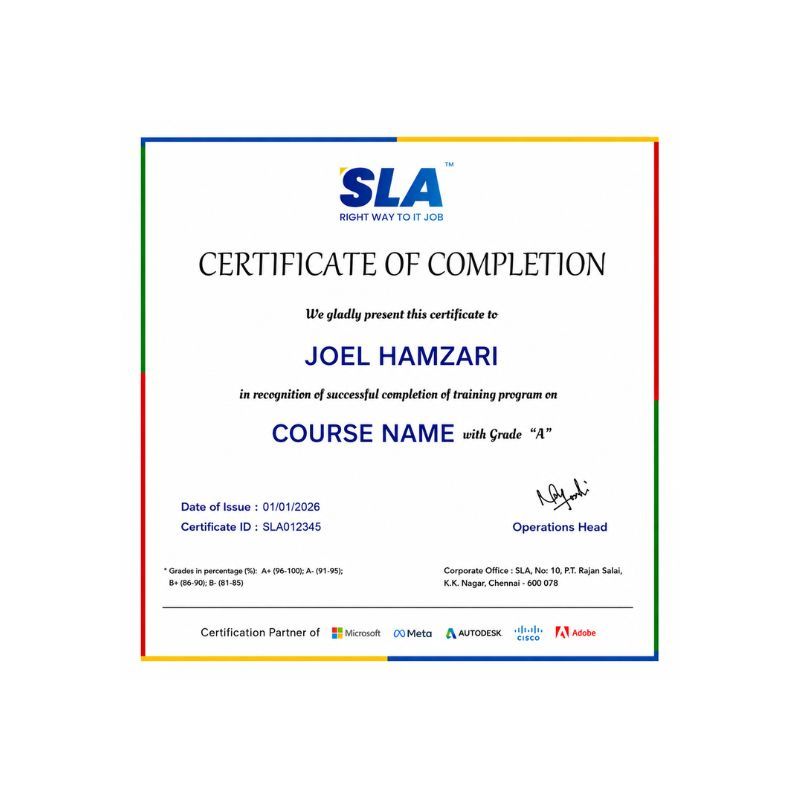
Earn Your Certificate of Completion
Take Your Career to the Next Level with Certifications
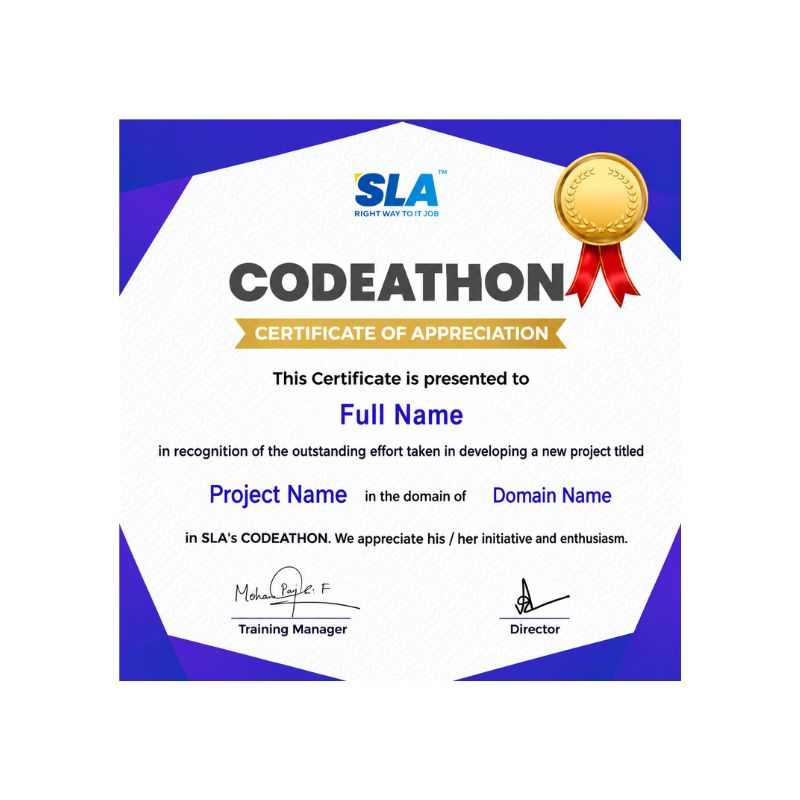
Stand Out from the Crowd with Codethon Certificate
Hands-on Project Practices in MongoDB Course
Recipe Sharing Platform
Fitness Tracker
Customer Relationship Management (CRM) System
Expense Tracking Application
Travel Booking System
Job Portal
Online Learning Platform
Event Management Platform
Inventory Management System
The SLA Way to Get Placed in Top IT Companies
Enrollment
Technology Training
Realtime Projects
Placement Training
Interview Skills
Panel Mock
Interview
Unlimited
Interviews
Interview
Feedback
100%
IT Career
Placement Support for a MongoDB Job
Genuine Placements. No Backdoor Jobs at Softlogic Systems.
Aptitude Training
from Day 1
Interview Skills
from Day 1
Softskills Training
from Day 1
Build Your Resume
Build your LinkedIn Profile
Build your GitHub
digital portfolio
Panel Mock Interview
Unlimited Interviews until you get placed
Life Long Placement Support at no cost
FAQs
Does SLA have experienced trainers ?
Yes, SLA’s trainer’s are very experienced in the field of teaching and IT.
What kinds of payments does SLA accept?
SLA accepts all types of payments ranging from cash, cheques, cards(Debit/Credit), and all kinds of digital UPI Payments.
Does SLA have personnel to look into student issues?
Yes, SLA has a specially designated HR personnel to look into student issues and grievances.
How many branches does SLA have?
SLA has two branches, one is in Navalur, OMR and another in K.K. Nagar.
What are the unique features of SLA’s Navalur branch?
SLA’s Navalur branch is located in the center of OMR’s IT hub which gives the Navalur branch incredible credibility.
How can MongoDB be installed?
MongoDB provides installation packages tailored to different operating systems. Users can obtain the appropriate package from the MongoDB website and proceed with installation by following the instructions outlined in the provided documentation.
How are CRUD operations performed in MongoDB?
CRUD operations (Create, Read, Update, Delete) in MongoDB are facilitated through its query language and APIs. Commands such as insertOne, find, updateOne, and deleteOne are utilized to execute these operations on MongoDB collections.
What is the process for setting up indexing in MongoDB?
To enhance query performance, MongoDB supports indexing. Indexes can be established on fields within collections using the createIndex method or by defining indexes within the collection’s schema. These indexes can be configured for various properties like sorting and uniqueness, and may be single-field or compound.
What is sharding in MongoDB, and how can it be configured?
Sharding in MongoDB involves distributing data across multiple servers to enhance scalability and performance. To configure sharding, a sharded cluster consisting of multiple shards (servers) and a shard key (field used for data partitioning) must be set up. MongoDB provides tools such as mongos and mongod for managing sharded clusters.
How can data security be ensured in MongoDB?
MongoDB offers several security features to safeguard data, including authentication, authorization, and encryption. User authentication can be established using roles and privileges, access control lists (ACLs) can be configured to control access to databases and collections, and encryption for data in transit and at rest can be enabled using TLS/SSL and encryption at the storage level. Additionally, MongoDB provides auditing capabilities to monitor user activity and security events.
Additional Information for
the MongoDB Course
Trends in MongoDB
MongoDB is experiencing several trends indicating its growing usage across industries:
- Cloud Adoption: More organizations are migrating to MongoDB Atlas, a fully managed cloud service, for scalability and reduced operational burden.
- Microservices Architecture: MongoDB’s flexibility suits microservices architectures, popular for their scalability and agility.
- Real-Time Analytics: MongoDB facilitates real-time analytics with its aggregation framework and powerful query capabilities, aiding faster decision-making.
- Data Privacy and Compliance: MongoDB’s security features are crucial for compliance with regulations like GDPR and CCPA, ensuring data protection.
- Machine Learning and AI Integration: MongoDB integrates seamlessly with AI and ML technologies, enabling intelligent applications and predictive analytics.
- DevOps and CI/CD: MongoDB’s compatibility with DevOps practices and CI/CD pipelines is rising. Automation tools streamline deployment and management tasks, accelerating application delivery.