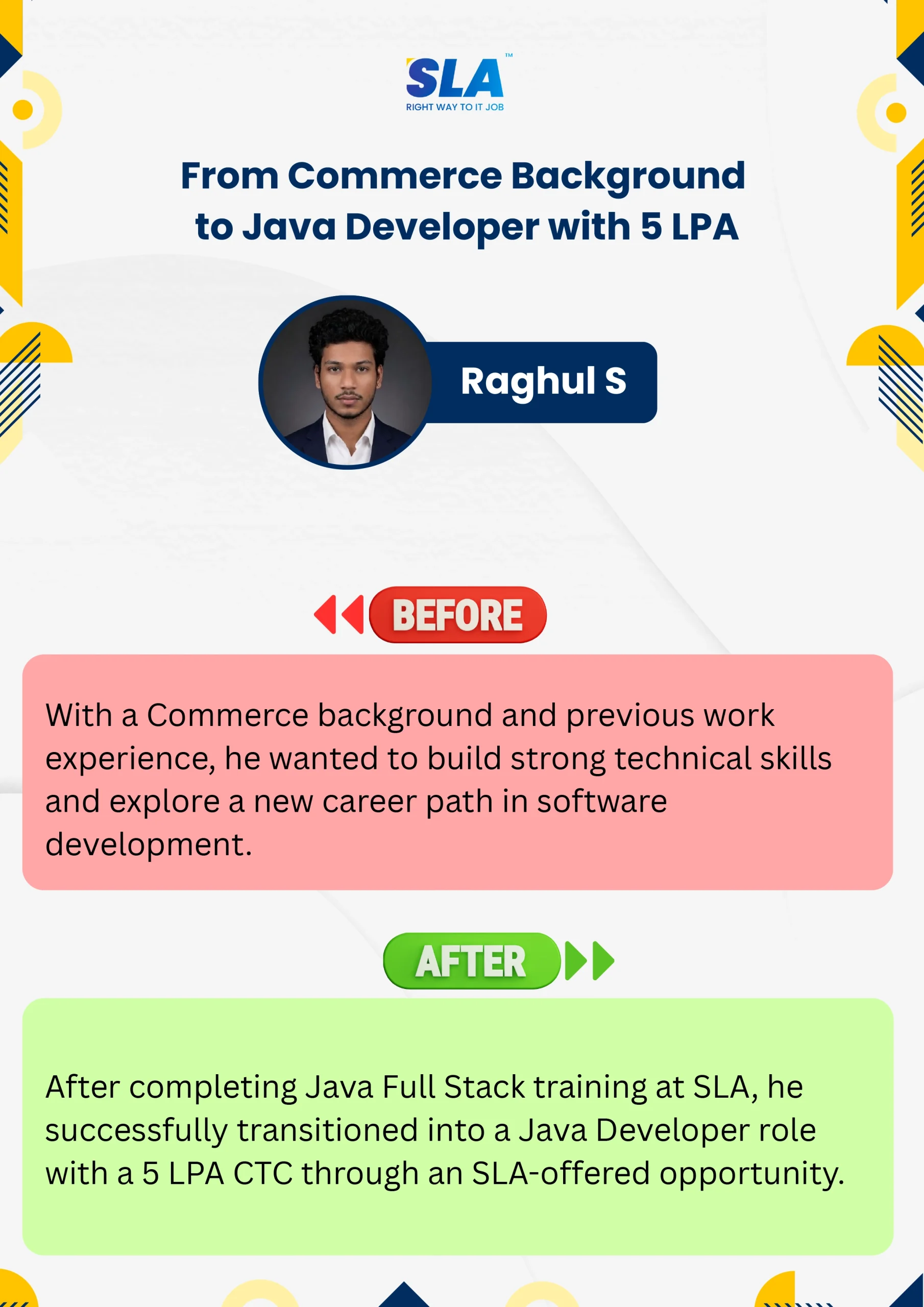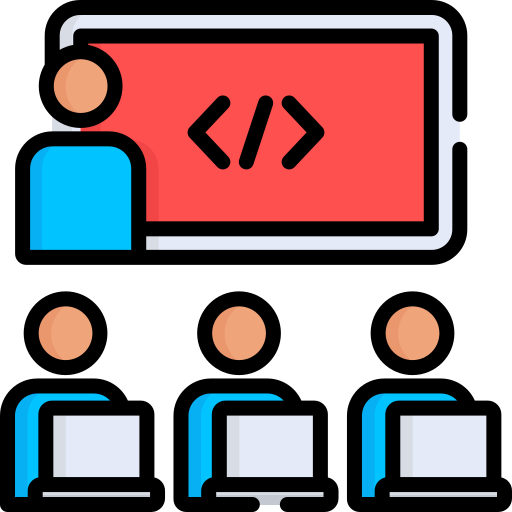

Our Java Online Training programs are designed for students, freshers, and working professionals who want to upskill and stay relevant. We offer Java Online Courses that are practical, interactive, and aligned with the latest industry demands. Our Java Syllabus Covers the Core Java, Advanced Java (J2EE), JDBC, Servlets, JSP, Spring, Hibernate, and more. Enroll now and learn from industry experts with flexible timings and get Job support.
Java Online Training
DURATION
3 to 6 months
EMI
0% Interest
Mode
Live Online / Offline
Let's take the first step to becoming an expert in Java
100% Placement
Assurance
Get Certified
JOB PLACEMENT ELIGIBILITY TEST
Your Placement Eligibility Report
Want more details about Java Course?
Course Schedules
Course Syllabus
Course Fees
or any other questions...
Fees, Duration & Batch Timings for Java Course
Hands On Training
3-5 Real Time Projects
60-100 Practical Assignments
3+ Assessments / Mock Interviews
June 2026
Week days
(Mon-Fri)
Online/Offline
2 Hours Real Time Interactive Technical Training
1 Hour Aptitude
1 Hour Communication & Soft Skills
(Suitable for Fresh Jobseekers / Non IT to IT transition)
June 2026
Week ends
(Sat-Sun)
Online/Offline
4 Hours Real Time Interactive Technical Training
(Suitable for working IT Professionals)
Save up to 20% in your Course Fee on our Job Seeker Course Series
Syllabus of Java Course
Introduction
- Why Java
- Paradigms
- Diff B/W Java & Other (C,C++)
- Java History
- Java Features
- Java programming format
- Java Statements
- Java Data Types
OOPS (Object Oriented Programming & Systems)
- Introduction
- Object
- Constructors
- This Key Word
- Inheritance
- Super Key Word
- Polymorphism (Over Loading & Over Riding)
- Abstraction
- Interface
- Encapsulation
- Introduction to all predefined packages
- User Defined Packages
- Access Specifiers
STRING Manipulation
- String
- String Buffer
Array
- What is Array
- Single Dimensional Array
- Multi Dimensional Array
- Sorting of Arrays
Exception Handling
- Introduction
- Pre Defined Exceptions
- Try-Catch-Finally
- Throws, throw
- User Defined Exception examples
I/O Streams
- Introduction
- Byte-oriented streams
- Character – oriented streams
- File
Multithreading
- Introduction
- Thread Creations
- Thread Life Cycle
- Life Cycle Methods
- Synchronization
- Wait() notify() notify all() methods
Wrapper Classes
- Introduction
- Byte, Short, Integer, Long, Float, Double, Character
- Boolean classes
Inner Classes
- Introduction
- Member Inner Class
- Static Inner Class
- Local Inner Class
- Anonymous Inner Class
Collection Frame Work
- Introduction
- Util Package interfaces, List, Set, Map
- List Interface 7 Its Classes
- Set Interface & Its Classes
- Map Interface & Is Classes
AWT
- Introduction
- Components
- Event-Delegation-Model
- Listeners
- Layouts
- Individual Components Lable, Button, Check Box, Radio Button,
- Choice, List, Menu, Text Field, Text Area
SWING (JFC)
- Introduction Diff B/W AWT and SWING
- Components hierarchy
- Panes
- Individual Swings components J Label
- JButton, JTextField, JTextAres
Advanced Java Syllabus (J2EE Course Syllabus) — Introduction to Enterprise Edition
- Distributed Multitier Applications
- J2EE Containers
- Web Services Support
- Packaging Applications
- J2EE 1.4 APIs
Web Server and Application Server
- Tomcat-Introduction
- Overview, installation, Configuring Tomcat
- Jboss server-Introduction
- Overview,installation and Configuration
- Comparison
SQL
- Basics of SQL queries
- SQL Joins
JDBC
- Introduction
- JDBC Architecture
- Types of Drivers
- Statement
- Result Set
- Read Only Result Set
- Updatable Result Set
- Forward Only Result Set
- Scrollable Result Set
- Prepared Statement
Servlets
- Introduction
- Web application Architecture
- HTTP Protocol & HTTP Methods
- Web Server & Web Container
- Servlet Interface
- HTTPServlet
- GenericServlet
- Servlet Life Cycle
- Servlet Config
- Servlet Context
- Servlet Communication<.li>
Servlet-Browser Communication
- sendError
- setHeader
- sendRedirect
Web-Component Communication
- Forward
- Include
Servlet-Applet Communication
- Session Tracking Mechanisms
- Http Session
- Cookies
- URL-Rewriting
- Hidden-Form Fields
- Filters & Wrappers
- Listeners
- Web-Security
JSP
- Introduction
- Jsp LifeCycle
- Jsp Implicit Objects & Scopes
- Jsp Directives
- page
- include
- taglib
Jsp Scripting Elements
- declaratives
- scriptlets
- expressions
JSP Actions
Standard Actions
- useBean tag
- setProperty tag
- getProperty tag
- include tag
- forward tag
- param tag
- plug-in tag
- params tag
- fallback tag
- directives tag
- scriptlet tag
- expression tag
Objectives of Java Training
The main benefit that students will enjoy in our institute is that they will be exposed to some of the most interesting topics like: Paradigms, Super KeyWord, String buffer, throws and more.
When students complete this online training, they will be having complete mastery over subjects in our Java course syllabus like:
- OOPs
- String Manipulation
- Array
- Exception handling and more.
Why Softlogic Systems is the Best Choice for Java Training – Learn, Practice, and Get Placed!
Online & Offline Training Options
Learn from 100+ Real-Time Developers
Hands-on Projects & Codeathons
0% EMI Fee Options
Resume & Interview Support
Placement with Top IT Firms
1000+ Hiring Partners
No Backdoor Jobs
Highlights of Java Course
What is Java?
Java is a powerful programming language created by Sun Microsystems, but now it is owned by Oracle Corporation. It came out in 1995 and quickly became super popular. One of its coolest features is that it can work on any device or system as long as it has something called a Java Virtual Machine (JVM). This makes Java great for making all sorts of apps, from websites to mobile apps and even big business programs. Java is known for being really strong, safe, and it has lots of tools and helpers to make coding easier.
What are the reasons for learning Java?
The following are the reasons for learning Java:
- Works Everywhere: Java is like a universal language for computers. It can run on any device or system that has something called a Java Virtual Machine (JVM) installed. This means you can use Java to make programs for lots of different things like websites, phones, and big business systems.
- Super Popular: Lots and lots of people use Java because it’s so versatile. Learning Java opens up tons of job opportunities in the software world because many companies rely on Java for their projects.
- Strong and Steady: Java is really solid and stable. It has features that help make sure your programs don’t mess up or crash easily. This makes Java a good choice for making programs that need to be reliable and work well.
- Does Many Things: Java can be used to make all sorts of programs, from simple websites to complex business software. Its flexibility makes it valuable for lots of different industries and jobs.
What are some of the prerequisites for learning Java Online Training?
The following are the prerequisites for learning the Java Online Training is not mandatory, we welcome everyone regardless of their past experiences, but having these prerequisites will give you an advantage in learning the course:
- Computer Knowledge: You should feel comfy using a computer, browsing the web, and doing basic stuff like organizing files.
- Know a Bit About Programming: While not a must, having some grasp of programming ideas like variables, loops, and conditions can give you a leg up. It’ll make learning Java smoother.
- Understand Object-Oriented Stuff: Java is all about objects and classes. Having a basic idea about these and other OOP concepts like inheritance and polymorphism can really help you get a handle on Java.
Our Java Online training program is suitable for:
- Students
- Job Seekers
- Freshers
- IT professionals aiming to enhance their skills
- Professionals seeking career change
- Enthusiastic programmers
What are the course fees and duration?
The Java Online certification course fees depend on the program level (basic, intermediate, or advanced) and the course format (online or in-person). On average, the Java Online training course fees come in the range of 20,000 INR -25,000 INR for 2 months, inclusive of international certification.
What are the jobs related to Java?
The following are the jobs related to Java:
- Java Developer
- Software Engineer
- Web Developer
- Mobile App Developer(Android)
What is the salary range for the position of Java Developer?
As per data from AmbitionBox, the Java Developer freshers salary typically with less than 2 years of experience earn approximately ₹3 lakhs – ₹4 lakhs annually. For mid-career Java Developers with 2-3 years of experience, the average annual salary is around ₹5.1 lakhs. An experienced Java Developer with more than 3 years of experience can anticipate an average yearly salary of around ₹7.7 lakhs.
List a few real-time Java applications.
Here are several real-time Java Applications:
- Financial Trading Systems
- Telecommunication Systems
- Embedded Systems
- Internet of Things(IoT) Devices
Boost Your Skills with Our Java Training Experts
Our Mentors are from Top Companies like:
- Our trainers possess 10+ years of hands-on experience in Java Training.
- Our trainers have real-time project expertise across various industries, ensuring you receive practical knowledge applicable to real-world scenarios.
- They have a proven track record of successful training and mentoring, having guided and supported 2000+ students annually.
- Our trainers consistently deliver high-quality education, ensuring you receive top-notch training that meets industry standards.
- They possess an in-depth understanding of both theoretical concepts and practical applications, bridging the gap between theory and real-world scenarios effectively.
- With strong connections with hiring HRs in multinational companies, our trainers provide insights into industry trends, requirements, and exclusive job opportunities to give you a competitive advantage.
- They have a robust understanding of essential Java concepts, such as Exception Handling, Threads, JSP, Operators, XML handling, Loops, Collections, Database Connectivity, and Servlets.
- Our trainers are well-equipped to impart comprehensive knowledge and guide learners through hands-on training in these key areas of Java development.
- They excel in communication skills, effectively delivering the course content by providing suitable examples in each Java class, making the learning experience engaging and understandable.
- Our trainers are dedicated to assisting students in achieving their goals and preparing them to approach interviews with confidence.
What Modes of Training are available for Java Course?
Offline / Classroom Training
- Direct Interaction with the Trainer
- Clarify doubts then and there
- Airconditioned Premium Classrooms and Lab with all amenities
- Codeathon Practices
- Direct Aptitude Training
- Live Interview Skills Training
- Direct Panel Mock Interviews
- Campus Drives
- 100% Placement Support
Online Training
- No Recorded Sessions
- Live Virtual Interaction with the Trainer
- Clarify doubts then and there virtually
- Live Virtual Interview Skills Training
- Live Virtual Aptitude Training
- Online Panel Mock Interviews
- 100% Placement Support
Corporate Training
- Industry endorsed Skilled Faculties
- Flexible Pricing Options
- Customized Syllabus
- 12X6 Assistance and Support
Certifications
Improve your abilities to get access to rewarding possibilities
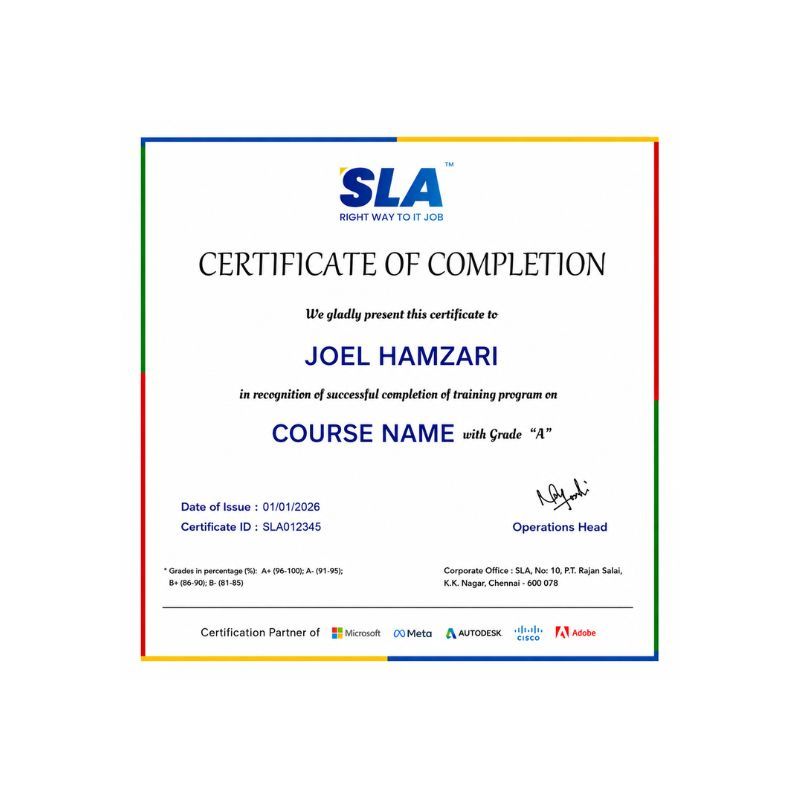
Earn Your Certificate of Completion
Take Your Career to the Next Level with Certifications
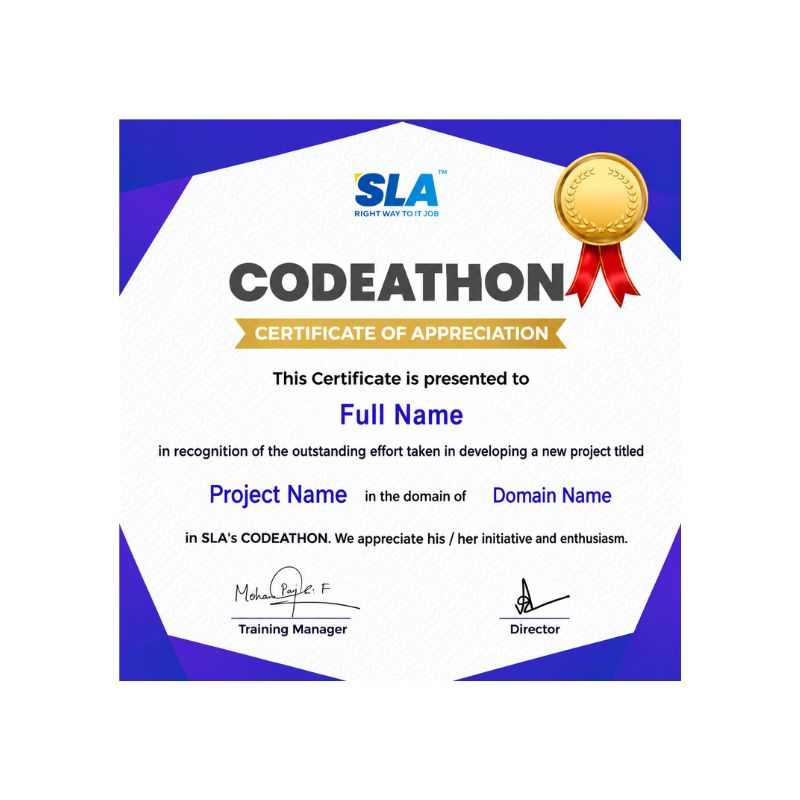
Stand Out from the Crowd with Codethon Certificate
Hands-on Project Practices in Java Course
Image Processing Application
Online Chat Application
Restaurant Management System
Weather Forecasting Application
Expense tracker
Online Marketplace
Movie Ticket Booking System
Tic-Tac-Toe Game
Health tracking application
The SLA Way to Get Placed in Top IT Companies
Enrollment
Technology Training
Realtime Projects
Placement Training
Interview Skills
Panel Mock
Interview
Unlimited
Interviews
Interview
Feedback
100%
IT Career
Placement Support for a Java Job
Genuine Placements. No Backdoor Jobs at Softlogic Systems.
Aptitude Training
from Day 1
Interview Skills
from Day 1
Softskills Training
from Day 1
Build Your Resume
Build your LinkedIn Profile
Build your GitHub
digital portfolio
Panel Mock Interview
Unlimited Interviews until you get placed
Life Long Placement Support at no cost
FAQs
Are you looking for exciting offers?
Call +91 86818 84318 right away and find out all about the great deals that are now available to you!
Can I learn Java in 3 months?
You can definitely master Java in three months with enough practise and effective learning. Our Java Training in Chennai achieves this by providing highly qualified trainers with a batch of 15 to 20 students each to meet all of the students’ needs in order to make them programming language professionals.
Does Softlogic provide job placement aid after completing the course?
- Softlogic is an expert when it comes to student placement.
- More than 90000+ students were placed in total.
- We offer a specialized placement service designed to meet the unique needs of students during the placement process.
- Softlogic organizes development programs that include mock interviews and presentation skills training, with the goal of preparing students to handle difficult interview scenarios professionally.
What training modes does Softlogic offer?
Softlogic offers a variety of training modes that cater to the needs of students, including:
- Classroom training
- One-to-One training
- Live instructor-led online training
- Customized training options
- Corporate Training
What accreditation will I get once the course is completed?
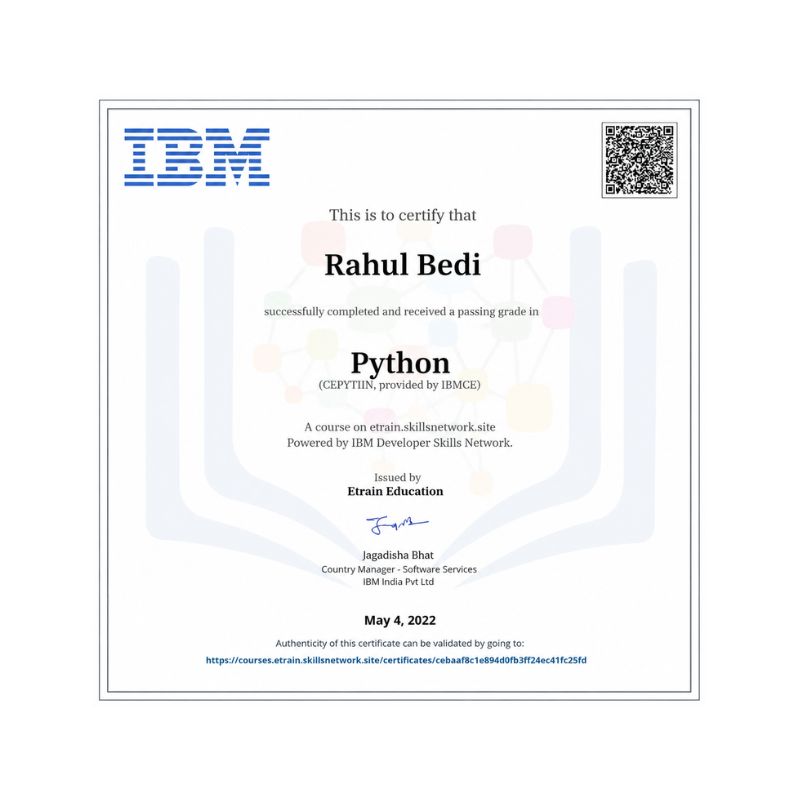
Upon completion of Softlogic’s training, you will be awarded with globally recognized course completion certificates from Softlogic, renowned IBM certificates, and Codeathon certificates, validating your real-time project experience.
What about group discounts or corporate training?
Yes, group discounts are available for Softlogic’s training courses. Visit our website and get in touch with us through call, email, live chat, or quick inquiry to learn more. We provide discounts in accordance with the terms and conditions based on the group size.
What methods of payment are available?
We accept all major payment methods. Cash, debit cards, credit cards (including Master, Visa, and Maestro), net banking, UPI, etc.
I have more queries?
Please contact our course counselor by call or Whatsapp at +91 86818 84318. As an alternative, you can use our Website chat, Website form, or email us at [email protected].
Can a Non-IT person learn Java?
Individuals from various backgrounds, including those without prior experience in IT, who possess an interest in programming and a desire to learn Java as a programming language, are eligible and encouraged to pursue Java training.
What is the highest salary for a Java Developer?
As per AmbitionBox, Java Developer salary for freshers in Chennai with less than 1 year of experience to 4 years of experience range from 1.6 lakhs to 8.4 lakhs, with an average yearly income of 3.9 lakhs. And the salary for Senior Java Developers in India falls within the range of ₹4.2 Lakhs to ₹24.0 Lakhs per annum, with an average annual salary of ₹10.0 Lakhs.
Additional Information for
the Java Course
History of Java
Java’s story goes back to the early 1990s when a team at Sun Microsystems, led by James Gosling, started creating a new programming language for gadgets. Here’s a quick rundown of Java’s journey:
- Starting Point: The Java adventure began in 1991 when engineers at Sun Microsystems kicked off work on a fresh programming language and system for gadgets like set-top boxes.
- Origins of Oak: Originally dubbed Oak, after an oak tree outside Gosling’s office, the language aimed to be easy, adaptable, and safe for embedded systems.
- Going Public: Sun Microsystems unveiled Java to the world in May 1995 at the SunWorld conference. They touted it as “Write Once, Run Anywhere,” meaning you could use Java on any device without changing the code.
- First Steps: Java 1.0 hit the scene in January 1996, introducing features like the Java Virtual Machine (JVM) and Java applets for web browsers.
- Spreading the Word: Thanks to its ability to work on any platform and its security, Java quickly became popular among developers for web, business, and mobile applications.
- Growing Bigger: Over time, Java kept growing to include more features and tools for different types of development, like enterprise applications and mobile devices.
- Becoming Open Source: In November 2006, Sun Microsystems made the Java Development Kit (JDK) open source, leading to even wider use and development.
- New Owner: Oracle Corporation took over Sun Microsystems in January 2010, continuing to improve and support Java with new releases and updates.
- Community Power: The Java Community Process, created in 1998, lets developers have a say in how Java evolves by suggesting and reviewing new features.
- Today: Java is still one of the most popular programming languages globally, used for everything from websites to big business systems. It keeps growing and changing to keep up with the ever-evolving world of technology.