
Software quality is really important in today’s tech world. This means there is a need for good testing professionals. The Software Testing Course in Bangalore helps new learners understand how to check software quality, performance, functionality, and reliability. The training covers Manual Testing and Automation Testing. It also covers testing methods, tracking defects, and real-world testing practices through hands-on projects. When students do these projects, they get to use tools and techniques that are used in the industry. Students work on applications that help them gain practical experience. The course has expert trainers to guide you. Students learn by doing projects, and they also help you get a job with placement support. This course helps you build the skills you need for a career in software testing and quality assurance.
Software Testing Training In Bangalore
DURATION

3 Months
EMI
0% Interest
Mode

Live Online / Offline

Let's take the first step to becoming an expert in Software Testing
100% Placement
Assurance
Get Certified
JOB PLACEMENT ELIGIBILITY TEST
Your Placement Eligibility Report
Want more details about Software Testing Course?

Course Schedules

Course Syllabus

Course Fees

or any other questions...
Fees, Duration & Batch Timings for Software Testing Course
Hands On Training
3-5 Real Time Projects
60-100 Practical Assignments
3+ Assessments / Mock Interviews
June 2026
Week days
(Mon-Fri)
Online/Offline
2 Hours Real Time Interactive Technical Training
1 Hour Aptitude
1 Hour Communication & Soft Skills
(Suitable for Fresh Jobseekers / Non IT to IT transition)
June 2026
Week ends
(Sat-Sun)
Online/Offline
4 Hours Real Time Interactive Technical Training
(Suitable for working IT Professionals)
Save up to 20% in your Course Fee on our Job Seeker Course Series
Objectives of Software Testing Training
The main goal of this Software Testing Training in Bangalore is to teach students about software quality assurance processes. It covers testing methodologies, defect tracking, and automation concepts. This course is focused on practical learning, real-time testing scenarios, and industry-relevant tools.
Basic Software Testing Concepts:
Students learn about the software development life cycle, software testing life cycle, testing principles, defect management, test cases, test scenarios, and manual testing basics. This helps students understand the basics of software quality assurance.
Intermediate Testing Techniques:
Understand functional testing, integration testing, system testing, regression testing, database testing, API testing, and test management processes. They get to practice with real-world testing scenarios. This is where students learn about types of testing.
Advanced Automation Testing:
Students learn about Selenium WebDriver, TestNG, automation frameworks, API automation, continuous testing concepts, and real-time automation projects. This helps students build skills needed for software testing environments. They learn about automation testing and how it works.
Why Softlogic Systems is the Best Choice for Software Testing Training – Learn, Practice, and Get Placed!
Online & Offline Training Options

Learn from 100+ Real-Time Developers

Hands-on Projects & Codeathons
0% EMI Fee Options

Resume & Interview Support

Placement with Top IT Firms

1000+ Hiring Partners

No Backdoor Jobs
Highlights of Software Testing Course
What is the primary focus of this Software Testing course?
This Software Testing course focuses on software quality assurance, defect identification, test execution, automation testing, and real-world project experience.
What testing methodologies are covered?
The training covers Manual Testing, Automation Testing, Agile Testing, Functional Testing, Regression Testing, and API Testing concepts. These are the testing methodologies that students learn.
Are practical testing sessions included?
Yes, students work on application testing scenarios, bug reporting activities, and automation scripts. They gain hands-on experience by applying their knowledge.
Does the course cover automation tools?
Yes, the course includes Selenium WebDriver, TestNG, and other commonly used automation testing tools. These are the tools that students learn to use.
Is this course suitable for beginners?
Yes, the course starts with testing fundamentals. Gradually moves to advanced testing and automation concepts.
Are real-time projects included?
Yes, students gain practical experience through real-time testing projects and industry-oriented assignments. They work on projects.
What career benefits and opportunities does this course offer?
Students can apply for roles such as Software Tester, QA Analyst, Automation Tester, Test Engineer, and Quality Assurance Engineer. These are the jobs that students can get.
Is placement support provided?
Yes, placement assistance includes resume preparation, interview guidance, mock interviews, and career support. Students get support with job placement opportunities.
Boost Your Skills with Our Software Testing Training Experts
Our Mentors are from Top Companies like:
What Modes of Training are available for Software Testing Course?
Offline / Classroom Training
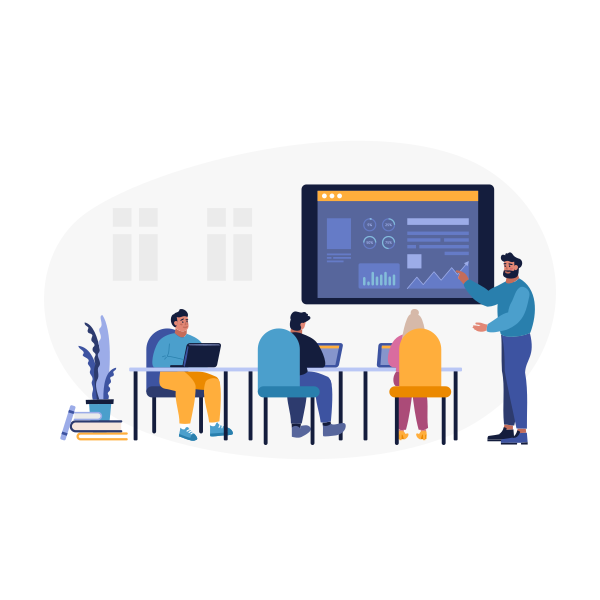
- Direct Interaction with the Trainer
- Clarify doubts then and there
- Airconditioned Premium Classrooms and Lab with all amenities
- Codeathon Practices
- Direct Aptitude Training
- Live Interview Skills Training
- Direct Panel Mock Interviews
- Campus Drives
- 100% Placement Support
Online Training

- No Recorded Sessions
- Live Virtual Interaction with the Trainer
- Clarify doubts then and there virtually
- Live Virtual Interview Skills Training
- Live Virtual Aptitude Training
- Online Panel Mock Interviews
- 100% Placement Support
Corporate Training

- Industry endorsed Skilled Faculties
- Flexible Pricing Options
- Customized Syllabus
- 12X6 Assistance and Support
Certifications
Improve your abilities to get access to rewarding possibilities

Earn Your Certificate of Completion
Take Your Career to the Next Level with Certifications

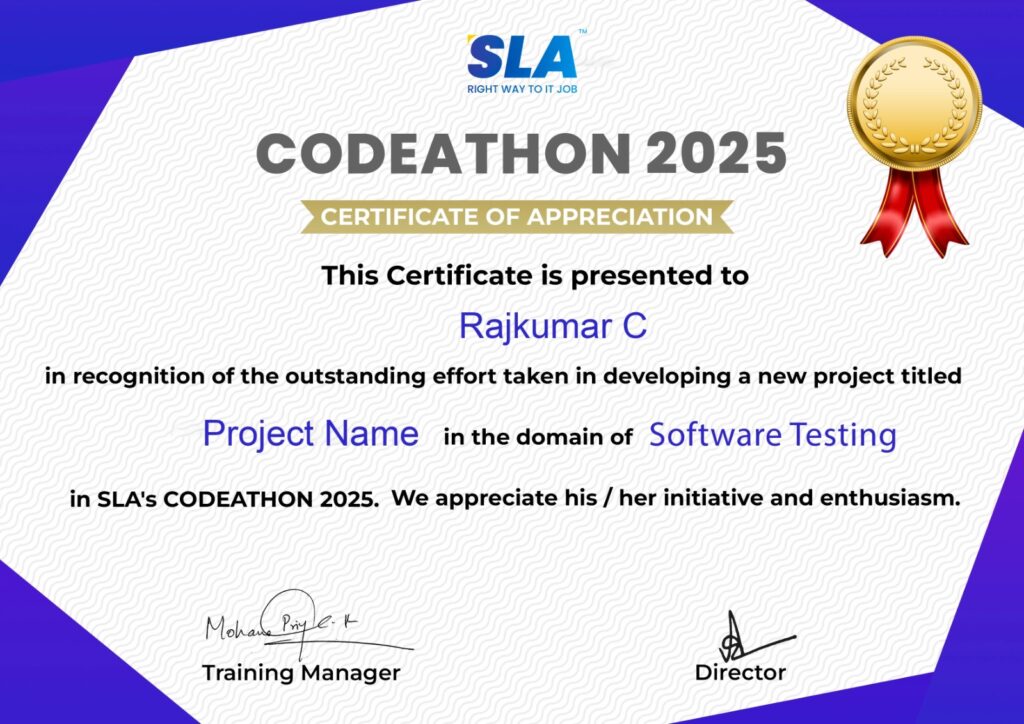
Stand Out from the Crowd with Codethon Certificate
Hands-on Project Practices in Software Testing Course
Real-Time Defect Tracking Project
Automation Framework Development
Learning Management System Testing
Inventory Management System Testing
API Testing Project
CRM Application Testing
Travel Booking Portal Testing
Mobile Application Testing
Online Food Delivery App Testing
Hospital Management System Testing
Banking Application Testing
E-Commerce Website Testing
The SLA Way to Get Placed in Top IT Companies
Enrollment

Technology Training
Realtime Projects
Placement Training
Interview Skills
Panel Mock
Interview

Unlimited
Interviews

Interview
Feedback

100%
IT Career
Google Reviews


NalluKumar Ravichandran


Nithish Sahoo

Shaaru Menan

SARAN M

MATHAN KUMAR G EEE

Surya
Discover What Our Students Have To Say
See More ReviewsPlacement Support for a Software Testing Job
Genuine Placements. No Backdoor Jobs at Softlogic Systems.
Aptitude Training
from Day 1
Interview Skills
from Day 1

Softskills Training
from Day 1
Build Your Resume

Build your LinkedIn Profile

Build your GitHub
digital portfolio

Panel Mock Interview
Unlimited Interviews until you get placed

Life Long Placement Support at no cost
FAQs
What is the purpose of the Software Testing Life Cycle (STLC)?
The Software Testing Life Cycle is a process used to ensure software quality. It includes requirement analysis, test planning, test case creation, test execution, defect tracking and test closure activities. This is a part of software testing.
Can you explain the distinction between verification and validation?
- Verification:
- It checks if the software is being developed correctly according to requirements.
- Validation:
- It checks if the final software works as expected and meets user needs.
These are two important steps in software testing.
How are Manual Testing and Automation Testing different?
- Manual Testing: Test cases are manually executed by testers.
- Automation Testing: Test scripts and tools are used to perform testing automatically.
- Automation is faster for testing tasks
What distinguishes regression testing from retesting?
- Retesting is performed to confirm that a reported defect has been resolved.
- Regression Testing ensures recent changes have not affected existing features.
- Both are important for software quality.
What are Defect Severity and Defect Priority?
- Severity measures the impact of a defect on the application.
- Priority indicates how quickly the defect should be fixed based on business requirements.
What is the Bug Life Cycle?
A bug progresses through stages such as New, Assigned, Open, Fixed, Retest, Closed, and Reopened. This process helps track defects until resolution.
What is Black Box Testing?
Black Box Testing evaluates software functionality without looking at the source code. Testers focus on inputs, outputs, and expected system behavior.
What is White Box Testing?
White Box Testing examines the code structure, logic, and program flow. It is commonly performed by developers or technical testers.
What is a Requirement Traceability Matrix (RTM)?
RTM is a document that links requirements with test cases. It helps ensure every requirement is properly tested and no functionality is missed.
What are Functional and Non-Functional Testing?
- Functional Testing ensures that an application’s features and functions work as expected.
- Non-Functional Testing focuses on assessing performance, security, usability, and reliability.
- Both help deliver a quality software product.