
Softlogic is one of the Top Training institutes for Oracle. Learn how to use Oracle, from beginner basics to advanced techniques. Our Oracle Syllabus covers the Oracle architecture, SQL & PL/SQL programming, database design, user management, backup & recovery, performance tuning, and security. We offer an Oracle Course with Placement Assistance, Mock interviews, Resume building, and certification.
Oracle Certification Course
4.80
(1987)
DURATION

2 Months
EMI

0% Interest
Mode

Live Online / Offline

Let's take the first step to becoming an expert in Oracle
Click Here to Get Started
Lifelong Placement
Assistance
Get Certified
JOB PLACEMENT ELIGIBILITY TEST
×
Your Placement Eligibility Report
Want more details about Oracle?
Fill out the form, and our counsellors will get in touch with you at your preferred time. You can have all your queries answered. Once you decide that SLA is the perfect fit for your training needs, our counselors will guide you through the process every step of the way.

Course Schedules

Course Syllabus

Course Fees

or any other questions...
Fees, Duration & Batch Timings for Oracle
Hands On Training
3-5 Real Time Projects
60-100 Practical Assignments
3+ Assessments / Mock Interviews
July 2026
Week days
(Mon-Fri)
Online/Offline
2 Hours Real Time Interactive Technical Training
1 Hour Aptitude
1 Hour Communication & Soft Skills
(Suitable for Fresh Jobseekers / Non IT to IT transition)
Course Fee
July 2026
Week ends
(Sat-Sun)
Online/Offline
4 Hours Real Time Interactive Technical Training
(Suitable for working IT Professionals)
Course Fee
Save up to 20% in your Course Fee on our Job Seeker Course Series
Learn More
Syllabus of Oracle
Download Syllabus
Chapter 1: Introduction To SQL
- Introduction Database
- Understanding DBMS vs RDBMS
- Gone through SQL Standards
- Sub languages of SQL
- Difference between 10g vs 11g vs 12c
- Installation of 12c
- About SQL*Plus and use of developer tool
- Datatypes in Oracle
- Operators in Oracle
- Understanding Schema design and objects
Chapter 2: Data Retrieval Techniques
- How to use select statement in different ways to retrieve records?
- Working with Column alias
- Working with Table alias
- Data filtering and sorting with in single table
- Clauses and its types in oracle
-
- Where clause
- Having clause
- From clause
- Group by clause
- Order by clause
- Using clause
- Constraint clause
- For update clause
Chapter 3: Working With DDL Commands
- Table creation using CREATE statement
- Creating table from another table
- Dropping a table using DROP command
- Altering the column of a table
- Modifying the column datatype in a table
- Renaming the column of a table
- Renaming an entire table
- Using truncate command
- Difference between Delete and Truncate command
Chapter 4: Working With DML Commands
- How to copy data from one table to another table?
- How to copy the structure alone from a table?
- Different types of inserting row to an existing table
- Updating any value of with in a record using UPDATE command
- Deleting a particular record from a table
- Using merge & insert all command [Implementation of Project 1 ]
Chapter 5: Integrity Constraints
- How to declare column level constraints?
- How to declare row level constraints ?
- How to add constraints to an existing table?
- Types of integrity constraints
- Not null
- Unique key
- Primary key
- Referential integrity
- Check integrity
- How to enable and disable constraints?
- How to get information about constraints?
Chapter 6: Built In Functions
- Understanding Single row functions
- How to use single row functions using dummy table?
- Types of single row functions
- String functions
- Date functions
- Mathematical functions
- Conversion functions
- Special functions
- Analytical functions
- Working with multi row functions [Implementation of Project 2]
Chapter 7: Data Aggregation
- Working with aggregate function
- Count()
- Sum()
- Max()
- Min()
- Avg()
- Working with group by clause
- Working with having clause
- Difference between WHERE and HAVING clause
Chapter 8: Importance Of JOIN
- Understanding joins and its uses
- Types of joins
- Equi join
- Non – equi join
- Self join
- Outer join
- Left & Right outer join
- Full outer join
- Cross join [Implementation of Project 3]
Chapter 9: Set Operators And Pseudo Columns:
- How to use set operators in a single table content?
- Working with set operator types
- UNION
- UNION ALL
- INTERSECT
- MINUS
- Working with pseudo columns using the following
- ROWID
- ROWNUM
Chapter 10: Sub Queries
- Importance of sub queries
- Using different types of sub queries
- Single row sub queries
- Multi row sub queries
- Nested queries
- Multi column sub queries
- Correlated sub queries
- Using inline views and scalar queries [ Implementation of Project 4]
Chapter 11: Database Transaction And Security
- Working with data query language using TCL
- Working with data control language commands
- Use of commit and rollback
- Use of savepoint and set transaction
- How to give system privileges to an user?
- How to invoke and revoke object privileges?
- How to create users and roles?
Chapter 12: Design Of Schema Objects
- Creating and working with Views
- Working with Synonyms
- Creating Index and clusters
- Working with in materialized view
- Understanding sequences and its types [Implementation of Project 5]
Chapter 1: Introduction To PL/SQL
- Informal introduction to PL/SQL
- Advantages of PL/SQL
- Datatypes in PL/SQL
- Program structure of PL/SQL
- Embedding SQL statements
- Using conditional statements and loops
Chapter 2: Creating And Using Cursors
- What is cursor?
- How to create cursor?
- Using cursors in PL/SQL
- How to create explicit cursor?
- Creation of for loop cursor
- What are cursor parameters?
- How to use for update clause?
- What is ref cursors?
- How to use implicit cursors?
Chapter 3: Understanding Exception Handling
- What is an Exception?
- Describing Exception types
- Handling system defined exceptions
- Handling user defined exceptions?
- Sql code vs Sql errm
- Pragma exception_init
Chapter 4: Creation Of Stored Procedures
- Creating procedures in Pl/SQL
- Working with procedure parameters
- IN parameter
- OUT parameter
- INOUT parameter
- How to create procedures with cursors
- How procedures return records?
- What is Pragma autonomous transaction?
Chapter 5: Creating & Using Functions
- Importance of function
- How to create functions?
- Difference between procedures and functions
- How to use inline functions?
Chapter 6: Creating & Using Packages
- What is a Package?
- Reasons to use packages
- What is package specification?
- What is package body?
- How to instantiate package?
- How to initialize instantiated package?
- What are all the package state?
Chapter 7: Triggers In PL/SQL
- How to create triggers?
- Benefits of trigger
- How to trigger a trigger?
- Using DML trigger & DDL trigger
- How to audit database using triggers?
- What are database level trigger?
Chapter 8: Collections In PL/SQL
- What is collection?
- How to use arrays?
- Using nested tables
- How to use index by value?
- Listing types of collection methods.
- General overview and discussion about DBA Concepts
Objectives of Oracle
The objectives of learning Oracle training include
- Acquire skills in database design, create databases with a modeling tool, and become acquainted with SQL to create and query databases.
- To use Oracle Database to develop contemporary cloud database solutions.
- To analyze intricate business scenarios.
- To model data utilizing fundamental SQL syntax and the guidelines for creating legitimate SQL statements.
- To design, develop, and implement database-driven web applications using low-code/no-code design techniques.
Request a Free Callback
Why Softlogic Systems is the Best Choice for Oracle – Learn, Practice, and Get Placed!

Online & Offline Training Options
Learn at your convenience with flexible classroom and live online training.

Learn from 100+ Real-Time Developers
Get trained by industry professionals with years of hands-on experience.

Hands-on Projects & Codeathons
Practice with real-time projects and coding challenges to build confidence.
0% EMI Fee Options
Pay your course fees flexibly with easy EMI plans at zero interest.

Resume & Interview Support
Get expert help with resume building, mock interviews, and soft skills.

Placement with Top IT Firms
Access placement opportunities with leading MNCs and IT companies.

1000+ Hiring Partners
Benefit from Softlogic’s strong recruiter network for faster job placement.

No Backdoor Jobs
We ensure only genuine placement opportunities with trusted companies.
Request a Free Callback
Highlights of Oracle
What is an Oracle database?
A group of data that is handled collectively is called an Oracle database. A database’s main function is to hold and retrieve relevant data. A database server holds the key to unlocking information management’s mysteries.
What are the reasons for learning Oracle?
Learning Oracle is beneficial for several reasons:
- Career opportunities: Your earning potential, work performance, and confidence can all rise with an Oracle certification.
- High Performance: The Oracle Database is built to function well under demanding conditions.
- Diverse Roles: IT job titles like database developer, cloud engineer, DBAs, database engineers, etc. were frequently held by those with the Oracle credential.
What are the prerequisites for learning Oracle?
People from a range of backgrounds who are interested in learning Oracle are encouraged through Oracle Training. Proficiency with SQL and PL SQL programming, along with a basic understanding of technical concepts, would be advantageous.
Our Oracle Course is suitable for:
- Students
- Professionals seeking a career change
- IT professionals aiming to enhance their skills
- Enthusiastic programmers
- Job Seekers
What are the course fees and duration?
Our Oracle training is offered for around 22,000 INR, with potential variations based on the course level (basic, intermediate, or advanced) and format (online or in person). Generally, the training spans approximately 2 months and includes certification upon completion. For accurate details concerning fees, duration, and certification, we suggest reaching out to our training center directly.
What are some job roles related to Oracle?
Oracle provides a broad range of technologies and software solutions that lead to a variety of job responsibilities in a range of industries. The following are a few Oracle-related jobs:
- Database Administrator (DBA)
- Database Developer
- Oracle Developer
- Business Intelligence Analyst
- Data Analyst
- Oracle Cloud Engineer
- Oracle Data Warehouse Developer
What is the salary range for an Oracle engineer?
An Oracle DBA with less than three years of experience usually makes between ₹4-6 lakhs per year. The average yearly compensation for an Oracle DBA in their mid-career who has roughly 7 years of experience is ₹13.4 lakhs. An average monthly income of approximately ₹17.1 lakhs can be expected for an experienced Oracle DBA with over 10 years of experience.
List a few Oracle real-time applications.
Utilizing their capabilities for effective data management, analysis, and business operations, Oracle technologies are employed in a variety of real-time applications across sectors. Oracle is used in the following real-time applications:
- Smart Cities: Facilitate waste control and real-time traffic management.
- IoT Applications: Handles data from IoT devices in real time.
- Financial Services: Oracle manages fraud detection and real-time transactions.
- Manufacturing: Facilitates in-the-moment production tracking and quality assurance.
- Public Sector: Facilitates data analytics and real-time citizen services.
- Pharmaceuticals: Manages clinical trials and real-time drug research data.
Boost Your Skills with Our Oracle Experts
Our Mentors are from Top Companies like:
- With over 10 years of professional expertise in the IT field, we have highly skilled Oracle trainers.
- They have extensive experience working with Oracle technology and products and are Certified Oracle Professionals.
- They are skilled in the planning and creation of intricate Oracle applications.
- They have outstanding expertise in PL/SQL programming, database design, performance tuning, data modeling, and other areas related to corporate application development.
- They have database administration experience and are fluent in Oracle 10g and higher.
- They are also skilled in troubleshooting issues and finding solutions for Oracle applications.
- They have experience with Oracle training at both the corporate and academic levels, and they are skilled in database migrations and integration.
Request a Free Callback
What Modes of Training are available for Oracle?
Offline / Classroom Training

A Personalized Learning Experience with Direct Trainer Engagement!
- Direct Interaction with the Trainer
- Clarify doubts then and there
- Airconditioned Premium Classrooms and Lab with all amenities
- Codeathon Practices
- Direct Aptitude Training
- Live Interview Skills Training
- Direct Panel Mock Interviews
- Campus Drives
- 100% Placement Support
Online Training

Instructor Led Live Training! Learn at the comfort of your home
- No Recorded Sessions
- Live Virtual Interaction with the Trainer
- Clarify doubts then and there virtually
- Live Virtual Interview Skills Training
- Live Virtual Aptitude Training
- Online Panel Mock Interviews
- 100% Placement Support
Corporate Training

Blended Delivery model (both Online and Offline as per Clients’ requirement)
- Industry endorsed Skilled Faculties
- Flexible Pricing Options
- Customized Syllabus
- 12X6 Assistance and Support
GET Free Consultation
Certifications
Take your career to new heights with Softlogic's software training certifications.
Improve your abilities to get access to rewarding possibilities
Improve your abilities to get access to rewarding possibilities

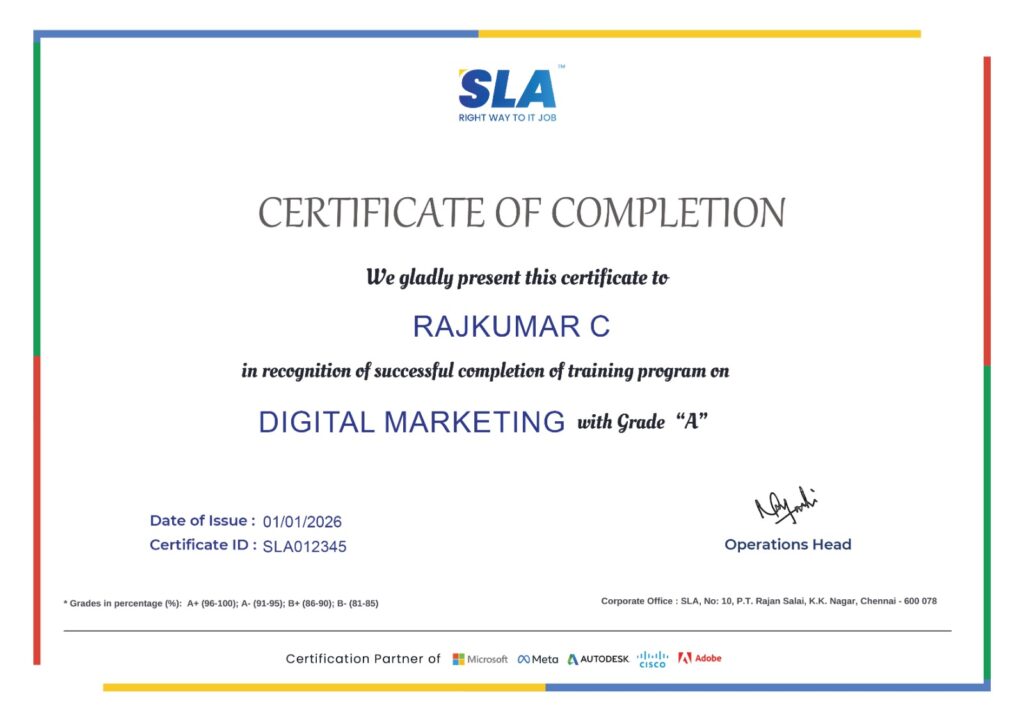
Earn Your Certificate of Completion
Validate your achievements with Softlogic's Certificate of Completion, verifying successful fulfillment of all essential components.
Take Your Career to the Next Level with Certifications
Get a certifications through our training programs to gain a competitive edge in the industry.

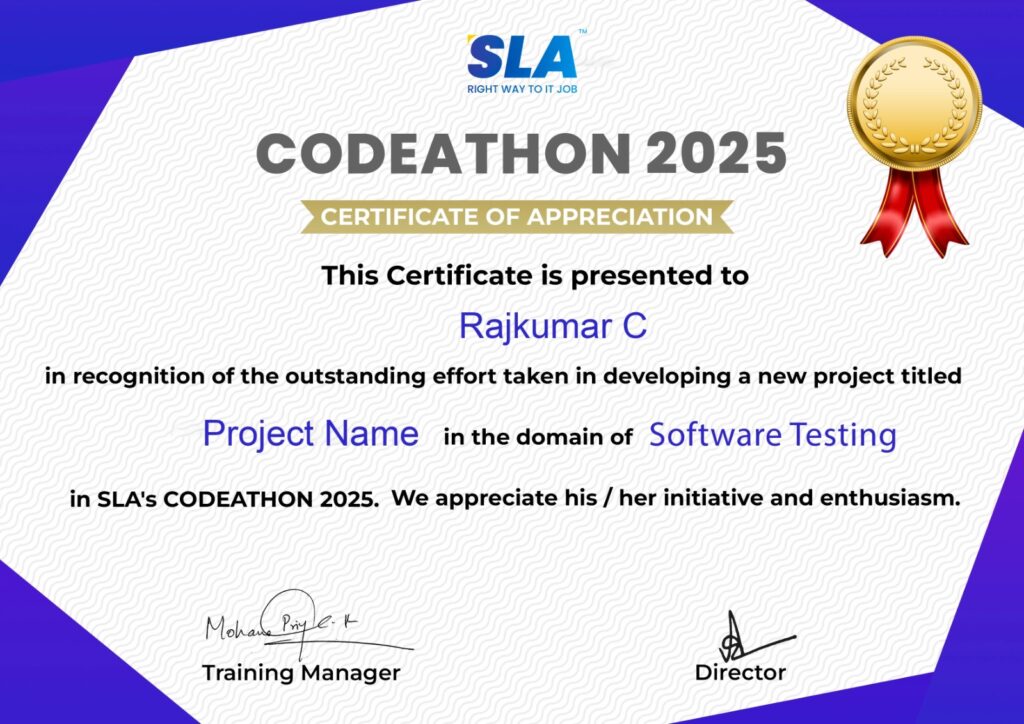
Stand Out from the Crowd with Codethon Certificate
Verify the authenticity of your real-time projects with Softlogic's Codethon certificate.
Hands-on Project Practices in Oracle
Oracle Performance Optimization
Database Vault for Oracle
Oracle Cloud Migration
Oracle EPM Setup
Big Data Integration with Oracle
Integration of Data
Customization of Oracle EBS
Database Transfer
Oracle APEX Development
The SLA Way to Get Placed in Top IT Companies
Enrollment

Technology Training
Coding Practices
Realtime Projects
Realtime Projects
Placement Training
Aptitude Training
Interview Skills
Interview Skills
Panel Mock
Interview

Unlimited
Interviews

Interview
Feedback

100%
IT Career
Placement Support for a Oracle Job
Genuine Placements. No Backdoor Jobs at Softlogic Systems.

Aptitude Training
from Day 1
Interview Skills
from Day 1

Softskills Training
from Day 1
Build Your Resume

Build your LinkedIn Profile

Build your GitHub
digital portfolio

Panel Mock Interview
Unlimited Interviews until you get placed

Life Long Placement Support at no cost
Request a Free Callback
FAQs
Oracle: Is it an SQL database?
All users and programs access data in an Oracle database using a set of statements called Structured Query Language (SQL).
What skills do you need to work with Oracle databases?
Oracle database software should be familiar to you, as should the tools it provides for storing, retrieving, and safeguarding data. You must be familiar with the UNIX operating system, MySQL, PostgreSQL, Oracle Exadata and Golden Gate.
What does Oracle stand for in full?
John von Neumann’s IAS design served as the foundation for Oak Ridge National Laboratory’s first computer, the ORACLE, or Oak Ridge Automatic Computer and Logical Engine.
Is Oracle easy?
The fundamentals of Oracle APEX are easy to learn and won’t take long. However, have a look at foundational concepts at our Oracle training if you’re unsure of where to start, need some reading material, or simply need a little encouragement along the way.
When should I utilize Oracle?
The high-performance features of Oracle Database are intended to manage challenging, complicated workloads. Better query performance and faster analytics are also made possible by this technology.
Is Oracle in demand?
Oracle certifications are constantly in great demand, according to the data. It validates database expertise and knowledge about the creation of data-driven applications.
How can the placement team at SLA help us?
The SLA placement team provides all-encompassing support to enhance your career prospects. Whether you are a first-time employee or a certified student looking to change careers, our placement services offer you comprehensive support. SLA includes the following finest services in our placement assistance:
- Creating a CV
- Career guidance and counseling
- Practice speaking with others.
- Career fairs
What certification will I receive after finishing the Oracle course?
You will receive internationally recognized SLA course completion certificates for Oracle training, prestigious IBM credentials, and Codeathon certificates upon completing the training, all of which validate your practical project expertise.
What are the possible payment methods at SLA for Oracle training?
We take cash, credit cards (Visa, Maestro, Mastercard), Netbanking, and other major payment options for Oracle training at SLA.
I still have some questions.
Kindly contact our course advisor via WhatsApp or at +91 86818 84318. As an alternative, you can contact us by chat on our website, email enquiry@softlogicsys.in, or through our contact form.
Additional Information for
the Oracle
Future Prospects:
Oracle and SQL Server have a bright future ahead of them, and we can anticipate both platforms to develop further and add new capabilities to meet the demands of contemporary data management. Cybersecurity professionals need to keep up with the newest developments in Oracle and SQL Server in order to remain ahead of the curve.
Oracle Certification Value:
Getting Oracle Certified is going to improve your tech skills. Your ability to think and perform will be evaluated and challenged as you prepare for the Oracle Certification Exam. Obtaining a highly respected and valuable Oracle certification will accelerate your professional progress by improving your job opportunities and stability.
Continuous Learning:
DBAs will have stable employment for many years to come if they adjust to the shifting market.
DBAs who are branching out into fields other than fundamental database management, like diving deeply into public cloud platforms, investigating DevOps, and learning about many database technologies, are keeping up with the changing IT landscape.
DBAs will likely be viewed more as cloud experts, data engineers, or architects in the future. DBAs’ responsibilities have evolved significantly. They are essential to the long-term expansion and prosperity of businesses.
Related Blogs
Oracle DBA Challenges and Solutions
Published On: November 27, 2024
Introduction Companies can gain a lot from Oracle Cloud Applications, including increased productivity and cost…
Oracle Project Ideas
Published On: October 23, 2024
Introduction If you want to strengthen your database and programming skills, working on Oracle Project…
Oracle Salary for Freshers and Experienced
Published On: October 5, 2024
Introduction Oracle provides a challenging and rewarding career path, which features robust salary packages aimed…
Top 20 Oracle Interview Questions and Answers
Published On: March 8, 2022
Introduction Data sits behind almost every business system today. Teams record orders, update customer details,…
Google Reviews

Rating
4.8
1,053 Google reviews

Shaaru Menan
I had a 3 year career break. Joined SLA on Java Full Stack course and completed it.Did projects with the help of my Mentor. They…

Click here for Full Review

SARAN M
SLA Institute provides training in communication and aptitude along with strong technical skills. The trainers explain concepts clearly with a practical approach, which helps build…
Click here for Full Review

NalluKumar Ravichandran
Hi, I recently completed the DOT NET Full Stack Development course at SLA, and I had a great learning experience. The teaching style and student…
Click here for Full Review

Nithish Sahoo
I had an excellent experience taking this DevOps course. The curriculum is well-structured and covers both fundamental and advanced DevOps concepts in a clear manner.…
Click here for Full Review

MATHAN KUMAR G EEE
SLA Institute provides a structured learning environment for data analytics. The syllabus is relevant, and trainers are knowledgeable. Some sessions were very useful practically, while…
Click here for Full Review

Surya
Special thanks to Vishal Sir, the Placement Officer, for his interview guidance, resume support, and continuous motivation throughout the placement process. I would also like…
Click here for Full Review