
Softlogic is one of the Top Training institutes for Machine Learning. Learn how to use Machine Learning, from beginner basics to advanced techniques. Our Machine Learning Syllabus Covers Python for ML, data preprocessing, supervised & unsupervised learning, model training, evaluation, deep learning basics, and real-world ML projects. We offer a Machine Learning Course with Placement Assistance, Mock interviews, Resume building, and certification.
Machine Learning Training For Beginners
4.80
(1987)
DURATION

1.5 Months
EMI

0% Interest
Mode

Live Online / Offline

Let's take the first step to becoming an expert in Machine Learning
Click Here to Get Started
Lifelong Placement
Assistance
Get Certified
JOB PLACEMENT ELIGIBILITY TEST
×
Your Placement Eligibility Report
Want more details about Machine Learning?
Fill out the form, and our counsellors will get in touch with you at your preferred time. You can have all your queries answered. Once you decide that SLA is the perfect fit for your training needs, our counselors will guide you through the process every step of the way.

Course Schedules

Course Syllabus

Course Fees

or any other questions...
Fees, Duration & Batch Timings for Machine Learning
Hands On Training
3-5 Real Time Projects
60-100 Practical Assignments
3+ Assessments / Mock Interviews
July 2026
Week days
(Mon-Fri)
Online/Offline
2 Hours Real Time Interactive Technical Training
1 Hour Aptitude
1 Hour Communication & Soft Skills
(Suitable for Fresh Jobseekers / Non IT to IT transition)
Course Fee
July 2026
Week ends
(Sat-Sun)
Online/Offline
4 Hours Real Time Interactive Technical Training
(Suitable for working IT Professionals)
Course Fee
Save up to 20% in your Course Fee on our Job Seeker Course Series
Learn More
Syllabus of Machine Learning
Download Syllabus
Module 1 – Core Java Fundamentals
- Java Programming Language Keywords
- Literals and Ranges of All Primitive
- Data Types
- Array Declaration, Construction, and Initialization
Module 2 – Declarations and Access Control
- Declarations and Modifiers
- Declaration Rules
- Interface Implementation
Module 3 – Object Orientation, Overloading and Overriding, Constructors
- Benefits of Encapsulation
- Overridden and Overloaded Methods
- Constructors and Instantiation
- Legal Return Types
Module 4 – Flow Control, Exceptions, and Assertions
- Writing Code Using if and switch statements
- Writing Code Using Loops
- Handling Exceptions
- Working with the Assertion Mechanism
- Write Java Programs
Module 5 – TestNG
- Setting up TestNG
- Testing with TestNG
- Composing test and test suites
- Generating and analyzing HTML test reports
- Troubleshooting
Module 6 – Machine Learning
- Introducing Machine Learning
- To Automate or Not to Automate?
- Test Automation for Web Applications
- Machine Learning Components
- Supported Browsers
- Flexibility and Extensibility
Module 7 – Machine Learning -IDE
- Introduction
- Installing the IDE
- Opening the IDE
- IDE Features
- Building Test Cases
- Running Test Cases
- Debugging
- Writing a Test Suite
- Executing Machine Learning -IDE Tests on Different Browsers
Module 8 – XPATH
- Understanding of Source files and Target
- XPATH and different techniques
- Using attribute
- Text ()
- Following
Module 9 – Machine Learning
- Introduction
- How Machine Learning Works
- Installation
- Configuring Machine Learning With Eclipse
- Machine Learning RC Vs Machine Learning
- Programming your tests in WebDriver
- Debugging WebDriver test cases
- Troubleshooting
- Handling HTTPS and Security Pop-ups
- Running tests in different browsers
- Handle Alerts / Pop-ups and Multiple Windows using WebDriver
Module 10 – Automation Test Design Considerations
- Introducing Test Design
- What to Test
- Verifying Results
- Choosing a Location Strategy
- UI Mapping
- Handling Errors
- Testing Ajax Applications
- How to debug the test scripts
Module 11 – Handling Test Data
- Reading test data from excel file
- Writing data to excel file
- Reading test configuration data from text file
- Test logging
- Machine Learning Grid Overview
Module 12 – Building Automation Frameworks Using Machine Learning
- What is a Framework
- Types of Frameworks
- Modular framework
- Data Driven framework
- Keyword driven framework
- Hybrid framework
- Use of Framework
- Develop a framework using TestNG/WebDriver
Objectives of Machine Learning
The Machine Learning Training will cover all the topics ranging from fundamental to advanced concepts, which will make it easy for students to grasp Machine Learning. The Machine Learning Course Curriculum is composed of some of the most useful and rare concepts that will surely give students a complete understanding of Machine Learning as well. So, some of those curriculum are discussed below as objectives:
- To make students well-versed with fundamental concepts of Machine Learning like – Core Java Fundamentals, Declarations and Access Control, Object Orientation, Overloading and Overriding, Constructors etc.
- To make students more aware of Machine Learning by making them learn concepts like – TestNG, Machine Learning IDE, XPATH, Programming Tests in WebDriver etc.
- To make students more knowledgeable in advanced concepts of Machine Learning like- Testing Ajax Applications, How to debug the test scripts, Handling Test Data, Building Automation Frameworks Using Machine Learning etc.
Request a Free Callback
Why Softlogic Systems is the Best Choice for Machine Learning – Learn, Practice, and Get Placed!

Online & Offline Training Options
Learn at your convenience with flexible classroom and live online training.

Learn from 100+ Real-Time Developers
Get trained by industry professionals with years of hands-on experience.

Hands-on Projects & Codeathons
Practice with real-time projects and coding challenges to build confidence.
0% EMI Fee Options
Pay your course fees flexibly with easy EMI plans at zero interest.

Resume & Interview Support
Get expert help with resume building, mock interviews, and soft skills.

Placement with Top IT Firms
Access placement opportunities with leading MNCs and IT companies.

1000+ Hiring Partners
Benefit from Softlogic’s strong recruiter network for faster job placement.

No Backdoor Jobs
We ensure only genuine placement opportunities with trusted companies.
Request a Free Callback
Highlights of Machine Learning
What is Machine Learning?
Machine learning (ML), a branch of artificial intelligence (AI), involves creating algorithms that enable computers to learn from data and make decisions without explicit programming. By analyzing data, ML models can enhance their performance over time. Key aspects include algorithms, data, training, and various learning methods, with applications in areas like image recognition and autonomous vehicles.
What is Machine Learning Full Stack?
Machine Learning Full Stack involves managing the entire lifecycle of machine learning systems, from data collection and preprocessing to model development, deployment, and maintenance. It includes aspects such as data management, feature engineering, model training, evaluation, and scaling, ensuring a cohesive approach to building and maintaining ML solutions.
What are the reasons for learning Machine Learning?
The following are the reasons for learning Machine Learning:
- Career Advancement: Expertise in ML opens up high-demand roles such as data scientist, ML engineer, and AI specialist, with competitive salaries and diverse job opportunities.
- Broad Industry Application: ML is increasingly used across various sectors, including finance, healthcare, retail, and technology, making it a versatile skill applicable to many fields.
- Complex Problem Solving: ML provides tools to address intricate problems, like trend prediction, task automation, and large-scale data analysis, improving decision-making and efficiency.
- Innovation and Research Contribution: Studying ML allows you to engage in groundbreaking research and development, contributing to advancements in AI and technology.
What are the prerequisites for learning Machine Learning?
The following are the prerequisites for learning Machine Learning, but they are not mandatory:
- Probability and Statistics: A solid foundation in probability distributions, statistical tests, and hypothesis testing is vital for modeling and assessing data.+
- Python: Python is widely used in ML due to its rich ecosystem of libraries and frameworks. Proficiency in Python, including libraries such as NumPy and Pandas, is highly recommended.
- Data Cleaning: Skills in managing missing values, outliers, and inconsistencies are crucial for preparing data.
- Basic Algorithms: Understanding fundamental algorithms such as sorting and searching is helpful for comprehending more complex ML algorithms.
What are the course fees and duration?
Our Machine Learning Course Fees may vary depending on the specific course program you choose (basic / intermediate / full stack), course duration, and course format (remote or in-person). On an average the Machine Learning Course Fees range from 15k to 25k, for a duration of 2 months total with international certification.
What are some of the jobs related to Machine Learning?
The following are the jobs related to Machine Learning:
- Machine Learning Engineer
- Data Scientist
- AI Research Scientist
- Data Engineer
- Business Intelligence (BI) Analyst
- ML Ops Engineer
List a few real time Machine Learning applications.
The following are the real-time Machine Learning applications:
- Recommendation Systems
- Fraud Detection
- Autonomous Vehicles
- Real-Time Translation
- Chatbots and Virtual Assistants
- Personalized Advertising
Boost Your Skills with Our Machine Learning Experts
Our Mentors are from Top Companies like:
- Experienced Machine Learning Trainers with over 8 years in cutting-edge software technologies across diverse industries.
- They excel in programming languages such as Java, Python, R, and MATLAB, and are adept in ML algorithms including supervised, unsupervised, and deep learning techniques.
- Their expertise covers a broad range of ML models and concepts, including dimensionality reduction, recommender systems, reinforcement learning, natural language processing, and image processing.
- These trainers have led workshops on Machine Learning, Neural Networks, deep learning, and other related subjects at various educational institutions.
- They also have in-depth knowledge of Big Data technologies like Apache Spark, Hadoop, and Tableau.
- They are proficient in teaching various ML tools and techniques such as Linear Regression, Logistic Regression, Naive Bayes, K-Nearest Neighbors, SVM, Q-Learning, Decision Trees, and Random Forests.
- Additionally, they are skilled in statistical analysis tools such as SAS, Excel, and SPSS, as well as data visualization tools.
- With hands-on experience in deploying and optimizing ML solutions, they are experts in preparing students for Machine Learning certifications.
- They are committed to creating a collaborative and stimulating learning environment, building strong relationships with students, and motivating them through complex tasks, assignments, resume development, and interview preparation.
Request a Free Callback
What Modes of Training are available for Machine Learning?
Offline / Classroom Training

A Personalized Learning Experience with Direct Trainer Engagement!
- Direct Interaction with the Trainer
- Clarify doubts then and there
- Airconditioned Premium Classrooms and Lab with all amenities
- Codeathon Practices
- Direct Aptitude Training
- Live Interview Skills Training
- Direct Panel Mock Interviews
- Campus Drives
- 100% Placement Support
Online Training

Instructor Led Live Training! Learn at the comfort of your home
- No Recorded Sessions
- Live Virtual Interaction with the Trainer
- Clarify doubts then and there virtually
- Live Virtual Interview Skills Training
- Live Virtual Aptitude Training
- Online Panel Mock Interviews
- 100% Placement Support
Corporate Training

Blended Delivery model (both Online and Offline as per Clients’ requirement)
- Industry endorsed Skilled Faculties
- Flexible Pricing Options
- Customized Syllabus
- 12X6 Assistance and Support
GET Free Consultation
Certifications
Take your career to new heights with Softlogic's software training certifications.
Improve your abilities to get access to rewarding possibilities
Improve your abilities to get access to rewarding possibilities

Earn Your Certificate of Completion
Validate your achievements with Softlogic's Certificate of Completion, verifying successful fulfillment of all essential components.
Take Your Career to the Next Level with Certifications
Get a certifications through our training programs to gain a competitive edge in the industry.

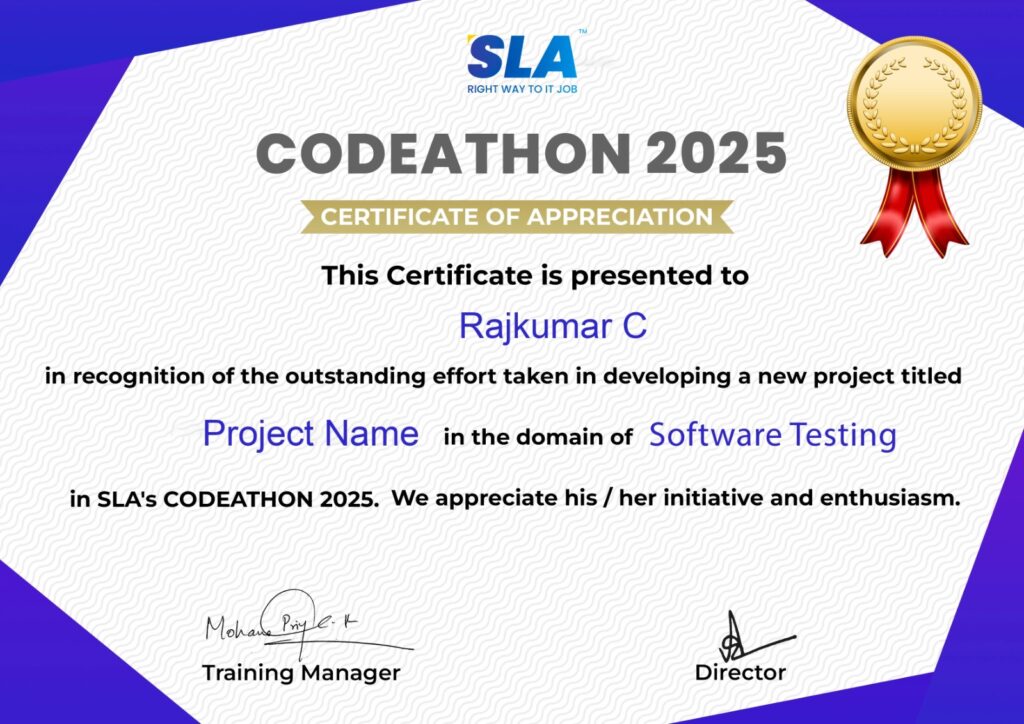
Stand Out from the Crowd with Codethon Certificate
Verify the authenticity of your real-time projects with Softlogic's Codethon certificate.

Hands-on Project Practices in Machine Learning
Traffic Flow Prediction
Chatbot with Real-Time Interaction
Face Recognition System
Real-Time Fraud Detection
Personalized Recommendation System
Autonomous Vehicle Simulation
Real-Time Stock Market Prediction
Predictive Maintenance for IoT Devices
Real-Time Sentiment Analysis
The SLA Way to Get Placed in Top IT Companies
Enrollment

Technology Training
Coding Practices
Realtime Projects
Realtime Projects
Placement Training
Aptitude Training
Interview Skills
Interview Skills
Panel Mock
Interview

Unlimited
Interviews

Interview
Feedback

100%
IT Career
Placement Support for a Machine Learning Job
Genuine Placements. No Backdoor Jobs at Softlogic Systems.

Aptitude Training
from Day 1
Interview Skills
from Day 1

Softskills Training
from Day 1
Build Your Resume

Build your LinkedIn Profile

Build your GitHub
digital portfolio

Panel Mock Interview
Unlimited Interviews until you get placed

Life Long Placement Support at no cost
Request a Free Callback
FAQs
What does dimensionality reduction involve, and why is it significant?
Dimensionality reduction aims to decrease the number of features in a dataset while retaining as much essential information as possible. Techniques such as Principal Component Analysis (PCA) and t-Distributed Stochastic Neighbor Embedding (t-SNE) are used to simplify models, cut down on computational costs, and address issues like the curse of dimensionality.
How does cross-validation enhance the evaluation of machine learning models?
Cross-validation improves model evaluation by dividing the data into multiple subsets or folds. The model is trained on some of these folds and tested on the others. This process is repeated several times, and the results are averaged, providing a more accurate assessment of the model’s performance.
What are activation functions in neural networks, and what role do they play?
Activation functions introduce non-linearity into neural networks, enabling them to learn and model complex patterns. Examples include ReLU (Rectified Linear Unit), Sigmoid, and Tanh. These functions decide whether a neuron should be activated, helping the network capture a broad range of functions.
Can you explain how decision trees operate, including their main benefits and drawbacks?
Decision trees operate by partitioning data into subsets based on feature values, forming a tree-like structure of decisions and outcomes. They are valued for their interpretability and ease of use but can suffer from overfitting and can be sensitive to slight changes in the data.
What is the purpose of regularization, and what are some common methods?
Regularization is used to prevent overfitting by adding a penalty to the complexity of the model. Common methods include L1 regularization (Lasso), which promotes sparsity by setting some weights to zero, and L2 regularization (Ridge), which penalizes large weights without necessarily eliminating them.
What is the purpose of regularization, and what are some common methods?
Regularization is used to prevent overfitting by adding a penalty to the complexity of the model. Common methods include L1 regularization (Lasso), which promotes sparsity by setting some weights to zero, and L2 regularization (Ridge), which penalizes large weights without necessarily eliminating them.
What does transfer learning involve, and how is it applied in machine learning?
Transfer learning involves leveraging a model that has been pre-trained on a large dataset for a new, related task. This technique allows for fine-tuning the existing model rather than starting from scratch, which is particularly useful when there is limited data or computational resources.
What are Generative Adversarial Networks (GANs), and what is their operational mechanism?
Generative Adversarial Networks (GANs) are composed of two opposing neural networks: the generator and the discriminator. The generator creates synthetic data, while the discriminator assesses the authenticity of this data. They are trained together, with the generator trying to create data that can fool the discriminator, and the discriminator aiming to correctly identify real versus fake data.
Where is the corporate office of Softlogic Systems located?
The corporate office of the Softlogic Systems is located at the institute’s K.K.Nagar branch.
What payment methods does Softlogic accept?
Softlogic accepts a wide range of payment methods, including:
- Cash
- Debit cards
- Credit cards (MasterCard, Visa, Maestro)
- Net banking
- UPI
- Including EMI.
Additional Information for
the Machine Learning
Scopes available in the future for learning Machine Learning
The following are the scopes available in the future for learning Machine Learning Course:
- Advanced AI Systems: ML will be integral in developing more sophisticated AI technologies, combining with natural language processing, computer vision, and robotics to build more intelligent and autonomous systems.
- Customized Medicine: ML will advance personalized medicine by analyzing genetic information and patient records to customize treatments and predict health risks.
- Self-Driving Technologies: ML will enhance autonomous vehicles, improving their safety, navigation, and real-time decision-making capabilities.
- Algorithmic Trading: ML will be used to develop advanced trading algorithms that forecast market trends and make more efficient trading decisions.
- IoT Innovations: ML integration with Internet of Things (IoT) devices will lead to smarter homes and industries, enhancing predictive maintenance and automation.
- Enhanced Language Models: ML will facilitate the creation of more advanced NLP models for tasks like translation, sentiment analysis, and human-computer interaction, improving communication tools and virtual assistants.
- Adaptive Learning: ML will foster the development of personalized educational tools that adjust to individual learning styles and progress, thereby enhancing educational experiences.
- Bias Reduction: ML research will focus on methods to minimize biases and ensure fairness in AI systems, addressing ethical issues and promoting equitable technology use.
Related Blogs
Eligibility Criteria For Machine Learning Course
Published On: February 18, 2025
Understanding the eligibility criteria for a machine learning course is important for anyone looking to…
Common Machine Learning Challenges and Solutions for Beginners and Professionals
Published On: November 25, 2024
Introduction Machine learning (ML) has revolutionized a number of sectors, including healthcare and finance, thanks…
Machine Learning Project Ideas
Published On: October 16, 2024
Working on Machine Learning Project Ideas helps students and freshers understand how ML works in…
Machine Learning Engineer Salary For Freshers and Experienced
Published On: September 30, 2024
Introduction In the rapidly evolving world of artificial intelligence, Machine Learning Engineering has turned out…
Machine Learning Tutorial for Beginners
Published On: September 21, 2024
Introduction Feeling overwhelmed by complex math and shifting job requirements? You are not alone. Most…
Machine Learning Interview Questions and Answers
Published On: April 1, 2022
Introduction Machine Learning Process is the new-age technology adopted by companies that are striving hard…





Google Reviews

Rating
4.8
1,053 Google reviews

Surya
Special thanks to Vishal Sir, the Placement Officer, for his interview guidance, resume support, and continuous motivation throughout the placement process. I would also like…

Click here for Full Review

NalluKumar Ravichandran
Hi, I recently completed the DOT NET Full Stack Development course at SLA, and I had a great learning experience. The teaching style and student…
Click here for Full Review

Shaaru Menan
I had a 3 year career break. Joined SLA on Java Full Stack course and completed it.Did projects with the help of my Mentor. They…
Click here for Full Review

Nithish Sahoo
I had an excellent experience taking this DevOps course. The curriculum is well-structured and covers both fundamental and advanced DevOps concepts in a clear manner.…
Click here for Full Review

MATHAN KUMAR G EEE
SLA Institute provides a structured learning environment for data analytics. The syllabus is relevant, and trainers are knowledgeable. Some sessions were very useful practically, while…
Click here for Full Review

SARAN M
SLA Institute provides training in communication and aptitude along with strong technical skills. The trainers explain concepts clearly with a practical approach, which helps build…
Click here for Full Review