
Softlogic is one of the Top Training institutes for J2EE. Learn how to use J2EE, from beginner basics to advanced techniques. Our J2EE syllabus covers the Java 2 Platform, Enterprise Edition concepts such as Servlets, JSP, EJB, JDBC, and Web Services. We offer a J2EE Course with Placement Assistance, Mock interviews, Resume building, and certification.
J2ee Certification Course
4.80
(1538)
DURATION

2 Months
EMI

0% Interest
Mode

Live Online / Offline

Let's take the first step to becoming an expert in J2EE
Click Here to Get Started
Lifelong Placement
Assistance
Get Certified
JOB PLACEMENT ELIGIBILITY TEST
×
Your Placement Eligibility Report
Want more details about J2EE?
Fill out the form, and our counsellors will get in touch with you at your preferred time. You can have all your queries answered. Once you decide that SLA is the perfect fit for your training needs, our counselors will guide you through the process every step of the way.

Course Schedules

Course Syllabus

Course Fees

or any other questions...
Fees, Duration & Batch Timings for J2EE
Hands On Training
3-5 Real Time Projects
60-100 Practical Assignments
3+ Assessments / Mock Interviews
July 2026
Week days
(Mon-Fri)
Online/Offline
2 Hours Real Time Interactive Technical Training
1 Hour Aptitude
1 Hour Communication & Soft Skills
(Suitable for Fresh Jobseekers / Non IT to IT transition)
Course Fee
July 2026
Week ends
(Sat-Sun)
Online/Offline
4 Hours Real Time Interactive Technical Training
(Suitable for working IT Professionals)
Course Fee
Save up to 20% in your Course Fee on our Job Seeker Course Series
Learn More
Syllabus of J2EE
Download Syllabus
Module 1: Remote Method Invocation (RMI)
- Object Persistence and Serialization
- Introduction to Distributed Computing
- RMI Architecture
- Importance of RMI Registry
- Developing Simple RMI application
- Callback Implementation in RMI
Module 2: CORBA
- Introduction to CORBA
- CORBA for Distributed computing
- ORB & IIOP
- Interface Definition Language (IDL)
Module 3: Java EE Application
- Java EE Architecture
- Introduction to Java EE Components, Containers and
- Connectors
- Java EE Modules (Web App, EJB JAR, App Client)
- Structure of Java EE Application (Enterprise Archive)
- Packaging and Deploying Java EE Applications
Module 4: JNDI (Java Naming and Directory Interface)
- Introduction to Naming Services
- JNDI as Java API to Naming Services
- Using JNDI
Module 5: JDBC Extension
- javax.sql package (Extension to JDBC)
- DataSource and Connection Pool
- Using JDBC and JNDI
Module 6: Enterprise JavaBeans [EJB 3]
- Introduction to Server-Side Components
- EJB Design Goals and Roles
- EJB Architecture
- Simplified EJB 3 API
- Metadata Annotations in place of XML
- RMI over IIOP
Types of EJB
- Session Bean
- MessageDriven Bean
- Entity Bean
EJB Container Services
- Transactions
- Security
- Life Cycle Management
- State and Persistence of EJB
Session Beans
- Role of Business Interface
- Remote and Local Interfaces
- Session Bean Lifetime
- Developing Stateless Beans
- Developing Stateful Beans
- Standalone and Web Clients
Module 7: Java Persistence API (JPA)
- Designing Persistent Class
- Entity Fields and Properties
- Entity Instance Creation
- Primary Keys and Entity Identity
- Entity Relationships
- Entity Operations
- Entity Manager
- Entity Instance Life Cycle
- Persistence Context
- Query API
- Query Language
Module 8: Java Transaction Management (JTA)
- The ACID Test for Transactions
- Introduction to JTS & JTA
- Container-Managed Transactions
- Bean-Managed Transactions
- Transaction Attributes
- Using JTA
Module 9: Security Model
- Role-Driven Access Control
- Security Identity
- Security and the Deployment Descriptor
- Using Security Roles
- Accessing Security Information via EJBContext
- Using JAAS to access secure EJB
Module 10: Java Message Service (JMS)
- Benefits of using JMS
- Pub/Sub Model
- Point-to-Point Model
- Message Formats, Headers & Properties
- How JMS fits into EJB system
- Developing Message Driven Beans (MDB)
Module 11: Web Services
- Introduction to Web Services
- Service Oriented Architecture
- Architecture and Advantages
- SOAP Significance
- WSDL Importance
- Web Service Annotations
- Implementing a Web Service
- Java API for XML Web Services (JAX-WS)
- Writing a Web Service Client
Objectives of J2EE
The J2EE Training will cover all the topics ranging from fundamental to advanced concepts, which will make it easy for students to grasp J2EE. The J2EE Course Curriculum is composed of some of the most useful and rare concepts that will surely give students a complete understanding of J2EE as well. So, some of those curriculum are discussed below as objectives:
- To make students well-versed with fundamental concepts of J2EE like – Remote Method Invocation, CORBA, Java EE Application, Java Naming and Directory Interface etc.
- To make students more aware of J2EE by making them learn concepts like – JDBC Extension, Enterprise JavaBeans, Types of EJB, EJB Container Services, Designing Persistent Class etc.
- To make students knowledgeable on advanced concepts of J2EE like – Java Transaction Management, Security Model, Java Message Services, Web Services etc.
Request a Free Callback
Why Softlogic Systems is the Best Choice for J2EE – Learn, Practice, and Get Placed!
Online & Offline Training Options
Learn at your convenience with flexible classroom and live online training.

Learn from 100+ Real-Time Developers
Get trained by industry professionals with years of hands-on experience.

Hands-on Projects & Codeathons
Practice with real-time projects and coding challenges to build confidence.
0% EMI Fee Options
Pay your course fees flexibly with easy EMI plans at zero interest.

Resume & Interview Support
Get expert help with resume building, mock interviews, and soft skills.

Placement with Top IT Firms
Access placement opportunities with leading MNCs and IT companies.

1000+ Hiring Partners
Benefit from Softlogic’s strong recruiter network for faster job placement.

No Backdoor Jobs
We ensure only genuine placement opportunities with trusted companies.
Request a Free Callback
Highlights of J2EE
What is J2EE?
J2EE, now Jakarta EE, is a set of Java specifications for building enterprise applications. It includes technologies like Servlets, JSP, EJB, and JMS for creating scalable, reliable, and distributed applications. Jakarta EE, maintained by the Eclipse Foundation, continues to enhance enterprise Java development with advanced features.
What is J2EE Full Stack?
J2EE Full Stack encompasses a range of technologies for developing both front-end and back-end components of enterprise applications using Jakarta EE. It includes front-end tools like HTML/CSS/JavaScript and JSP/JSF, back-end technologies such as Servlets and EJB, and integration tools like JMS, JNDI, and RESTful APIs.
What are the reasons for learning J2EE?
The following are the reasons for learning J2EE:
- Enterprise Application Development: J2EE offers a strong framework for building scalable, reliable, and distributed enterprise applications.
- Career Prospects: Expertise in J2EE can lead to various roles like Java Developer, Systems Architect, or Enterprise Application Developer, often with attractive salary packages.
- High Demand: J2EE technologies are widely used in large organizations, making knowledge in this area highly sought after.
- Broad Skill Set: J2EE encompasses various technologies, including Servlets, JSP, EJB, and JMS, providing a versatile skill set for different projects.
What are the prerequisites for learning J2EE?
The following are the prerequisites for learning J2EE, but they are not mandatory:
- Core Java: Proficiency in Java basics, including syntax, object-oriented programming (OOP) principles, data types, and exception handling.
- Classes and Objects: Knowledge of classes, objects, inheritance, polymorphism, encapsulation, and abstraction.
- HTML/CSS: Understanding of HTML for page structure and CSS for styling.
- Networking: Awareness of basic networking concepts to aid in integrating applications and services.
What are the course fees and duration?
Our J2EE Course Fees may vary depending on the specific course program you choose (basic / intermediate / full stack), course duration, and course format (remote or in-person). On an average the J2EE Course Fees range from 25k to 30k, for a duration of 2 months total with international certification.
What are some of the jobs related to J2EE?
The following are the jobs related to J2EE:
- Java Developer
- Enterprise Application Developer
- Systems Architect
- Software Engineer
- Backend Developer
- Full Stack Developer
List a few real time J2EE applications.
The following are the real-time J2EE applications:
- E-commerce platforms like Amazon, ebay
- Enterprise Resource Planning (ERP) Systems
- Customer Relationship Management (CRM) Systems
- Financial Services Applications
- Healthcare Management Systems
- Telecommunication Systems
Boost Your Skills with Our J2EE Experts
Our Mentors are from Top Companies like:
- Our trainers are seasoned J2EE experts with over a decade of experience in crafting Java-based enterprise solutions.
- They excel in deploying applications within enterprise environments using J2EE architecture and have extensive experience in developing multi-tier applications with Java EE technologies, frameworks, and web services.
- They possess a deep understanding of the Object-Oriented programming model and have expert knowledge in Java, J2EE, Servlets, JMS, EJB, JDBC, JSP, XML, JavaScript, HTML, and CSS.
- Their skills include designing lightweight and secure applications that adhere to architectural principles and industry standards.
- They are well-versed in web technologies, design patterns, and best practices within the industry. Their proficiency extends to using Hibernate, Spring, Struts, and AJAX for creating interactive web applications. They have a thorough grasp of JDBC APIs, web services (RESTful and SOAP), Enterprise JavaBeans, and messaging technologies.
- Additionally, they have experience with messaging and integration architectures using platforms like WebLogic JMS, MQSeries, Tibco EMS, and Apache Camel.
- Their credentials include certifications such as Oracle Certified Master Java EE 5/6, Java SE Programmer, Spring Certified Professional, and Oracle Certified Professional Java SE 6 Programmer.
- With a collaborative approach and a positive attitude, they are dedicated to helping students master J2EE, prepare for interviews, and excel in their job search.
Request a Free Callback
What Modes of Training are available for J2EE?
Offline / Classroom Training

A Personalized Learning Experience with Direct Trainer Engagement!
- Direct Interaction with the Trainer
- Clarify doubts then and there
- Airconditioned Premium Classrooms and Lab with all amenities
- Codeathon Practices
- Direct Aptitude Training
- Live Interview Skills Training
- Direct Panel Mock Interviews
- Campus Drives
- 100% Placement Support
Online Training

Instructor Led Live Training! Learn at the comfort of your home
- No Recorded Sessions
- Live Virtual Interaction with the Trainer
- Clarify doubts then and there virtually
- Live Virtual Interview Skills Training
- Live Virtual Aptitude Training
- Online Panel Mock Interviews
- 100% Placement Support
Corporate Training

Blended Delivery model (both Online and Offline as per Clients’ requirement)
- Industry endorsed Skilled Faculties
- Flexible Pricing Options
- Customized Syllabus
- 12X6 Assistance and Support
GET Free Consultation
Certifications
Take your career to new heights with Softlogic's software training certifications.
Improve your abilities to get access to rewarding possibilities
Improve your abilities to get access to rewarding possibilities

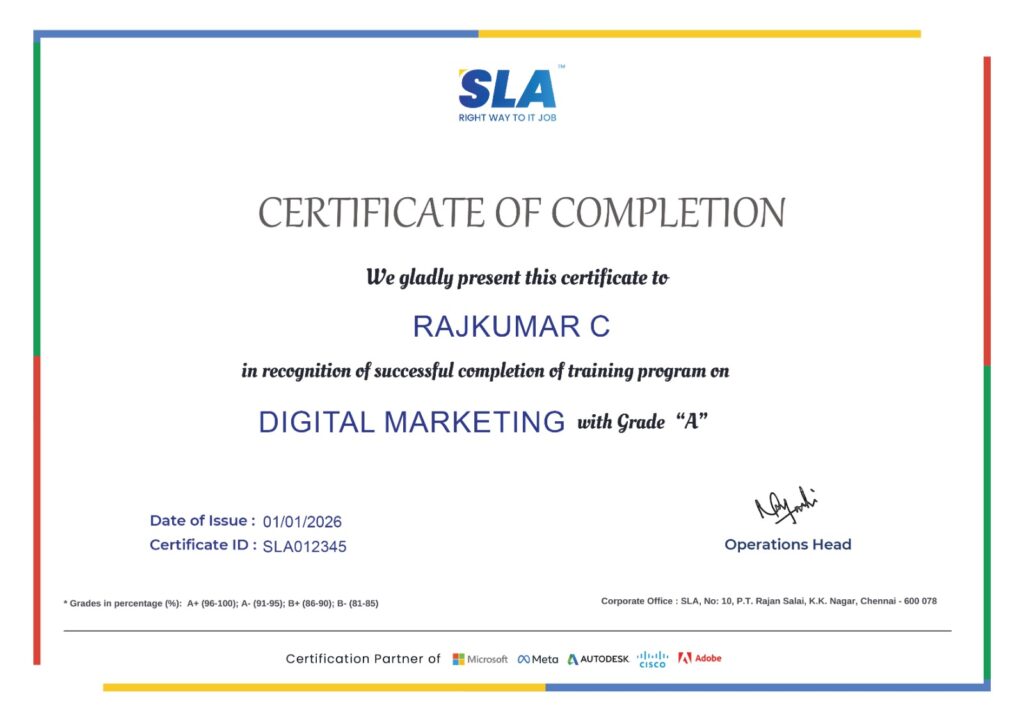
Earn Your Certificate of Completion
Validate your achievements with Softlogic's Certificate of Completion, verifying successful fulfillment of all essential components.
Take Your Career to the Next Level with Certifications
Get a certifications through our training programs to gain a competitive edge in the industry.

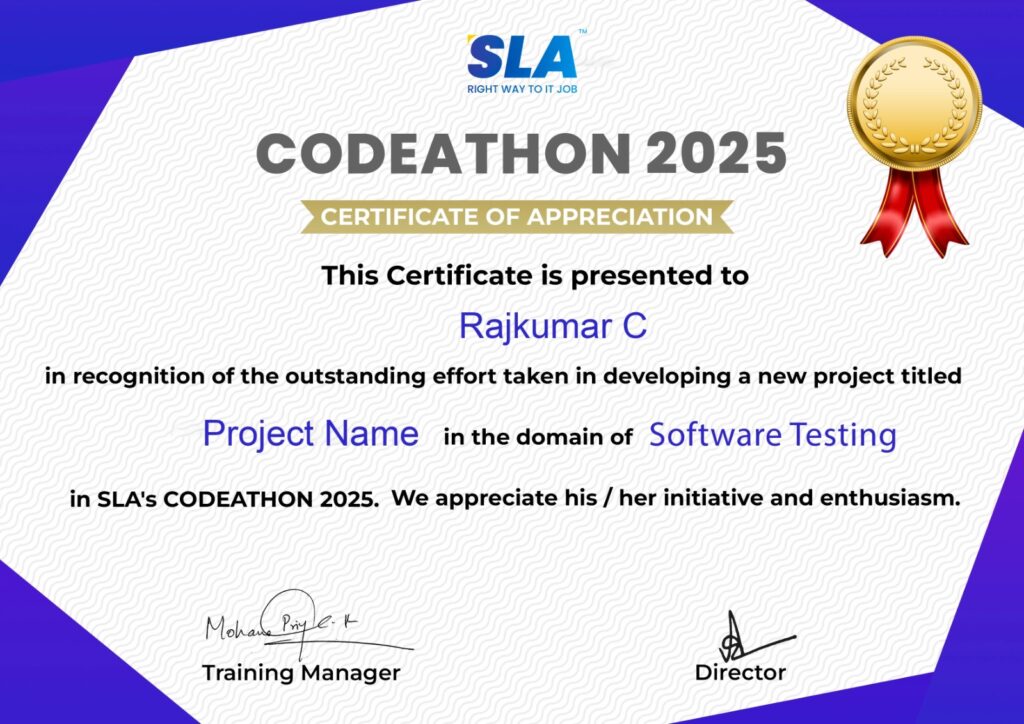
Stand Out from the Crowd with Codethon Certificate
Verify the authenticity of your real-time projects with Softlogic's Codethon certificate.
Hands-on Project Practices in J2EE
Social Networking Platform
Healthcare Management System
Event Management System
Learning Management System (LMS)
Inventory Tracking System
Hotel Booking System
Customer Relationship Management (CRM) System
E-Commerce Platform
Online Banking Application
The SLA Way to Get Placed in Top IT Companies
Enrollment

Technology Training
Coding Practices
Realtime Projects
Realtime Projects
Placement Training
Aptitude Training
Interview Skills
Interview Skills
Panel Mock
Interview

Unlimited
Interviews

Interview
Feedback

100%
IT Career
Placement Support for a J2EE Job
Genuine Placements. No Backdoor Jobs at Softlogic Systems.

Aptitude Training
from Day 1
Interview Skills
from Day 1

Softskills Training
from Day 1
Build Your Resume

Build your LinkedIn Profile

Build your GitHub
digital portfolio

Panel Mock Interview
Unlimited Interviews until you get placed

Life Long Placement Support at no cost
Request a Free Callback
FAQs
What distinguishes Servlets from JavaServer Pages (JSP)?
Servlets are Java classes designed to manage HTTP requests and responses, handling the business logic on the server side. JavaServer Pages (JSP), on the other hand, are used to generate dynamic web content by embedding Java code within HTML. Servlets focus on processing application logic, while JSPs handle the presentation layer.
How does Enterprise JavaBeans (EJB) manage transactions?
EJB facilitates transaction management through container-managed transactions. The EJB contains overseas transaction boundaries, automatically committing or rolling back transactions based on the outcome of business operations, which simplifies the process for developers.
What function does the Java Persistence API (JPA) serve in J2EE applications?
JPA provides a framework for object-relational mapping (ORM), enabling developers to interact with relational databases using Java objects. It streamlines database access by mapping Java entities to database tables and managing CRUD operations, minimizing the need for manual SQL coding.
In what way does Java Message Service (JMS) support messaging between distributed components?
JMS offers a messaging API for the asynchronous exchange of messages between distributed Java components. It supports communication through message queues and topics, helping to decouple system components and enhance scalability.
What is JavaServer Faces (JSF) and how does it differ from JSP?
JSF is a component-based framework for creating user interfaces in Java web applications. Unlike JSP, which integrates Java code directly into HTML, JSF employs reusable UI components and maintains the state of these components across requests, promoting a more organized and maintainable UI development approach.
Can you describe dependency injection in the context of J2EE?
Dependency injection (DI) is a design pattern utilized in J2EE to manage the dependencies between components. It allows components to receive necessary services or resources from an external source rather than instantiating them internally, fostering loose coupling and improving testability.
What advantages does the JavaBeans Activation Framework (JAF) offer in J2EE applications?
JAF provides a framework for managing different data types, especially for processing MIME types and handling data such as email attachments. It standardizes data handling processes, making it easier for applications to manage various data formats.
How does Java Naming and Directory Interface (JNDI) aid in resource lookup within J2EE applications?
JNDI offers a unified interface for accessing naming and directory services, such as LDAP. In J2EE applications, it is used to look up and connect to resources like databases and EJBs, ensuring a consistent and reliable method for resource management.
Where is the corporate office of Softlogic Systems located?
The corporate office of the Softlogic Systems is located at the institute’s K.K.Nagar branch.
What payment methods does Softlogic accept?
Softlogic accepts a wide range of payment methods, including:
- Cash
- Debit cards
- Credit cards (MasterCard, Visa, Maestro)
- Net banking
- UPI
- Including EMI.
Additional Information for
the J2EE
Scopes available in the future for learning J2EE
The following are the scopes available in the future for learning J2EE Course:
- Cloud-Based Development: With the growing adoption of cloud computing, J2EE skills are essential for developing and deploying cloud-native applications on platforms such as AWS, Azure, and Google Cloud. Proficiency in Jakarta EE technologies within cloud environments is vital for contemporary application development.
- Microservices Framework: Transitioning to microservices architecture involves dividing applications into smaller, independently deployable components. Jakarta EE supports this approach through frameworks like MicroProfile, which extends Java EE for cloud-native and microservice-based scenarios.
- Containerization and DevOps Integration: Technologies such as Docker and Kubernetes are revolutionizing application deployment and management. J2EE expertise is valuable for creating and managing containerized Java applications and integrating them into DevOps pipelines for continuous integration and delivery.
- Serverless Architecture: Serverless computing allows for running code in response to events without server management. Knowledge of developing serverless applications with Jakarta EE and integrating them with serverless platforms presents new opportunities in this evolving field.
- Modern Front-End Integration: Combining J2EE with contemporary front-end frameworks like Angular, React, or Vue.js is crucial for building dynamic and robust web applications. Mastery of J2EE complements skills in these frameworks, enabling the creation of comprehensive full-stack solutions.
- Big Data and Analytics: As big data and analytics gain prominence, robust backend systems are needed to handle large data volumes. Jakarta EE can be leveraged to build scalable applications that process big data and integrate with tools like Apache Hadoop or Spark.
- Enterprise Integration Solutions: As businesses require seamless integration across various systems and services, expertise in J2EE technologies for implementing enterprise integration patterns (EIPs) and message-driven beans (MDBs) is crucial for designing effective integration strategies.
- Advanced Security Practices: With increasing cybersecurity concerns, implementing sophisticated security measures in Jakarta EE applications is essential. This includes applying best practices for authentication, authorization, and data protection.
Related Blogs
J2EE Challenges and Solutions for Java Aspirants
Published On: November 23, 2024
Introduction It is not difficult to design and construct a Java/J2EE application. In actuality, you…
J2EE Project Ideas
Published On: October 16, 2024
Introduction If you’re a computer science student or fresher looking to strengthen your backend development…
J2EE Developer Salary For Freshers and Experienced
Published On: September 26, 2024
Introduction In the ever-changing tech environment, J2EE (Jakarta EE) is one of the most fundamental…
J2EE Tutorial for Beginners
Published On: September 20, 2024
Introduction Does Java excite you, yet you're confused about how to go about architecting large…
J2EE Interview Questions and Answers
Published On: June 7, 2024
Introduction J2EE (Java 2 Enterprise Edition) mastery is essential for creating scalable and secure multi-tier…
Google Reviews

Rating
4.8
1,053 Google reviews

Shaaru Menan
I had a 3 year career break. Joined SLA on Java Full Stack course and completed it.Did projects with the help of my Mentor. They…

Click here for Full Review

SARAN M
SLA Institute provides training in communication and aptitude along with strong technical skills. The trainers explain concepts clearly with a practical approach, which helps build…
Click here for Full Review

NalluKumar Ravichandran
Hi, I recently completed the DOT NET Full Stack Development course at SLA, and I had a great learning experience. The teaching style and student…
Click here for Full Review

Nithish Sahoo
I had an excellent experience taking this DevOps course. The curriculum is well-structured and covers both fundamental and advanced DevOps concepts in a clear manner.…
Click here for Full Review

MATHAN KUMAR G EEE
SLA Institute provides a structured learning environment for data analytics. The syllabus is relevant, and trainers are knowledgeable. Some sessions were very useful practically, while…
Click here for Full Review

Surya
Special thanks to Vishal Sir, the Placement Officer, for his interview guidance, resume support, and continuous motivation throughout the placement process. I would also like…
Click here for Full Review