
Softlogic is one of the Top Training institutes for Big Data and Hadoop. Learn how to use Big Data and Hadoop, from beginner basics to advanced techniques. Our Big Data Hadoop Syllabus covers the core components such as HDFS, MapReduce, YARN, Hive, Pig, HBase, Sqoop, and Flume, along with an introduction to Apache Spark for fast data processing. We offer a Big Data and Hadoop Course with Placement Assistance, Mock interviews, Resume building, and certification.
Big Data Hadoop Certification Training Course
4.90
(1538)
DURATION

2 Months
EMI

0% Interest
Mode

Live Online / Offline

Let's take the first step to becoming an expert in Big Data Hadoop
Click Here to Get Started
Lifelong Placement
Assistance
Get Certified
JOB PLACEMENT ELIGIBILITY TEST
×
Your Placement Eligibility Report
Want more details about Big Data Hadoop?
Fill out the form, and our counsellors will get in touch with you at your preferred time. You can have all your queries answered. Once you decide that SLA is the perfect fit for your training needs, our counselors will guide you through the process every step of the way.

Course Schedules

Course Syllabus

Course Fees

or any other questions...
Fees, Duration & Batch Timings for Big Data Hadoop
Hands On Training
3-5 Real Time Projects
60-100 Practical Assignments
3+ Assessments / Mock Interviews
July 2026
Week days
(Mon-Fri)
Online/Offline
2 Hours Real Time Interactive Technical Training
1 Hour Aptitude
1 Hour Communication & Soft Skills
(Suitable for Fresh Jobseekers / Non IT to IT transition)
Course Fee
July 2026
Week ends
(Sat-Sun)
Online/Offline
4 Hours Real Time Interactive Technical Training
(Suitable for working IT Professionals)
Course Fee
Save up to 20% in your Course Fee on our Job Seeker Course Series
Learn More
Syllabus of Big Data Hadoop
Download Syllabus
Big Data : Introduction
❖ What is Big Data
❖ Evolution of Big Data
❖ Benefits of Big Data
❖ Operational vs Analytical Big Data
❖ Need for Big Data Analytics
❖ Big Data Challenges
Hadoop cluster
❖ Master Nodes
❖ Name Node
❖ Secondary Name Node
❖ Job Tracker
❖ Client Nodes
❖ Slaves
❖ Hadoop configuration
❖ Setting up a Hadoop cluster
HDFS
❖ Introduction to HDFS
❖ HDFS Features
❖ HDFS Architecture
❖ Blocks
❖ Goals of HDFS
❖ The Name node & Data Node
❖ Secondary Name node
❖ The Job Tracker
❖ The Process of a File Read
❖ How does a File Write work
❖ Data Replication
❖ Rack Awareness
❖ HDFS Federation
❖ Configuring HDFS
❖ HDFS Web Interface
❖ Fault tolerance
❖ Name node failure management
❖ Access HDFS from Java
Yarn
❖ Introduction to Yarn
❖ Why Yarn
❖ Classic MapReduce v/s Yarn
❖ Advantages of Yarn
❖ Yarn Architecture
❖ Resource Manager
❖ Node Manager
❖ Application Master
❖ Application submission in YARN
❖ Node Manager containers
❖ Resource Manager components
❖ Yarn applications
❖ Scheduling in Yarn
❖ Fair Scheduler
❖ Capacity Scheduler
❖ Fault tolerance
MapReduce
❖ What is MapReduce
❖ Why MapReduce
❖ How MapReduce works
❖ Difference between Hadoop 1 & Hadoop 2
❖ Identity mapper & reducer
❖ Data flow in MapReduce
❖ Input Splits
❖ Relation Between Input Splits and HDFS Blocks
❖ Flow of Job Submission in MapReduce
❖ Job submission & Monitoring
❖ MapReduce algorithms
❖ Sorting
❖ Searching
❖ Indexing
❖ TF-IDF
Hadoop Fundamentals
❖ What is Hadoop
❖ History of Hadoop
❖ Hadoop Architecture
❖ Hadoop Ecosystem Components
❖ How does Hadoop work
❖ Why Hadoop & Big Data
❖ Hadoop Cluster introduction
❖ Cluster Modes
❖ Standalone
❖ Pseudo-distributed
❖ Fully – distributed
❖ HDFS Overview
❖ Introduction to MapReduce
❖ Hadoop in demand
HDFS Operations
❖ Starting HDFS
❖ Listing files in HDFS
❖ Writing a file into HDFS
❖ Reading data from HDFS
❖ Shutting down HDFS
HDFS Command Reference
❖ Listing contents of directory
❖ Displaying and printing disk usage
❖ Moving files & directories
❖ Copying files and directories
❖ Displaying file contents
Java Overview For Hadoop
❖ Object oriented concepts
❖ Variables and Data types
❖ Static data type
❖ Primitive data types
❖ Objects & Classes
❖ Java Operators
❖ Method and its types
❖ Constructors
❖ Conditional statements
❖ Looping in Java
❖ Access Modifiers
❖ Inheritance
❖ Polymorphism
❖ Method overloading & overriding
❖ Interfaces
MapReduce Programming
❖ Hadoop data types
❖ The Mapper Class
❖ Map method
❖ The Reducer Class
❖ Shuffle Phase
❖ Sort Phase
❖ Secondary Sort
❖ Reduce Phase
❖ The Job class
❖ Job class constructor
❖ Job Context interface
❖ Combiner Class
❖ How Combiner works
❖ Record Reader
❖ Map Phase
❖ Combiner Phase
❖ Reducer Phase
❖ Record Writer
❖ Partitioners
❖ Input Data
❖ Map Tasks
❖ Partitioner Task
❖ Reduce Task
❖ Compilation & Execution
Hadoop Ecosystems Pig
❖ What is Apache Pig?
❖ Why Apache Pig?
❖ Pig features
❖ Where should Pig be used
❖ Where not to use Pig
❖ The Pig Architecture
❖ Pig components
❖ Pig v/s MapReduce
❖ Pig v/s SQL
❖ Pig v/s Hive
❖ Pig Installation
❖ Pig Execution Modes & Mechanisms
❖ Grunt Shell Commands
❖ Pig Latin – Data Model
❖ Pig Latin Statements
❖ Pig data types
❖ Pig Latin operators
❖ Case Sensitivity
❖ Grouping & Co Grouping in Pig Latin
❖ Sorting & Filtering
❖ Joins in Pig latin
❖ Built-in Function
❖ Writing UDFs
❖ Macros in Pig
HBase
❖ What is HBase
❖ History Of HBase
❖ The NoSQL Scenario
❖ HBase & HDFS
❖ Physical Storage
❖ HBase v/s RDBMS
❖ Features of HBase
❖ HBase Data model
❖ Master server
❖ Region servers & Regions
❖ HBase Shell
❖ Create table and column family
❖ The HBase Client API
Spark
❖ Introduction to Apache Spark
❖ Features of Spark
❖ Spark built on Hadoop
❖ Components of Spark
❖ Resilient Distributed Datasets
❖ Data Sharing using Spark RDD
❖ Iterative Operations on Spark RDD
❖ Interactive Operations on Spark RDD
❖ Spark shell
❖ RDD transformations
❖ Actions
❖ Programming with RDD
❖ Start Shell
❖ Create RDD
❖ Execute Transformations
❖ Caching Transformations
❖ Applying Action
❖ Checking output
❖ GraphX overview
Impala
❖ Introducing Cloudera Impala
❖ Impala Benefits
❖ Features of Impala
❖ Relational databases vs Impala
❖ How Impala works
❖ Architecture of Impala
❖ Components of the Impala
❖ The Impala Daemon
❖ The Impala Statestore
❖ The Impala Catalog Service
❖ Query Processing Interfaces
❖ Impala Shell Command Reference
❖ Impala Data Types
❖ Creating & deleting databases and tables
❖ Inserting & overwriting table data
❖ Record Fetching and ordering
❖ Grouping records
❖ Using the Union clause
❖ Working of Impala with Hive
❖ Impala v/s Hive v/s HBase
MongoDB Overview
❖ Introduction to MongoDB
❖ MongoDB v/s RDBMS
❖ Why & Where to use MongoDB
❖ Databases & Collections
❖ Inserting & querying documents
❖ Schema Design
❖ CRUD Operations
Oozie & Hue Overview
❖ Introduction to Apache Oozie
❖ Oozie Workflow
❖ Oozie Coordinators
❖ Property File
❖ Oozie Bundle system
❖ CLI and extensions
❖ Overview of Hue
Hive
❖ What is Hive?
❖ Features of Hive
❖ The Hive Architecture
❖ Components of Hive
❖ Installation & configuration
❖ Primitive types
❖ Complex types
❖ Built in functions
❖ Hive UDFs
❖ Views & Indexes
❖ Hive Data Models
❖ Hive vs Pig
❖ Co-groups
❖ Importing data
❖ Hive DDL statements
❖ Hive Query Language
❖ Data types & Operators
❖ Type conversions
❖ Joins
❖ Sorting & controlling data flow
❖ local vs mapreduce mode
❖ Partitions
❖ Buckets
Sqoop
❖ Introducing Sqoop
❖ Scoop installation
❖ Working of Sqoop
❖ Understanding connectors
❖ Importing data from MySQL to Hadoop HDFS
❖ Selective imports
❖ Importing data to Hive
❖ Importing to Hbase
❖ Exporting data to MySQL from Hadoop
❖ Controlling import process
Flume
❖ What is Flume?
❖ Applications of Flume
❖ Advantages of Flume
❖ Flume architecture
❖ Data flow in Flume
❖ Flume features
❖ Flume Event
❖ Flume Agent
❖ Sources
❖ Channels
❖ Sinks
❖ Log Data in Flume
Zookeeper Overview
❖ Zookeeper Introduction
❖ Distributed Application
❖ Benefits of Distributed Applications
❖ Why use Zookeeper
❖ Zookeeper Architecture
❖ Hierarchial Namespace
❖ Znodes
❖ Stat structure of a Znode
❖ Electing a leader
Objectives of Big Data Hadoop
The objectives of learning Big Data Hadoop Training include
- Understand Hadoop Basics: Learn about Hadoop’s core components and architecture for managing large datasets.
- Master Hadoop Ecosystem: Get familiar with Hadoop ecosystem tools like HDFS, MapReduce, Hive, and Pig.
- Data Processing: Gain skills in processing and analyzing large volumes of data using Hadoop.
- Work with HDFS: Learn how to store and manage data in Hadoop Distributed File System (HDFS).
- Develop MapReduce Jobs: Understand how to write and execute MapReduce programs for data processing.
Request a Free Callback
Why Softlogic Systems is the Best Choice for Big Data Hadoop – Learn, Practice, and Get Placed!

Online & Offline Training Options
Learn at your convenience with flexible classroom and live online training.

Learn from 100+ Real-Time Developers
Get trained by industry professionals with years of hands-on experience.

Hands-on Projects & Codeathons
Practice with real-time projects and coding challenges to build confidence.
0% EMI Fee Options
Pay your course fees flexibly with easy EMI plans at zero interest.

Resume & Interview Support
Get expert help with resume building, mock interviews, and soft skills.

Placement with Top IT Firms
Access placement opportunities with leading MNCs and IT companies.

1000+ Hiring Partners
Benefit from Softlogic’s strong recruiter network for faster job placement.

No Backdoor Jobs
We ensure only genuine placement opportunities with trusted companies.
Request a Free Callback
Highlights of Big Data Hadoop
What is Big Data Hadoop?
Big Data Hadoop is a free framework for managing and analyzing large amounts of data. It uses Hadoop’s HDFS for storing data and MapReduce for processing it, making it easier to handle big data across multiple computers.
What are the reasons for learning Big Data Hadoop?
Learning Big Data Hadoop is useful because:
- Manage Large Data: It helps handle and analyze big amounts of data easily.
- Job Opportunities: Hadoop skills are highly sought after in many industries.
- Affordable: It’s free to use, which saves money on data management.
- Scalability: Hadoop grows with your data needs.
- Fast Processing: It processes large data quickly using multiple computers.
- New Technology: Learning Hadoop lets you work with cutting-edge data tools.
What are the prerequisites for learning Big Data Hadoop?
There are no mandatory prerequisites for learning Big Data Hadoop. However, having a basic understanding of programming and data concepts can be helpful.
Our Big Data Hadoop Training is suitable for:
- Students
- Professionals seeking a career change
- IT professionals aiming to enhance their skills
- Enthusiastic programmers
- Job Seekers
What are the course fees and duration?
Our Big Data Hadoop Training fees depend on the level (basic, intermediate, or advanced) and the format (online or in-person). The course usually costs about 25,000 INR and lasts around 2 months, including international certification. For the latest details on fees and certification, please contact us directly.
What are some job roles related to Big Data Hadoop?
Here are some job roles related to Big Data Hadoop:
- Big Data Engineer: Builds and manages systems to handle large amounts of data.
- Data Scientist: Analyzes data to help businesses make decisions.
- Data Analyst: Looks at data to provide useful insights.
- Hadoop Developer: Creates and maintains Hadoop applications.
- Hadoop Administrator: Oversees and maintains Hadoop systems.
What is the salary range for Hadoop Developer?
A new Hadoop Developer earns about ₹4,00,000 Lakhs per year. A Hadoop Developer with 4-9 years of experience makes around ₹8,30,000 Lakhs annually. Those with 10-20 years of experience earn about ₹20,30,000 Lakhs per year.
List a few Big Data Hadoop real-time applications.
Here are a few real-time applications made with Big Data Hadoop:
- Fraud Detection: Spotting and stopping fraudulent activities in financial transactions.
- Recommendation Systems: Suggesting products or content based on user activity.
- Predictive Maintenance: Predicting equipment failures to avoid breakdowns.
- Customer Analytics: Using customer data to improve marketing and service.
Boost Your Skills with Our Big Data Hadoop Experts
Our Mentors are from Top Companies like:
- Our trainers have extensive experience with Big Data Hadoop across various industries, ensuring practical and relevant knowledge.
- Each trainer is certified in Big Data Hadoop and related technologies, guaranteeing high-quality instruction and expertise.
- Trainers have real-world experience and keep up with current industry trends and best practices in Big Data.
- They are skilled educators who make complex concepts easy to understand through clear and effective teaching methods.
- Trainers provide hands-on experience with real-world examples and projects, enhancing practical learning and application.
- They offer personalized support and guidance throughout the training, addressing individual needs and learning goals.
- Trainers stay current with the latest advancements in Big Data technologies to ensure up-to-date knowledge and practices.
- The sessions are interactive and engaging, fostering a dynamic learning environment and active participation.
- Trainers focus on solving real-world problems and analyzing case studies to provide practical, problem-solving skills.
- They also offer career advice and support for job placement, helping you advance in the Big Data field.
Request a Free Callback
What Modes of Training are available for Big Data Hadoop?
Offline / Classroom Training

A Personalized Learning Experience with Direct Trainer Engagement!
- Direct Interaction with the Trainer
- Clarify doubts then and there
- Airconditioned Premium Classrooms and Lab with all amenities
- Codeathon Practices
- Direct Aptitude Training
- Live Interview Skills Training
- Direct Panel Mock Interviews
- Campus Drives
- 100% Placement Support
Online Training

Instructor Led Live Training! Learn at the comfort of your home
- No Recorded Sessions
- Live Virtual Interaction with the Trainer
- Clarify doubts then and there virtually
- Live Virtual Interview Skills Training
- Live Virtual Aptitude Training
- Online Panel Mock Interviews
- 100% Placement Support
Corporate Training

Blended Delivery model (both Online and Offline as per Clients’ requirement)
- Industry endorsed Skilled Faculties
- Flexible Pricing Options
- Customized Syllabus
- 12X6 Assistance and Support
GET Free Consultation
Certifications
Take your career to new heights with Softlogic's software training certifications.
Improve your abilities to get access to rewarding possibilities
Improve your abilities to get access to rewarding possibilities

Earn Your Certificate of Completion
Validate your achievements with Softlogic's Certificate of Completion, verifying successful fulfillment of all essential components.
Take Your Career to the Next Level with Certifications
Get a certifications through our training programs to gain a competitive edge in the industry.

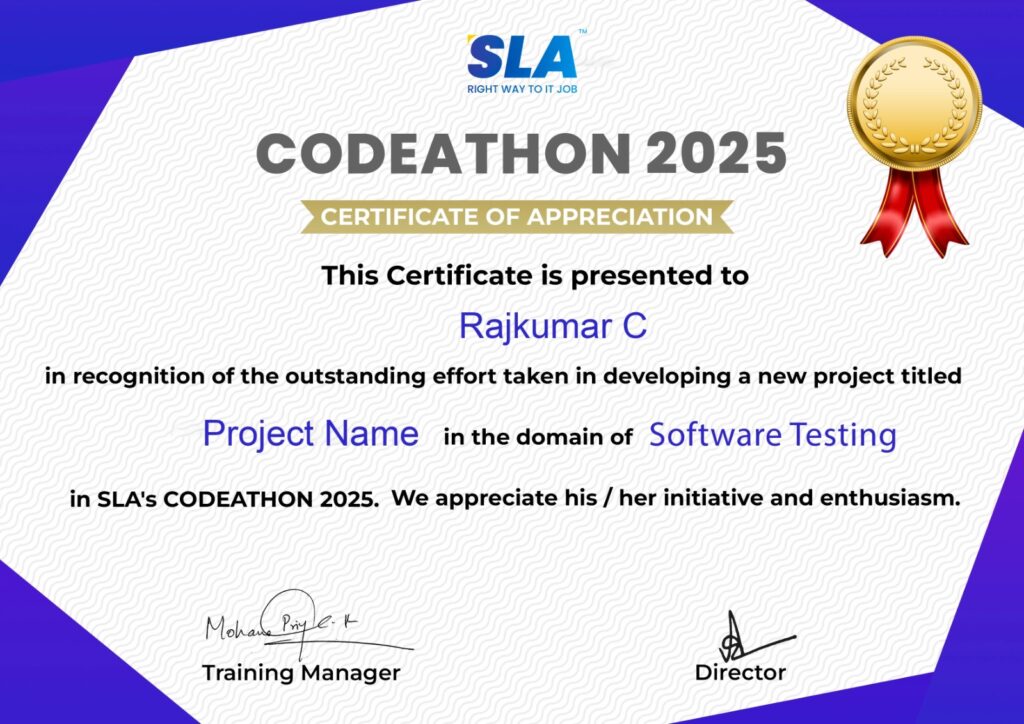
Stand Out from the Crowd with Codethon Certificate
Verify the authenticity of your real-time projects with Softlogic's Codethon certificate.

Hands-on Project Practices in Big Data Hadoop
Fraud Detection
Healthcare Data Analysis
Text Mining
IoT Data Processing
Predictive Analytics
Sentiment Analysis
Recommendation Engine
Log Analysis
Customer Segmentation
The SLA Way to Get Placed in Top IT Companies
Enrollment

Technology Training
Coding Practices
Realtime Projects
Realtime Projects
Placement Training
Aptitude Training
Interview Skills
Interview Skills
Panel Mock
Interview

Unlimited
Interviews

Interview
Feedback

100%
IT Career
Placement Support for a Big Data Hadoop Job
Genuine Placements. No Backdoor Jobs at Softlogic Systems.

Aptitude Training
from Day 1
Interview Skills
from Day 1

Softskills Training
from Day 1
Build Your Resume

Build your LinkedIn Profile

Build your GitHub
digital portfolio

Panel Mock Interview
Unlimited Interviews until you get placed

Life Long Placement Support at no cost
Request a Free Callback
FAQs
Does Big Data Hadoop require coding?
Yes, Big Data Hadoop requires some coding. You’ll need to write code for MapReduce programs and custom scripts. While tools like Hive and Pig are easier to use, knowing how to code helps with more complex tasks.
Is it easy to learn Big Data Hadoop?
Learning Big Data Hadoop can be tough, especially if you’re new to coding and data. But with good training and practice, it gets easier over time. Starting with basics and doing projects helps a lot.
Can a fresher learn Big Data Hadoop?
Yes, a fresher can learn Big Data Hadoop. By starting with the basics and following a good training program, even beginners can understand and use Hadoop effectively.
Is Big Data Hadoop in demand?
Yes, Big Data Hadoop is in high demand. Many companies use it to handle and analyze large data sets, making skills in Hadoop valuable in the job market.
Can I still join job placement events if I already have a job offer?
Definitely! We offer ongoing placement assistance to help candidates achieve their career goals. Contact our career advisor to arrange a free demo for the leading Big Data Hadoop online course, featuring placement support.
Does SLA support the EMI option?
Yes, SLA does indeed give the option of EMI to students with 0% interest.
How does the placement team at SLA support us?
The placement team at SLA enhances your job prospects by providing comprehensive support. Whether you’re a certified student looking to switch careers or entering the workforce for the first time, you’ll receive extensive assistance through our placement services. SLA offers the following premium services as part of our placement support:
- Resume building
- Career guidance and advising
- Interview practice sessions
- Career expos
What accreditation will I get once the course is completed?
Upon completion of SLA’s training, you will be awarded with globally recognized course completion certificates from SLA, renowned IBM certificates, and Codeathon certificates, validating your real-time project experience.
What are the different payment options available?
We accept all sort of major payment methods like cash, credit cards (Visa, Maestro, Master card), Netbanking, etc
I have more queries?
Please contact our course counselor by call or Whatsapp at +91 86818 84318. As an alternative, you can use our Website chat, Website form, or email us at enquiry@softlogicsys.in
Additional Information for
the Big Data Hadoop
Growing Demand
Big Data Hadoop skills are increasingly sought after as organizations rely more on data for decision-making. The demand for professionals who can manage and analyze large data sets continues to rise, making Hadoop expertise highly valuable.
Career Opportunities
With experience in Big Data Hadoop, you can explore diverse roles such as Hadoop Developer, Data Analyst, and Data Engineer. These positions offer excellent career prospects and the chance to work on exciting, data-driven projects across various industries.
Technological Advancements
As technology evolves, Hadoop is integrating with newer tools and platforms. Staying updated with the latest developments in Hadoop and related technologies will enhance your skills and keep you competitive in the ever-changing tech landscape.
Related Blogs
Top Big Data Hadoop Challenges and Solutions for Beginners
Published On: October 30, 2024
Introduction Big Data and Hadoop look great on paper until you actually start working with…
Big data Hadoop Project Ideas
Published On: October 22, 2024
Introduction In the modern data-driven world, Big Data Hadoop has become a key skill for…
Big Data Hadoop Salary For Freshers and Experienced
Published On: September 14, 2024
Introduction Big Data Hadoop plays a key role in large scale data processing across industries.…
Top 20+ Big Data Hadoop Interview Questions and Answers
Published On: May 24, 2024
Introduction Hadoop is a common tool in big data projects. It helps teams store and…







Google Reviews

Rating
4.8
1,053 Google reviews

Surya
Special thanks to Vishal Sir, the Placement Officer, for his interview guidance, resume support, and continuous motivation throughout the placement process. I would also like…

Click here for Full Review

NalluKumar Ravichandran
Hi, I recently completed the DOT NET Full Stack Development course at SLA, and I had a great learning experience. The teaching style and student…
Click here for Full Review

Shaaru Menan
I had a 3 year career break. Joined SLA on Java Full Stack course and completed it.Did projects with the help of my Mentor. They…
Click here for Full Review

Nithish Sahoo
I had an excellent experience taking this DevOps course. The curriculum is well-structured and covers both fundamental and advanced DevOps concepts in a clear manner.…
Click here for Full Review

MATHAN KUMAR G EEE
SLA Institute provides a structured learning environment for data analytics. The syllabus is relevant, and trainers are knowledgeable. Some sessions were very useful practically, while…
Click here for Full Review

SARAN M
SLA Institute provides training in communication and aptitude along with strong technical skills. The trainers explain concepts clearly with a practical approach, which helps build…
Click here for Full Review