
Softlogic is one of the Top Training institutes for Docker. Learn how to use Docker, from beginner basics to advanced techniques. Our Docker Syllabus Covers Docker fundamentals, container architecture, image creation, container orchestration, Docker Compose, networking, and integration with CI/CD pipelines. We offer a Docker Course with Placement Assistance, Mock interviews, Resume building, and certification.
Docker Course For Beginners
4.90
(1203)
DURATION

2 Months
EMI
0% Interest
Mode

Live Online / Offline

Let's take the first step to becoming an expert in Docker
Click Here to Get Started
Lifelong Placement
Assistance
Get Certified
JOB PLACEMENT ELIGIBILITY TEST
×
Your Placement Eligibility Report
Want more details about Docker?
Fill out the form, and our counsellors will get in touch with you at your preferred time. You can have all your queries answered. Once you decide that SLA is the perfect fit for your training needs, our counselors will guide you through the process every step of the way.

Course Schedules

Course Syllabus

Course Fees

or any other questions...
Fees, Duration & Batch Timings for Docker
Hands On Training
3-5 Real Time Projects
60-100 Practical Assignments
3+ Assessments / Mock Interviews
July 2026
Week days
(Mon-Fri)
Online/Offline
2 Hours Real Time Interactive Technical Training
1 Hour Aptitude
1 Hour Communication & Soft Skills
(Suitable for Fresh Jobseekers / Non IT to IT transition)
Course Fee
July 2026
Week ends
(Sat-Sun)
Online/Offline
4 Hours Real Time Interactive Technical Training
(Suitable for working IT Professionals)
Course Fee
Save up to 20% in your Course Fee on our Job Seeker Course Series
Learn More
Syllabus of Docker
Download Syllabus
What is Docker?
- Use cases
- Major components of Docker
- Docker architecture fundamentals
Docker architecture
- Docker images
- Docker registry
- Docker containers
The underlying technology
- Namespaces
- Control groups
- Union FS
- Container format
Installation of Docker
- Installation on Ubuntu via apt-get
- installation of newer version of Docker
Dockerizing applications
- The hello world example
- Interactive container
- Daemonizing programs
Container usage
- Running a web app in a container
- Investigating a container
- Port mapping
- Viewing the logs
- Looking at processes
- Stopping and restarting
- Removing a container
Managing images
- Listing images
- Downloading images
- Finding images
Networking of containers
- Port mapping details
- Container linking and naming
- Linking and environment variables
Data in containers
- Data volumes
- Host directories as data volume
- Host file as data volume
- Data volume containers
- Backup, restore of data volumes
Contributing to the ecosystem
- What is Docker Hub?
- Registering on Docker Hub
- Command line login
- Uploading to Docker Hub
- Private repositories
- Automated builds
Objectives of Docker
The Docker Training will cover all the topics ranging from fundamental to advanced concepts, which will make it easy for students to grasp Docker. The Docker Course Curriculum is composed of some of the most useful and rare concepts that will surely give students a complete understanding of Docker as well. So, some of those curriculum are discussed below as objectives:
- To make students well-versed in foundational concepts of Docker like – Docker Architecture, Installation of Docker, Dockerizing applications, Container Usage etc.
- To make students learn more about Docker by making them learn concepts like – Listing images, Downloading images, Finding images, Networking of Containers – Port mapping details, Container linking and naming etc.
- To make students learn the advanced concepts in Docker like – Data in Containers – Data volumes, Host directories as data volume, Host file as data volume,What is Docker Hub?, Registering on Docker Hub, Command line login, Uploading to Docker Hub etc.
Request a Free Callback
Why Softlogic Systems is the Best Choice for Docker – Learn, Practice, and Get Placed!
Online & Offline Training Options
Learn at your convenience with flexible classroom and live online training.

Learn from 100+ Real-Time Developers
Get trained by industry professionals with years of hands-on experience.
Hands-on Projects & Codeathons
Practice with real-time projects and coding challenges to build confidence.
0% EMI Fee Options
Pay your course fees flexibly with easy EMI plans at zero interest.

Resume & Interview Support
Get expert help with resume building, mock interviews, and soft skills.

Placement with Top IT Firms
Access placement opportunities with leading MNCs and IT companies.

1000+ Hiring Partners
Benefit from Softlogic’s strong recruiter network for faster job placement.

No Backdoor Jobs
We ensure only genuine placement opportunities with trusted companies.
Request a Free Callback
Highlights of Docker
What is Docker?
Docker is an open-source platform that simplifies developing, shipping, and running applications using lightweight, portable containers. These containers bundle an app with its dependencies, ensuring consistent operation across environments. Key components include Docker Engine, Containers, Images, Dockerfile, and tools like Docker Compose and Kubernetes for orchestration. Docker enhances portability, efficiency, isolation, scalability, and flexibility in application management.
What is Docker Full Stack?
Docker Full Stack encompasses the entire lifecycle of application development and deployment using Docker. It includes creating and managing Docker containers, images, and Dockerfiles, as well as utilizing Docker Compose for multi-container setups and orchestration tools like Docker Swarm or Kubernetes. Benefits include consistent environments, efficient resource use, and simplified scaling and automation.
What are the reasons for learning Docker?
The following are the reasons for learning Docker Course:
- Portability: Docker containers guarantee consistent application performance across various environments by packaging the app and its dependencies into a portable unit.
- Resource Efficiency: Containers leverage the host OS’s kernel, which reduces resource usage and overhead compared to traditional virtual machines, thus enhancing performance.
- Streamlined Deployment: Docker simplifies deployment by bundling applications with their dependencies, making it easier to deploy across different environments.
- Uniform Environment: Docker resolves the “works on my machine” issue by ensuring a consistent runtime environment across development, testing, and production stages.
What are the prerequisites for learning Docker?
The following are the prerequisites for learning Docker, but they are not mandatory:
- Basic Operating System Knowledge: Understanding concepts such as processes, file systems, and networking on Linux and Windows can aid in comprehending how Docker interacts with the host environment.
- Command-Line Interface (CLI) Proficiency: Being comfortable with command-line interfaces is crucial, as Docker commands are executed via the terminal. Basic CLI skills will facilitate running Docker commands and scripts.
- Virtualization Concepts: A fundamental grasp of virtualization and containerization will help in understanding Docker’s role and its differences from traditional virtual machines.
- Networking Fundamentals: Knowledge of basic networking concepts, such as IP addresses, ports, and protocols, is beneficial since Docker involves configuring and managing networks.
What are the course fees and duration?
Our Docker Course Fees may vary depending on the specific course program you choose (basic / intermediate / full stack), course duration, and course format (remote or in-person). On an average the Docker Course Fees range from 25k to 30k, for a duration of 2 months total with international certification.
What are some of the jobs related to Docker?
The following are the jobs related to Docker:
- DevOps Engineer
- Site Reliability Engineer
- Cloud Engineer
- Software Developer
- System Administrator
- Infrastructure Engineer
- Continuous Integration/Continuous Deployment (CI/CD) Engineer
- Cloud Solutions Architect:
List a few real time Docker applications.
The following are the real-time Docker applications:
- Build and Deploy a Microservices Application
- Create a CI/CD Pipeline with Docker
- Develop a Multi-Container Web Application
- Set Up a Local Development Environment
- Implement Container Orchestration with Kubernetes
- Create a Docker-Based Data Pipeline
- Deploy a Monitoring and Logging Solution
Boost Your Skills with Our Docker Experts
Our Mentors are from Top Companies like:
- Our Docker trainers are highly skilled and dedicated professionals specializing in application and container technologies, possessing extensive technical knowledge and expertise.
- They have hands-on experience managing applications with containers, developing and deploying using Docker tools, and configuring cloud-native applications for optimal performance.
- They provide in-depth instruction on Docker engine installation and configuration across various platforms including Linux and Windows.
- The trainers are adept at preparing students for exams through practical examples and live sessions.
- They demonstrate strong communication and interpersonal skills to ensure effective learning and coordination with students.
- They have the technical capability to create Docker images and networks, install and use Docker platforms, secure deployments, and automate processes.
- Furthermore, they excel in creating and deploying container solutions, managing updates for containerized applications, and enhancing overall application performance.
- Our Docker trainers utilize a variety of tools and methods to assess student performance and offer feedback to enhance their technical skills. They foster a collaborative and positive environment, dedicated to helping students acquire the necessary knowledge, pass certification exams, and achieve career success.
Request a Free Callback
What Modes of Training are available for Docker?
Offline / Classroom Training

A Personalized Learning Experience with Direct Trainer Engagement!
- Direct Interaction with the Trainer
- Clarify doubts then and there
- Airconditioned Premium Classrooms and Lab with all amenities
- Codeathon Practices
- Direct Aptitude Training
- Live Interview Skills Training
- Direct Panel Mock Interviews
- Campus Drives
- 100% Placement Support
Online Training

Instructor Led Live Training! Learn at the comfort of your home
- No Recorded Sessions
- Live Virtual Interaction with the Trainer
- Clarify doubts then and there virtually
- Live Virtual Interview Skills Training
- Live Virtual Aptitude Training
- Online Panel Mock Interviews
- 100% Placement Support
Corporate Training
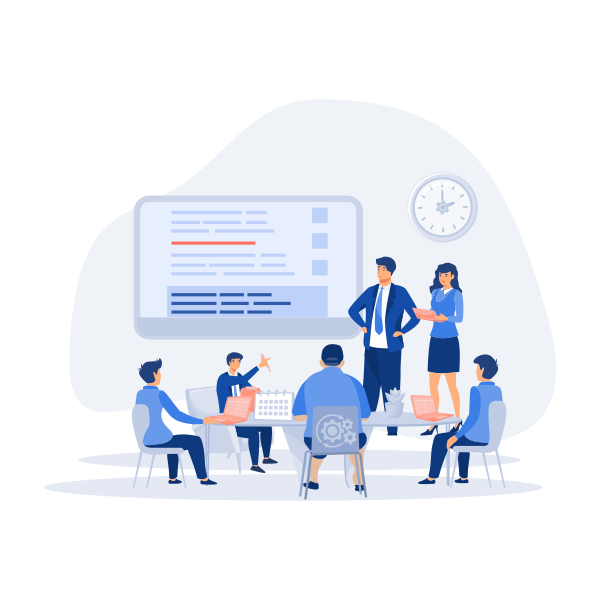
Blended Delivery model (both Online and Offline as per Clients’ requirement)
- Industry endorsed Skilled Faculties
- Flexible Pricing Options
- Customized Syllabus
- 12X6 Assistance and Support
GET Free Consultation
Certifications
Take your career to new heights with Softlogic's software training certifications.
Improve your abilities to get access to rewarding possibilities
Improve your abilities to get access to rewarding possibilities

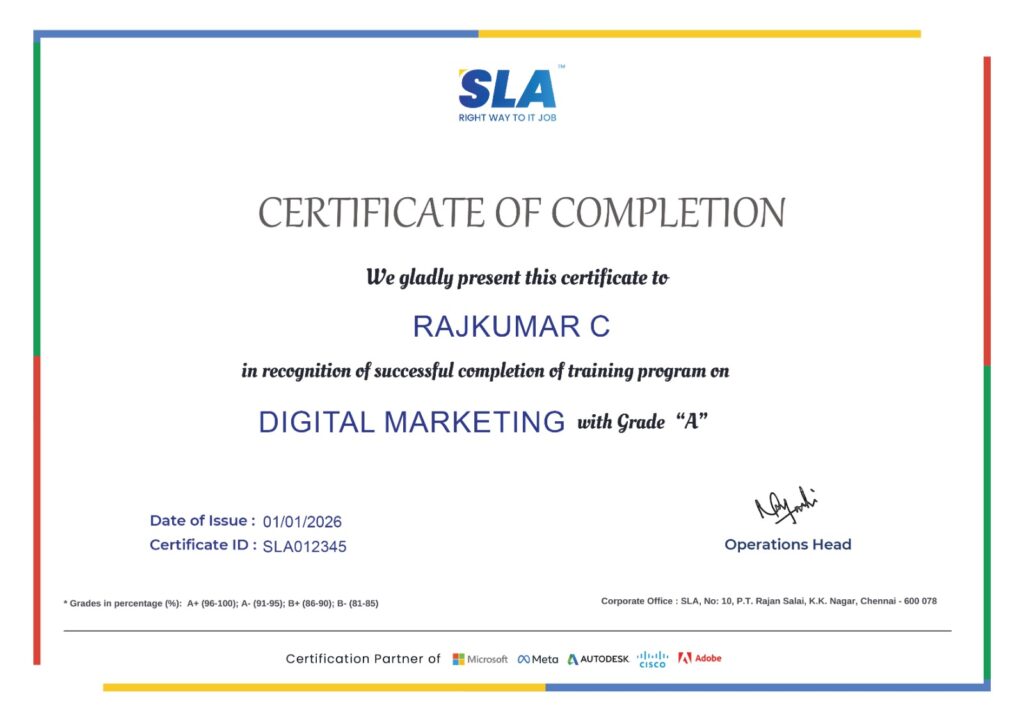
Earn Your Certificate of Completion
Validate your achievements with Softlogic's Certificate of Completion, verifying successful fulfillment of all essential components.
Take Your Career to the Next Level with Certifications
Get a certifications through our training programs to gain a competitive edge in the industry.

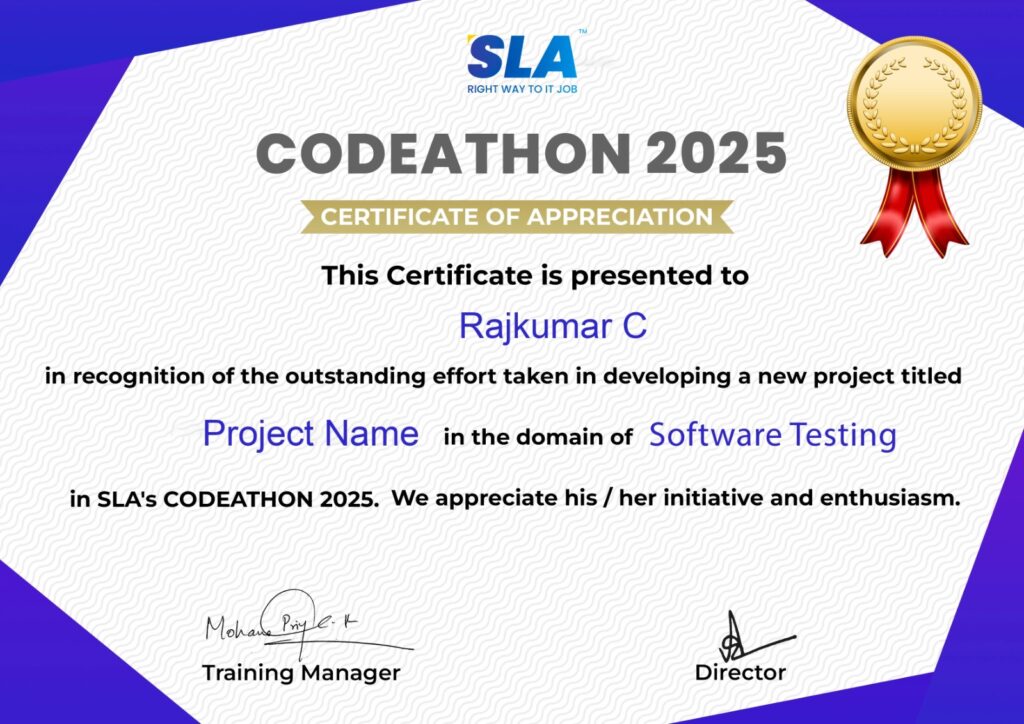
Stand Out from the Crowd with Codethon Certificate
Verify the authenticity of your real-time projects with Softlogic's Codethon certificate.
Hands-on Project Practices in Docker
Migrating Applications to Docker
Deploying Dockerized Databases
Implementing Logging and Monitoring
Securing Docker Containers
Setting Up a Docker Swarm Cluster
Configuring Custom Docker Networks
Integrating CI/CD Pipelines
Deploying a Multi-Container Application
Containerizing a Web Application
The SLA Way to Get Placed in Top IT Companies
Enrollment

Technology Training
Coding Practices
Realtime Projects
Realtime Projects
Placement Training
Aptitude Training
Interview Skills
Interview Skills
Panel Mock
Interview

Unlimited
Interviews

Interview
Feedback

100%
IT Career
Placement Support for a Docker Job
Genuine Placements. No Backdoor Jobs at Softlogic Systems.

Aptitude Training
from Day 1
Interview Skills
from Day 1

Softskills Training
from Day 1
Build Your Resume

Build your LinkedIn Profile

Build your GitHub
digital portfolio

Panel Mock Interview
Unlimited Interviews until you get placed

Life Long Placement Support at no cost
Request a Free Callback
FAQs
What distinguishes a Docker container from a virtual machine?
Docker containers are more lightweight as they share the host operating system’s kernel, which makes them quicker to start and more resource-efficient compared to virtual machines (VMs). VMs, in contrast, run a full operating system and its own kernel, which results in higher resource usage and slower boot times.
How does Docker manage data persistence within containers?
Docker uses volumes and bind mounts to manage data persistence. Volumes are Docker-managed storage areas within the host filesystem specifically designed for container data. Bind mounts, on the other hand, link to specific directories on the host, allowing data to persist beyond the lifecycle of the container and to be shared among containers.
What is a Dockerfile and its purpose?
A Dockerfile is a text file containing a series of commands to build a Docker image. It specifies the base image, dependencies, and configuration needed to set up the image. Dockerfiles automate the process of creating Docker images by defining how the application environment should be constructed.
In what way does Docker Compose support multi-container applications?
Docker Compose utilizes a YAML file to define and manage multi-container Docker applications. It allows users to configure various services, networks, and volumes in a single configuration file, simplifying the management and orchestration of multiple containers as one cohesive application.
Can you explain Docker Swarm and Kubernetes, and their differences?
Docker Swarm and Kubernetes are both systems designed for orchestrating containerized applications. Docker Swarm is Docker’s own clustering solution that offers straightforward integration with Docker. Kubernetes, however, is a more comprehensive and widely-used open-source platform that provides advanced features for scaling, load balancing, and maintaining containerized applications.
What methods are used to optimize the performance of Docker containers?
To optimize Docker container performance, consider strategies like reducing the image size, choosing efficient base images, refining Dockerfiles, managing resource allocations, and utilizing caching effectively. Performance can also be enhanced with monitoring tools and appropriate configuration of container resources.
What security measures should be taken when using Docker?
Essential security practices for Docker include using trusted images from reliable sources, scanning images for vulnerabilities regularly, avoiding root privileges, enforcing proper container isolation, and securing Docker daemon communications. Keeping Docker and its components updated is also critical for addressing security vulnerabilities.
How does Docker handle network configuration for containers?
Docker offers several networking options for containers, such as bridge networks (default for single-container setups), host networks (where containers share the host’s network stack), and overlay networks (used in Docker Swarm for multi-host communication). Docker allows customization of network configurations to manage container-to-container communication effectively.
Where is the corporate office of Softlogic Systems located?
The corporate office of the Softlogic Systems is located at the institute’s K.K.Nagar branch.
What payment methods does Softlogic accept?
Softlogic accepts a wide range of payment methods, including:
- Cash
- Debit cards
- Credit cards (MasterCard, Visa, Maestro)
- Net banking
- UPI
- Including EMI.
Additional Information for
the Docker
Scopes available in the future for learning Docker
The following are the scopes available in the future for learning the Docker Course:
- Advanced Container Orchestration: Develop expertise in sophisticated container orchestration tools like Kubernetes and Docker Swarm. Mastering these tools is essential for managing complex, distributed containerized applications effectively.
- Cloud-Native Architectures: Explore Docker’s role in cloud-native environments, including microservices and serverless architectures. Proficiency in building, deploying, and managing cloud-native applications with Docker will be crucial.
- Continuous Integration and Continuous Deployment (CI/CD): Focus on integrating Docker with CI/CD pipelines to automate build, test, and deployment processes. Mastery of this integration will enhance development workflows and ensure more efficient and reliable software delivery.
- Hybrid and Multi-Cloud Environments: Understand Docker’s application in hybrid and multi-cloud setups, managing containerized applications across various cloud providers and on-premises infrastructure.
- Security Best Practices: Gain expertise in securing Docker containers and orchestrations. This includes implementing best practices for container security, image vulnerability assessments, and secure deployment strategies.
- Container Performance Optimization: Learn advanced methods for optimizing container performance. This involves tuning container resource allocation, network performance, and storage solutions to ensure high efficiency and scalability.
- Serverless Computing Integration:Investigate how Docker can be integrated with serverless computing frameworks. This knowledge will help create serverless architectures that utilize containers for specific functions or tasks.
- Edge Computing: Examine Docker’s role in edge computing environments. Docker’s lightweight nature is ideal for deploying applications on edge devices and optimizing workloads in decentralized settings.
Related Blogs
Top 5 Common Docker Challenges and Solutions
Published On: November 18, 2024
Introduction Since Docker containers offer a consistent and portable environment, applications can execute reliably on…
Docker Project Ideas
Published On: October 10, 2024
Practicing Docker Project Ideas gives students and professionals practical exposure to containerization, enabling applications to…
Docker Salary For Freshers and Experienced
Published On: September 21, 2024
Introduction In the new age of cloud-native technology, Docker has transformed from a “trending technology”…
Docker Tutorial for Beginners
Published On: September 5, 2024
Introduction Got 'it works on my machine' problems? Docker eliminates the headaches of environment setup,…
Docker Interview Questions and Answers
Published On: May 31, 2024
Introduction Docker interview questions and answers commonly cover containerization concepts, Docker architecture, and the differences…
Google Reviews

Rating
4.8
1,053 Google reviews

Surya
Special thanks to Vishal Sir, the Placement Officer, for his interview guidance, resume support, and continuous motivation throughout the placement process. I would also like…

Click here for Full Review

NalluKumar Ravichandran
Hi, I recently completed the DOT NET Full Stack Development course at SLA, and I had a great learning experience. The teaching style and student…
Click here for Full Review

Shaaru Menan
I had a 3 year career break. Joined SLA on Java Full Stack course and completed it.Did projects with the help of my Mentor. They…
Click here for Full Review

Nithish Sahoo
I had an excellent experience taking this DevOps course. The curriculum is well-structured and covers both fundamental and advanced DevOps concepts in a clear manner.…
Click here for Full Review

MATHAN KUMAR G EEE
SLA Institute provides a structured learning environment for data analytics. The syllabus is relevant, and trainers are knowledgeable. Some sessions were very useful practically, while…
Click here for Full Review

SARAN M
SLA Institute provides training in communication and aptitude along with strong technical skills. The trainers explain concepts clearly with a practical approach, which helps build…
Click here for Full Review