
Join Our 100% Job-Guaranteed Machine Learning Course in OMR. We Provide Quality Machine Learning training with an affordable Cost in OMR. Our Machine Learning Syllabus Covers Python for ML, data preprocessing, supervised & unsupervised learning, model training, evaluation, deep learning basics, and real-world ML projects. At Softlogic Systems, you’ll earn globally recognized certifications, build real-time projects, and receive complete placement assistance to launch a successful career in your chosen field.
Machine Learning Training In Omr
DURATION
2 Months
EMI
0% Interest
Mode
Live Online / Offline
Let's take the first step to becoming an expert in Machine Learning
100% Placement
Assurance
Get Certified
JOB PLACEMENT ELIGIBILITY TEST
Your Placement Eligibility Report
Want more details about Machine Learning Course?
Course Schedules
Course Syllabus
Course Fees
or any other questions...
Fees, Duration & Batch Timings for Machine Learning Course
Hands On Training
3-5 Real Time Projects
60-100 Practical Assignments
3+ Assessments / Mock Interviews
June 2026
Week days
(Mon-Fri)
Online/Offline
2 Hours Real Time Interactive Technical Training
1 Hour Aptitude
1 Hour Communication & Soft Skills
(Suitable for Fresh Jobseekers / Non IT to IT transition)
June 2026
Week ends
(Sat-Sun)
Online/Offline
4 Hours Real Time Interactive Technical Training
(Suitable for working IT Professionals)
Save up to 20% in your Course Fee on our Job Seeker Course Series
Syllabus of Machine Learning Course
Module 1 – Core Java Fundamentals
- Java Programming Language Keywords
- Literals and Ranges of All Primitive
- Data Types
- Array Declaration, Construction, and Initialization
Module 2 – Declarations and Access Control
- Declarations and Modifiers
- Declaration Rules
- Interface Implementation
Module 3 – Object Orientation, Overloading and Overriding, Constructors
- Benefits of Encapsulation
- Overridden and Overloaded Methods
- Constructors and Instantiation
- Legal Return Types
Module 4 – Flow Control, Exceptions, and Assertions
- Writing Code Using if and switch statements
- Writing Code Using Loops
- Handling Exceptions
- Working with the Assertion Mechanism
- Write Java Programs
Module 5 – TestNG
- Setting up TestNG
- Testing with TestNG
- Composing test and test suites
- Generating and analyzing HTML test reports
- Troubleshooting
Module 6 – Machine Learning
- Introducing Machine Learning
- To Automate or Not to Automate?
- Test Automation for Web Applications
- Machine Learning Components
- Supported Browsers
- Flexibility and Extensibility
Module 7 – Machine Learning -IDE
- Introduction
- Installing the IDE
- Opening the IDE
- IDE Features
- Building Test Cases
- Running Test Cases
- Debugging
- Writing a Test Suite
- Executing Machine Learning -IDE Tests on Different Browsers
Module 8 – XPATH
- Understanding of Source files and Target
- XPATH and different techniques
- Using attribute
- Text ()
- Following
Module 9 – Machine Learning
- Introduction
- How Machine Learning Works
- Installation
- Configuring Machine Learning With Eclipse
- Machine Learning RC Vs Machine Learning
- Programming your tests in WebDriver
- Debugging WebDriver test cases
- Troubleshooting
- Handling HTTPS and Security Pop-ups
- Running tests in different browsers
- Handle Alerts / Pop-ups and Multiple Windows using WebDriver
Module 10 – Automation Test Design Considerations
- Introducing Test Design
- What to Test
- Verifying Results
- Choosing a Location Strategy
- UI Mapping
- Handling Errors
- Testing Ajax Applications
- How to debug the test scripts
Module 11 – Handling Test Data
- Reading test data from excel file
- Writing data to excel file
- Reading test configuration data from text file
- Test logging
- Machine Learning Grid Overview
Module 12 – Building Automation Frameworks Using Machine Learning
- What is a Framework
- Types of Frameworks
- Modular framework
- Data Driven framework
- Keyword driven framework
- Hybrid framework
- Use of Framework
- Develop a framework using TestNG/WebDriver
Objectives of Machine Learning Training
Our Machine Learning Course in OMR is a great example of world class syllabus that includes topics that are trending all over the globe in the topic of Machine Learning. Since our syllabus is designed for candidates of all levels of experience, it begins with fundamental topics and moves all the way to advanced topics gradually. Some of the topics from the syllabus are discussed below briefly:
- The Machine Learning Course in OMR begins with fundamental topics like Core Java Fundamentals, Declaration and Access Control, Object Orientation, Overloading and Overriding, Constructors etc.
- The syllabus then moves onto topics like, Flow Control, Exceptions, and Assertions, TestNG, Introduction to Machine Learning, Machine Learning IDE etc.
- The syllabus finally moves onto advanced Machine Learning topics like XPATH, Automation Test Design Considerations, Handline Test Data etc.
Why Softlogic Systems is the Best Choice for Machine Learning Training – Learn, Practice, and Get Placed!
Online & Offline Training Options
Learn from 100+ Real-Time Developers
Hands-on Projects & Codeathons
0% EMI Fee Options
Resume & Interview Support
Placement with Top IT Firms
1000+ Hiring Partners
No Backdoor Jobs
Highlights of Machine Learning Course
What is Machine Learning?
Machine learning, a branch of artificial intelligence (AI), is dedicated to crafting algorithms and methodologies empowering computers to obtain insights and anticipate outcomes from data. Unlike traditional programming where tasks are explicitly defined, machine learning algorithms are engineered to recognize patterns and correlations within datasets, facilitating autonomous learning and decision-making processes.
What are the reasons for learning Machine Learning?
The following are the reasons for learning Machine Learning:
- Data-Driven Decision Making: In today’s data-driven landscape, businesses leverage insights derived from data to inform decision-making. Machine learning facilitates the extraction of valuable insights from vast datasets, enhancing the decision-making process.
- Automation: Machine learning streamlines operations by automating repetitive tasks, freeing up human resources for more complex endeavors. This boosts efficiency and productivity across industries.
- Predictive Analytics: Machine learning empowers organizations with predictive analytics capabilities, enabling them to forecast trends, anticipate customer behavior, and optimize processes. This predictive edge fosters competitiveness in the market.
What are the prerequisites for learning a Machine Learning Course in OMR?
SLA does not demand or require any prerequisites for any courses. All the courses in SLA are designed to be taught from basic level, so it is open to everyone. However, having a fundamental understanding of the following topics can help you learn the course better:
- Programming Proficiency: Mastery of Python or R is vital, along with familiarity with fundamental programming concepts such as variables, loops, functions, and data structures.
- Mathematical Foundation: A robust grasp of calculus, linear algebra, and probability theory is crucial, as these concepts underpin many machine learning algorithms.
- Statistical Knowledge: Understanding statistics is essential for comprehending machine learning principles, assessing model performance, and interpreting outcomes effectively.
Our Machine Learning Course is suitable for:
- Students
- Job Seekers
- Freshers
- IT professionals aiming to enhance their skills
- Professionals seeking career change
- Enthusiastic programmers
What are the course fees and duration?
The Machine Learning course fees depend on the program level (basic, intermediate, or advanced) and the course format (online or in-person).On average, the Machine Learning course fees come in the range of ₹15,000 to ₹25,000 INR for 2 months, inclusive of international certification. For some of the most precise and up-to-date details on fees, duration, and certified Machine Learning certification, kindly contact our Best Placement Training Institute in Chennai directly.
What are some of the jobs related to Machine Learning?
The following are some of the jobs related to Machine Learning:
- Machine Learning Engineer
- Data Scientist
- Artificial Intelligence (A.I) Researcher
- Data Analyst
What is the salary range for the position of Machine Learning Engineer?
The Machine Learning Engineer freshers salary typically with less than 2 years of experience earn approximately ₹3-4 lakhs annually. For a mid-career Machine Learning Engineer with around 3 years of experience, the average annual salary is around ₹5-6 lakhs. An experienced Machine Learning Engineer with more than 6 years of experience can anticipate an average yearly salary of around ₹9-10 lakhs. Visit SLA for more courses.
List a few real time Machine Learning applications.
Here are several real time Machine Learning applications:
- Real TIme predictive maintenance
- Real Time Fraud Detection
- Real Time Sentiment Analysis
- Real-Time Object Detection and Tracking
Boost Your Skills with Our Machine Learning Training Experts
Our Mentors are from Top Companies like:
The following are our trainers profile for the Machine Learning Course in OMR:
- Experienced Machine Learning Trainers with 8+ years of experience in latest software technologies across several industries.
- They are proficient in programming languages like Java, Python, R and MATLAB as well as in Machine Learning algorithms including supervised, unsupervised, and deep learning.
- They offer creative and customized training to accelerate the learning curve of Machine Learning Training in Chennai.
- They are skilled in teaching various Machine Learning models and concepts such as dimensionality reduction, recommender systems, reinforcement learning, natural language processing, and image processing.
- They have conducted workshops on Machine Learning, Neural Networks, deep learning, and related topics in various educational institutions.
- They possess a deep knowledge on Big Data technologies such as Apache Spark, Hadoop, Tableau, etc.
- They are capable of teaching different types of Machine Learning tools and techniques like Linear Regression, Logistic Regression, Naive Bayes, K-Nearest Neighbors, SVM, Q-Learning, Decision Trees, and Random Forests.
- They are knowledgeable on statistical analysis tools like SAS, Excel, SPSS and various data visualization mediums and have hands-on experience in deploying and optimizing Machine Learning solutions.
- They are experts in preparing students to perform well in Machine Learning related certifications and are dedicated to fostering a collaborative and innovative learning environment.
- They are well versed in building strong and positive relationships with the students and are able to motivate them in complex tasks, assignments, resume making, and interview preparation.
What Modes of Training are available for Machine Learning Course?
Offline / Classroom Training
- Direct Interaction with the Trainer
- Clarify doubts then and there
- Airconditioned Premium Classrooms and Lab with all amenities
- Codeathon Practices
- Direct Aptitude Training
- Live Interview Skills Training
- Direct Panel Mock Interviews
- Campus Drives
- 100% Placement Support
Online Training
- No Recorded Sessions
- Live Virtual Interaction with the Trainer
- Clarify doubts then and there virtually
- Live Virtual Interview Skills Training
- Live Virtual Aptitude Training
- Online Panel Mock Interviews
- 100% Placement Support
Corporate Training
- Industry endorsed Skilled Faculties
- Flexible Pricing Options
- Customized Syllabus
- 12X6 Assistance and Support
Certifications
Improve your abilities to get access to rewarding possibilities
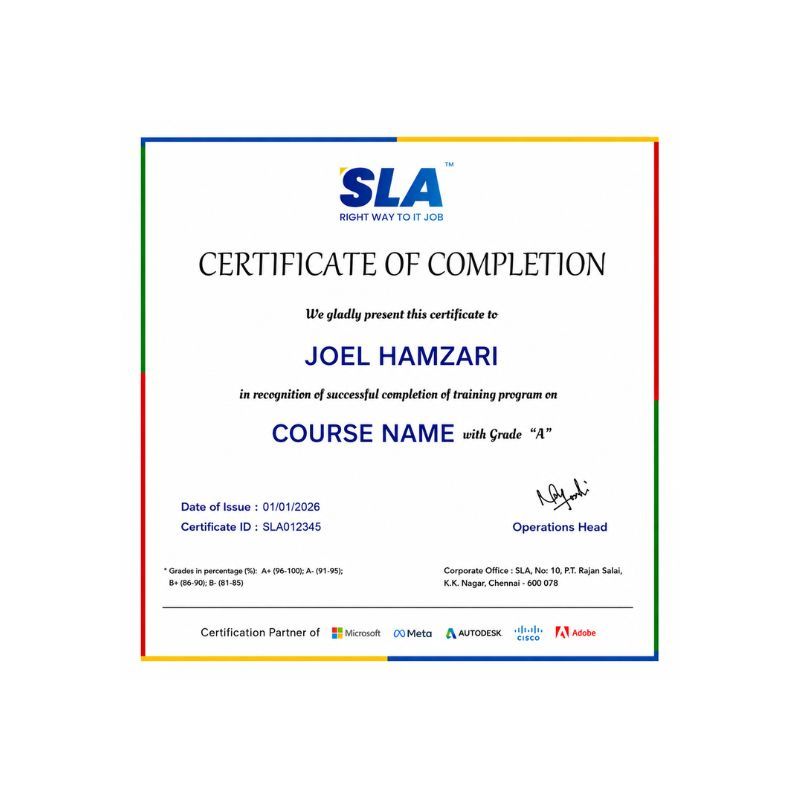
Earn Your Certificate of Completion
Take Your Career to the Next Level with Certifications
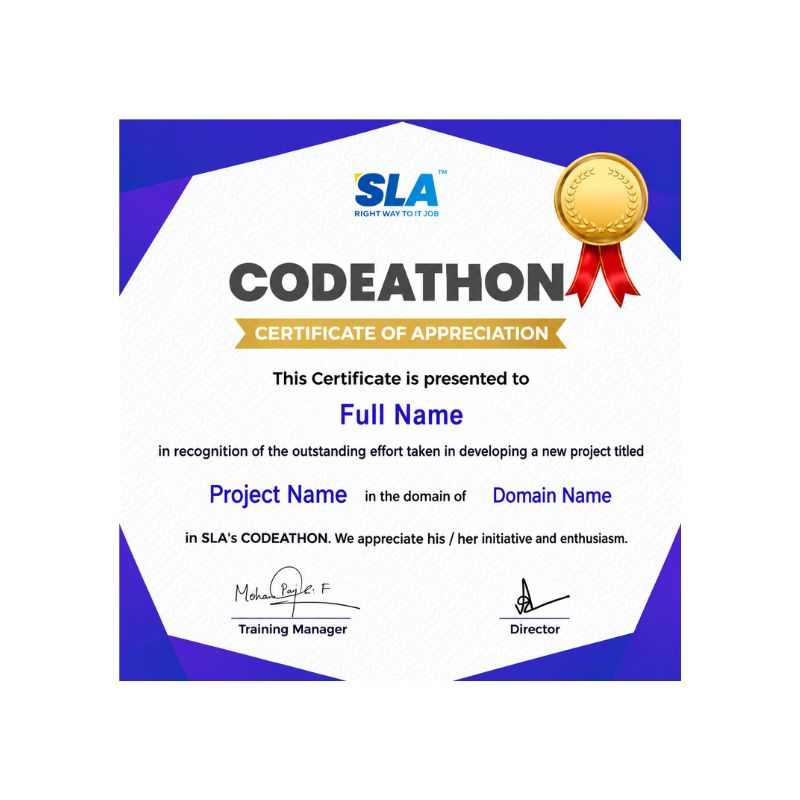
Stand Out from the Crowd with Codethon Certificate
Hands-on Project Practices in Machine Learning Course
Real-Time Language Translation
Consumption Forecasting
Real-Time Traffic Prediction
Real-Time Price Optimization
Real-Time Health Monitoring:
Real-Time Speech Recognition:
Real-Time Personalization:
Real-Time Anomaly Detection:
Real-Time Object Detection and Tracking
The SLA Way to Get Placed in Top IT Companies
Enrollment
Technology Training
Realtime Projects
Placement Training
Interview Skills
Panel Mock
Interview
Unlimited
Interviews
Interview
Feedback
100%
IT Career
Placement Support for a Machine Learning Job
Genuine Placements. No Backdoor Jobs at Softlogic Systems.
Aptitude Training
from Day 1
Interview Skills
from Day 1
Softskills Training
from Day 1
Build Your Resume
Build your LinkedIn Profile
Build your GitHub
digital portfolio
Panel Mock Interview
Unlimited Interviews until you get placed
Life Long Placement Support at no cost
FAQs
How many branches does SLA have?
SLA has a total of two branches in the city, one in Navalur, OMR and another in K.K. Nagar.
What is the specialty of SLA’s OMR branch?
SLA’s OMR branch has plenty of opportunity for candidate’s internship and placements as it is located in the hub of IT companies in OMR.
Does SLA support EMI options?
Yes, SLA has EMI options with 0% interest.
Does SLA have experienced trainers for Machine Learning Course?
Yes, SLA’s trainers have plenty of experience in IT and in teaching.
How does SLA deal with student issues?
SLA has a designated HR personnel to deal with student issues.
What is the difference between supervised and unsupervised learning?
In supervised learning, models learn from labeled data to make predictions, while unsupervised learning finds patterns in unlabeled data without guidance.
Howa performance of a machine learning model be evaluated ?
Performance is assessed using metrics like accuracy, precision, recall, and cross-validation techniques such as k-fold cross-validation.
What is overfitting in machine learning, and how can it be prevented?
Overfitting happens when models learn noise, countered by techniques like regularization and early stopping to prevent it.
What are the important steps involved in the process of building a machine learning model?
Steps include data collection, feature engineering, model selection, training, evaluation, hyperparameter tuning, and deployment with monitoring.
What are some common algorithms used in machine learning?
Common algorithms include linear regression, logistic regression, decision trees, random forests, SVM, k-NN, Naive Bayes, and neural networks.
Additional Information for
the Machine Learning Course
How did Machine Learning come into existence?
Machine learning originated from advancements in computer science, mathematics, and cognitive psychology, dating back to the mid-20th century. Key milestones include:
- Foundations in Cybernetics and Cognitive Science (1940s-1950s), with Norbert Wiener’s work in cybernetics and Alan Turing’s Turing Test inspiring the idea of learning machines.
- The Birth of Machine Learning (1950s-1960s), marked by Arthur Samuel’s term “machine learning” and the development of neural networks by Frank Rosenblatt.
- Symbolic AI and Expert Systems (1960s-1970s), focusing on rule-based approaches and expert systems for emulating human expertise.
- Connectionism and Neural Networks (1980s-1990s), witnessing a resurgence in neural networks and the development of backpropagation and Support Vector Machines (SVMs).
- Statistical Learning and Big Data (2000s-Present), characterized by the rise of statistical learning methods, big data technologies, and breakthroughs in deep learning for computer vision, natural language processing, and robotics. Machine learning’s evolution has been driven by interdisciplinary collaboration and practical applications.