
Softlogic Systems Data Science Full Stack Course Syllabus is specifically designed for College Students, Freshers, and Job Seekers. Our Data Science Full Stack Course Syllabus covers Python programming, statistics, data wrangling, data visualization, machine learning, deep learning, big data tools, cloud deployment, and real-world project implementation. Our Data Science Full Stack Course Content helps you learn Data Science Full Stack Step by Step with real-time projects and Interview Preparations.
Data Science Full Stack Developer Course Syllabus
4.50
(5142)
DURATION

3 Months
JOB READY

Syllabus
CERTIFIED

Courses

Let's take the first step to becoming an expert in Data Science Full Stack
Click Here to Get Started
Lifelong Placement
Support
Get Certified
Check Your Job Eligibility
×
Your Placement Eligibility Report
Syllabus for The Data Science Full Stack Course
Download Syllabus
CORE PYTHON
- Python Introduction & history
- Color coding schemes
- Salient features & flavors
- Application types
- Language components (variables, literals, operators, keywords…)
- String handling management
1. String operations – indexing, slicing, ranging
2. String methods – concatenation, repetition, formatting
3. Supporting functions - Native data types
1. List
2. Tuple
3. Set
4. Dictionary - Decision making statements
1. If
2. If…else
3. If…elif…else - Looping statements
1. For loop
2. While loop - Function types
1. Built-in functions
2. Math functions
3. User defined functions
4. Recursive functions
5. Lambda functions - OOPs
1. Classes and objects
2. __init__ constructor
3. Self-keyword
4. Data abstraction
5. Data encapsulation
6. Polymorphism
7. Inheritance - Exception handling
1. Error vs exception
2. Types of error
3. User defined exception handling
4. Exception handler components
5. Try block, except block, finally block - File handling
1. How to create a txt file using python
2. File access modes
3. Reading and writing data to a txt file
4. Data operations
DATA SCIENCE PHASE 1
- Working with PANDAS & NUMPY
1. PANDAS – data analysis intro
2. PANDAS – data structures
3. Series creation types
4. Data Frame creation types
5. Accessing data from Series and DataFrame
6. Data merging - Working with PANDAS & NUMPY
1. Data mapping
2. Finding duplicates
3. Removing duplicates
4. Describing data
5. Finding null values
6. Group by function
7. Sort values
8. Statistical functions
9. Reading and writing data from CSV
10. Data operations on CSV file
11. Basic visualizations
12. NUMPY array processing intro
13. Types of ndarray - Numpy attributes
1. ndim
2. shape
3. size
4. type - Shape manipulations
1. Ravel
2. Reshape
3. Resize
4. Hsplit
5. Vstack - Numpy additional functions
1. Tile
2. Eye
3. Zeros
4. Ones
5. Diag
6. arange
7. New axis addition
8. Random number generation
DATA SCIENCE PHASE 2
- Data science terminologies
- Exploratory data analysis intro
- Types of machine learning algorithms
- Classification and regression intro
- Prediction and analysis techniques to be used in ML
- MATPLOTLIB – data visualization
1. Histogram
2. Pdf
3. Adding axes
4. Adding grid
5. Adding label
6. Adding ticks
7. Setting limits
8. Adding legend - MATPLOTLIB plotting
1. Bar chart
2. Pie chart
3. Heat map
4. Box plot
5. Scatter plot
6. 3d plot - SEABORN – advanced color palette visualization
1. Bar chart
2. Pie chart
3. Dist plot
4. Pair plot
5. Reg plot
6. Count plot
7. Swarmplot
8. Heat map
9. Scatter plot
10. Lm plot
EDA – MACHINE LEARNING –WORKING WITH SCIKIT-LEARN
- Machine learning algorithm types
1. Supervised learning
2. Unsupervised learning
3. Ensemble learning technique - Working flow of dataset
1. Loading necessary modules
2. Loading dataset
3. Feature scaling
4. Feature extraction
5. Data standardization
6. Data normalization
7. Data manifesting
8. Model creation
9. Fitting data models
10. Model prediction - ML algorithms with live demo and mathematical intuition
1. Linear regression
2. Logistic regression
3. Naïve bayes classifier
4. KNN (K nearest neighbor)
5. KMC (K means clustering)
6. Support vector machines
7. Principal component analysis
8. Decision tree
9. Random forest
10. XGBoost
DEEP LEARNING & AI
- Neural networks introduction
- Brain activation functions and layer components
- Neural network terminologies of ANN, CNN, RNN
1. Models
2. Initializers
3. Optimizers
4. Layers
5. Activation functions
6. Loss functions
7. Metrics
8. Model compilations
9. Model evaluation
10. Max pooling layers
11. Edge filters
12. Back propagations
13. Early stopping
14. Epoch - Datasets to be used for MLP,ANN, CNN,RNN
1. Boston house prediction
2. CIFAR10
3. CIFAR100
4. MNIST
5. FASHION MNIST
6. IMDB Movie review analysis - NLP (Natural Language Processing)
1. NLTK
2. NLTK
3. SPACY - COMPUTER VISION
1. Digital Image Processing using CV2 library
2. LIVE PROJECTS
The SLA way to Become
a Data Science Full Stack Expert

Enrollment

Technology Training
Coding Practices
Realtime Projects
Realtime Projects

Placement Training
Aptitude Training
Interview Skills
Interview Skills

Panel Mock
Interview

Unlimited
Interviews

Interview
Feedback

100%
IT Career
FAQ
What is SLA’s Job Seeker program?
SLA’s Job Seeker program is designed to help freshers enter the IT industry quickly. The program offers a syllabus tailored for each fresher, based on the expectations of IT clients. It focuses on providing a combination of technologies in full-stack development, which enhances the fresher’s chances of securing a job in IT.
Is full stack need coding?
Yes, full stack development involves coding. Developers write code for both the frontend and backend of web applications.
Is full-stack useful for data science?
Yes, Full-stack skills are beneficial for data science. They offer a complete understanding of both frontend and backend technologies, allowing data scientists to create end-to-end applications, visualize data effectively, deploy quickly, integrate with backend systems, and collaborate efficiently.
Is full-stack useful for data science?
Yes, full-stack skills are useful for data science because they enable professionals to handle both frontend and backend aspects of data science projects, facilitating end-to-end development and deployment of data-driven applications.
Does data science have future?
Yes, data science has a bright future. As businesses and industries generate more data, the demand for skilled data scientists will increase. Data science is already used in various fields and with advancements in technology, its role will become more crucial in decision-making and innovation.
Is full-stack the future?
Yes, full-stack development is expected to be in high demand, as companies value developers who can work on both frontend and backend technologies efficiently.
Does data science require heavy coding?
Yes, data science usually involves coding, but the amount required can vary. Tasks like data cleaning and building models often require significant coding, while others, like visualization, may need less. However, knowing languages like Python or R is crucial for most data science jobs.
Is full-stack need coding?
Yes, full-stack development typically involves coding, as it encompasses both frontend and backend development tasks. Knowledge of programming languages like JavaScript, HTML, CSS, and backend languages such as Python, Java, or Ruby, is essential for full-stack developers.
Is Data Science full stack still in demand?
Yes, Data Science Full Stack roles are still in high demand as organizations continue to invest in data-driven decision-making and require professionals who can handle both data analysis and software development tasks effectively.
Is full-stack useful for data science?
Yes, full-stack skills are beneficial for data science. They enable the development of end-to-end solutions, from data collection to model deployment, enhancing scalability and comprehensiveness in project development.
What skills are required for data scientist?
Data scientists need to be skilled in programming languages like Python, R, and SQL, and have a good understanding of statistics and machine learning. They should also be adept at cleaning and organizing data, visualizing data effectively, and have knowledge of the industry they work in. Strong problem-solving, communication, curiosity, and creativity are also essential skills.
Does data science require SQL?
Yes, data science often involves SQL for querying and manipulating databases. It’s crucial for tasks like data extraction and analysis.
Is Data Science in demand in 2024?
Yes, Data Science continues to be in high demand in 2024. Organizations across industries are increasingly relying on data-driven insights to make informed decisions, driving the need for skilled data scientists.
Do data scientists get paid well?
Yes, data scientists often receive competitive salaries due to the high demand for their skills and expertise in analyzing and interpreting complex data.
Is data scientist a stressful job?
Data science offers varied stress levels based on project demands and individual preferences, with some finding it less stressful due to its problem-solving nature and data-centric focus.
What does a data scientist do?
A data scientist analyzes data to find useful information and solve problems. They use statistics, machine learning, and programming to clean, process, and study large datasets. Data scientists also create visualizations and share their findings with others to help organizations make decisions based on data.
Can I still join job placement events if I already have a job offer?
Definitely! We offer ongoing placement assistance to help candidates achieve their career goals. Contact our career advisor to arrange a free demo for the leading Data Science Fullstack course in OMR, featuring placement support.
Can I still join job placement events if I already have a job offer?
Definitely! We offer ongoing placement assistance to help candidates achieve their career goals. Contact our career advisor to arrange a free demo for the leading Data Science Fullstack online course, featuring placement support.
Can I still join job placement events if I already have a job offer?
Definitely! We offer ongoing placement assistance to help candidates achieve their career goals. Contact our career advisor to arrange a free demo for the leading Data Science Fullstack course in Chennai, featuring placement support.
Is data science need coding?
Yes, data science requires coding skills. Data scientists use programming languages like Python, R, and SQL to clean, process, analyze, and visualize data. Coding is essential for data scientists to manipulate data, build machine learning models, and extract insights from datasets.
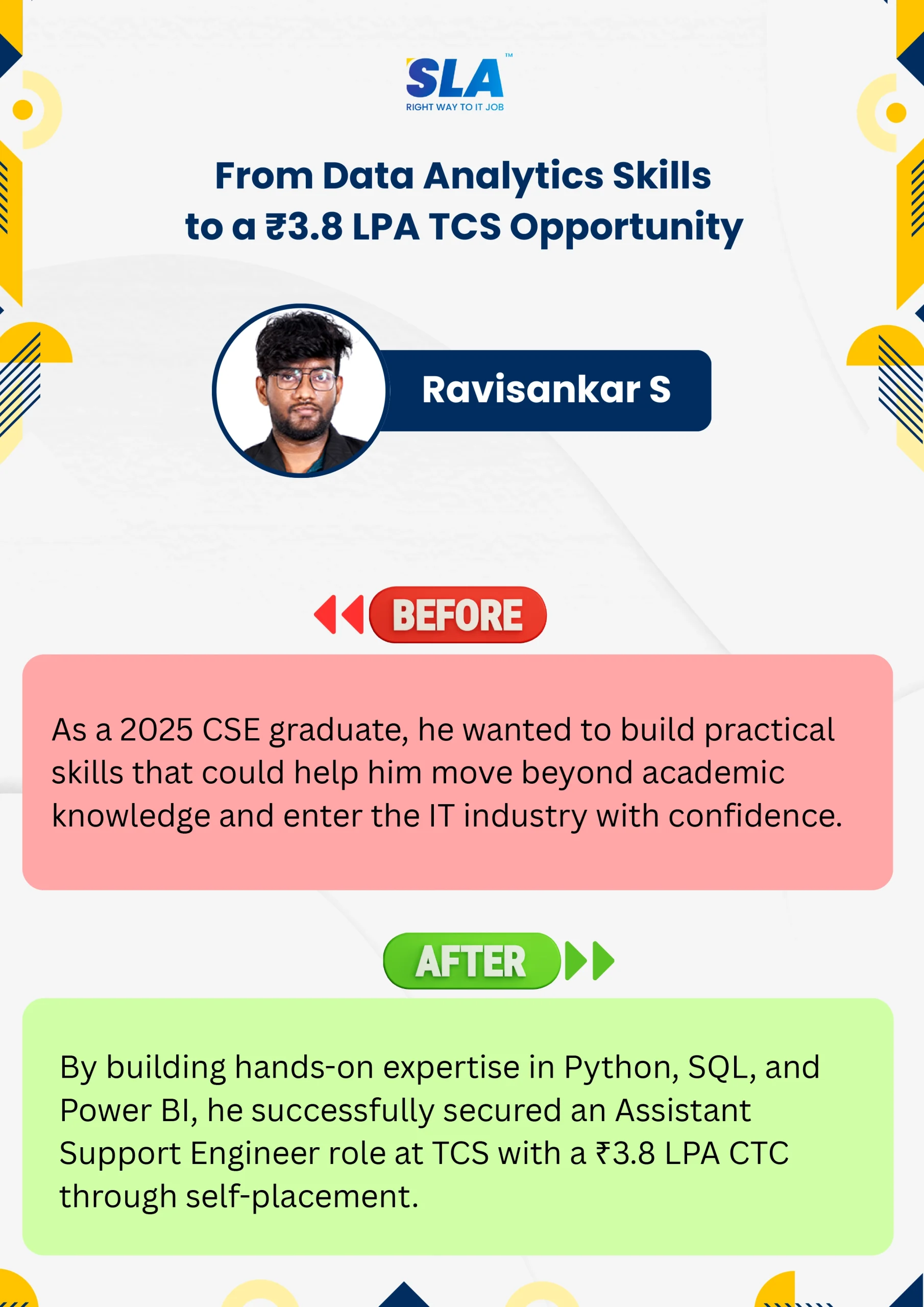
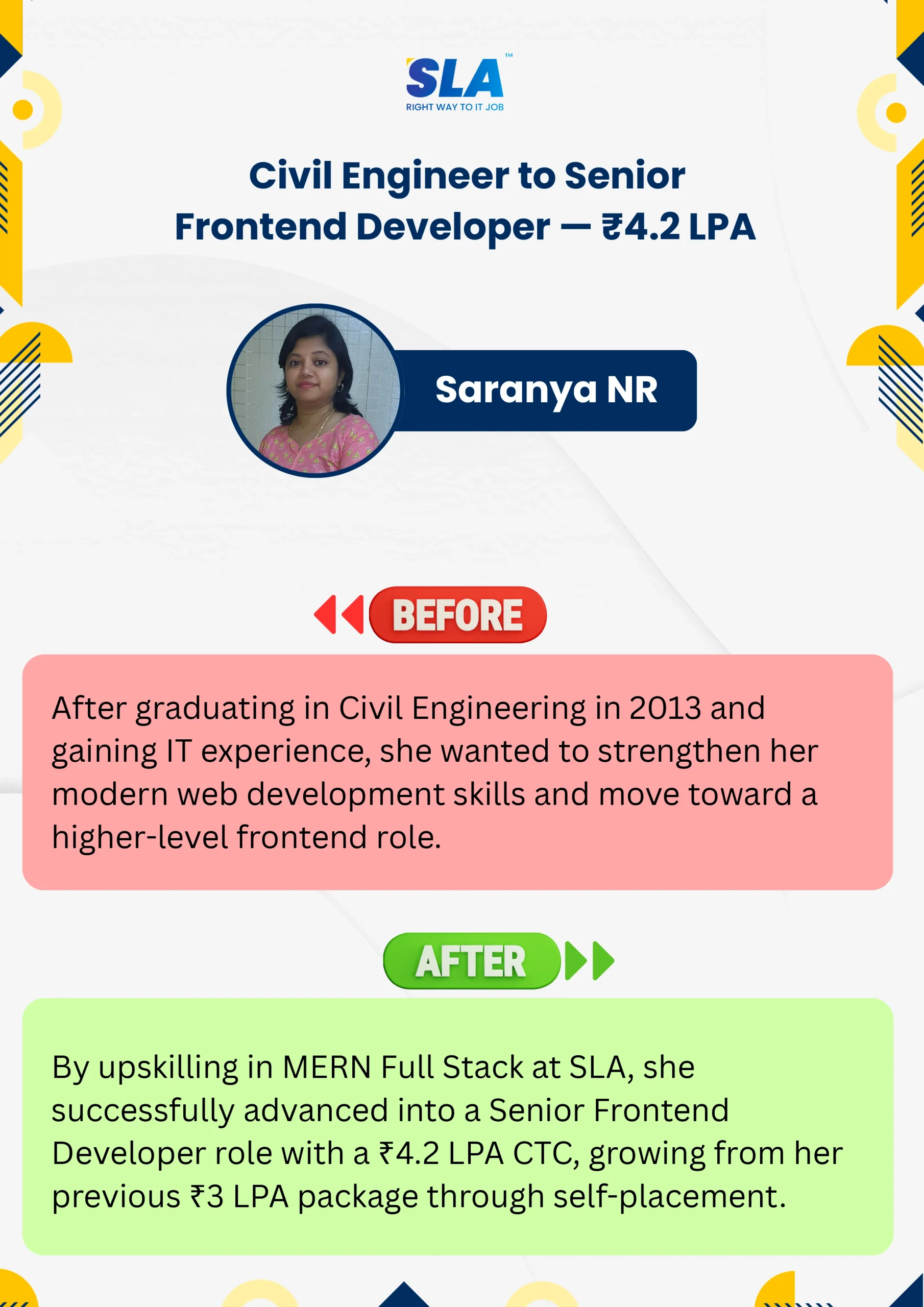
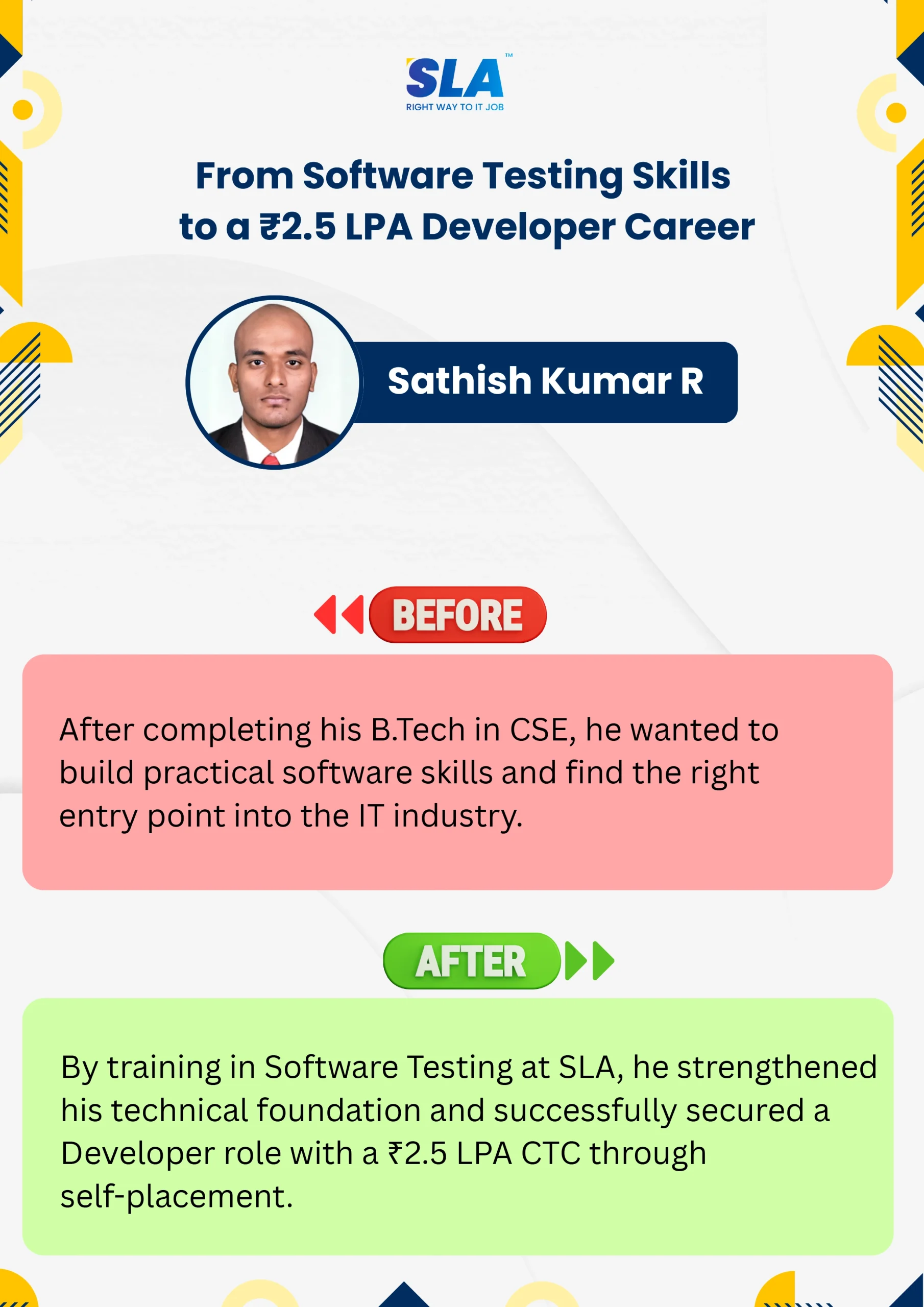
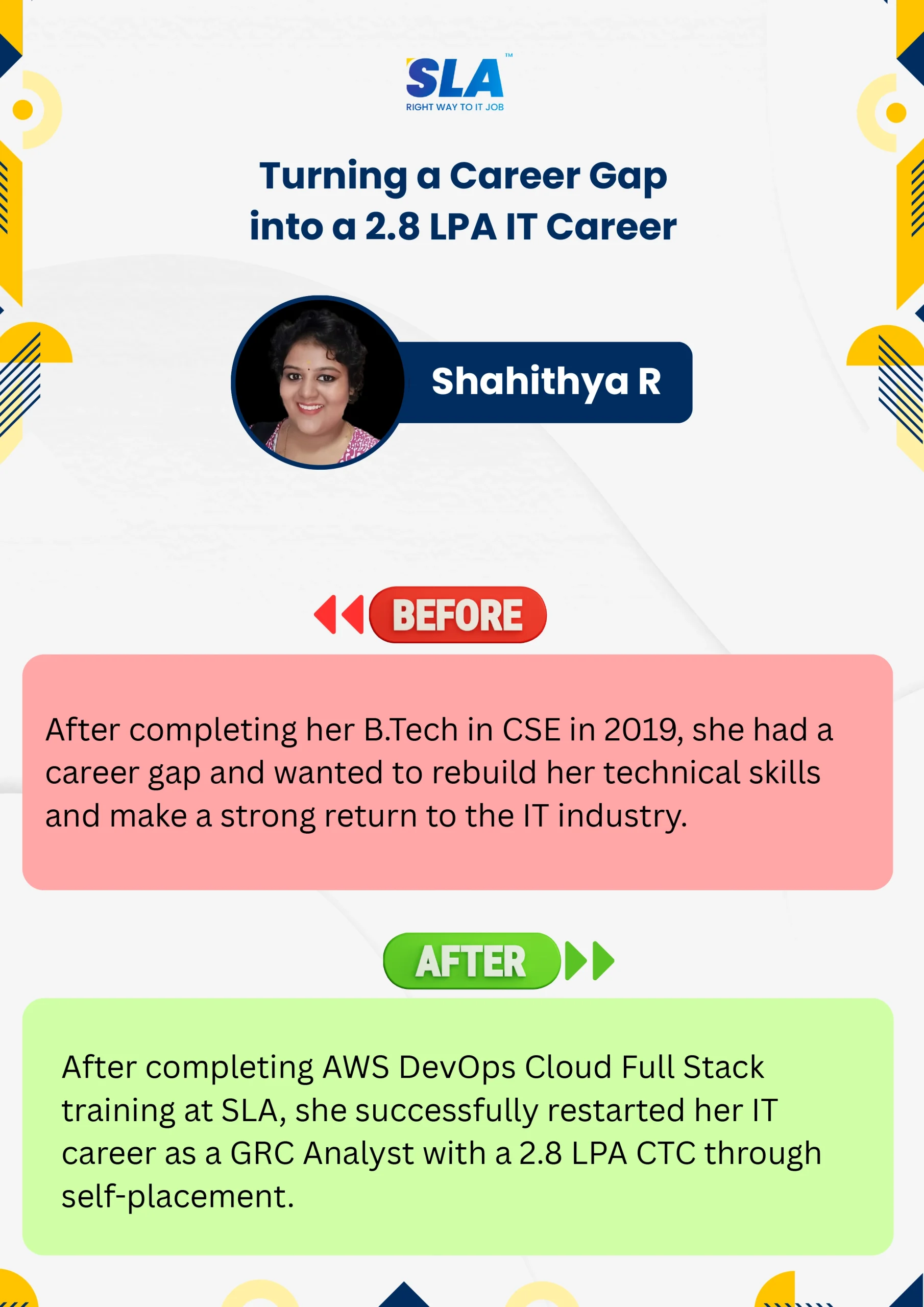
Google Reviews

Rating
4.8
1,053 Google reviews

MATHAN KUMAR G EEE
SLA Institute provides a structured learning environment for data analytics. The syllabus is relevant, and trainers are knowledgeable. Some sessions were very useful practically, while…

Click here for Full Review

Nithish Sahoo
I had an excellent experience taking this DevOps course. The curriculum is well-structured and covers both fundamental and advanced DevOps concepts in a clear manner.…
Click here for Full Review

NalluKumar Ravichandran
Hi, I recently completed the DOT NET Full Stack Development course at SLA, and I had a great learning experience. The teaching style and student…
Click here for Full Review

Shaaru Menan
I had a 3 year career break. Joined SLA on Java Full Stack course and completed it.Did projects with the help of my Mentor. They…
Click here for Full Review

Surya
Special thanks to Vishal Sir, the Placement Officer, for his interview guidance, resume support, and continuous motivation throughout the placement process. I would also like…
Click here for Full Review

SARAN M
SLA Institute provides training in communication and aptitude along with strong technical skills. The trainers explain concepts clearly with a practical approach, which helps build…
Click here for Full Review
Discover What Our Students Have To Say
See More ReviewsRelated Blogs for
The Data Science Full Stack Course
Install Python PIP Windows
Published On: April 8, 2026
Introduction to PIP and the Windows Ecosystem The art of installing pip in Windows is…
Data Science Course Eligibility
Published On: February 18, 2025
Understanding the data science course eligibility is essential for anyone aspiring to enter this dynamic…
Data Science Full Stack Developer Project Ideas
Published On: July 3, 2024
Introduction If you want to build a strong portfolio as a budding Data Science Full…